Hello!
I am now blogging at Family Planting!
Please find me here: www.kimererlamothe.com.
I also publish my posts at Psychology Today, where I host a blog called "What a Body Knows," in the Health section.
See you there!
Tuesday, October 4, 2011


Friday, May 20, 2011
What is Mental Health?
I am lying on the floor, knees held gently against my chest. My heart hurts. Thoughts flail and screech in ear-splitting rings around my head. Why did she say that? Doesn’t she understand? Who does she think I am? Why can’t she see me?
The pain sticks under my ribs, sucking vital energy in and down. I don’t want to move. I can’t. My stomach is locked shut. I just want to curl up in the palm of this gripping pain and dissolve into nothingness.
I breathe again (I can’t help it) and exhale sharply. I cling to my knees, drawing them in tight. I don’t want to let go. I don’t want to open my body, my self. I don’t want to be this vulnerable. I want to be safe, protected, enclosed like a small hard ball.
*
What is mental health?
I take my cue from the philosopher, Friedrich Nietzsche. “Great health” is an ability to digest our experiences. To digest or metabolize experiences is to take whatever is given in any moment—any thought, feeling, or sensation, any cruel word, kind act, or humiliating fall—and transform it—by chewing, mashing, churning, breaking it down—into a sweet stream of energy capable of nourishing our ongoing bodily becoming.
We humans are essentially creative at a sensory level. Our bodily selves are always sensing, always moving, always creating the patterns of sensation and response that make us who we are. Some of that bodily movement—firing and wiring—gives rise to a thinking mind as an inward extension of our bodily self. Our minds are tools that our bodily selves create in order to help us live well. Minds look forward and back. They predict what will happen on the basis of what has been. They calculate options and risks, and all in the service of keeping our bodily selves moving, creating, thriving, becoming who we are.
A healthy mind, then, is one that helps us embrace our experiences as occasions to discover the range and reach of what our bodies know. A healthy mind is one that finds in whatever fear, anger, sadness, despair, irritation, confusion, or frustration we feel, a potential for pleasure that has yet to unfold—an energy and guidance impelling us to move in relation to ourselves and others in ways that align our well-being with the challenge at hand. A healthy mind helps us move in life-enabling, experience-metabolizing ways.
Sometimes, however, our minds get sick: they can’t help us move. Nearly half of all adults, at some point in our lives, will endure times of acute mental, physical, and emotional suffering, and find ourselves unable to work, play, eat, sleep, or open deeply to others—times when we are arrested by anxiety or depression, anger or fear, compulsions or addictions, and unable to digest our experiences.
Why sick? Why stuck? We live in a culture that teaches us to ignore the movement of our bodily selves. From the earliest age, we learn to think and feel and act as if we were minds living in bodies. We learn to identify our “self” with our mental power; we learn to perceive our “body” as material thing for which “we” are responsible. Then, when faced with the stress of a life-altering change, a critical decision, or draining fatigue, we tend to mobilize the resource we think is best: mind over body. We try to control our bodies: we impose diets, schedules, and plans, or rely on drugs and surgery to exact a will we lack. We distract and numb, starve and indulge our sensory selves. We rehearse a separation from our bodily selves that prevents us from feeling what we are feeling. Our emotions remain lodged in our throats and bellies and hearts and limbs, undigested, causing so much depression and despair.
*
As I breathe again, unable to help it, I feel it. In spite of myself, I feel something new—a sensation of the earth pushing up from below me. I am not falling into a black hole. I am resting on a presence that is larger than me that is pressing up through me and holding me up.
Instinctively, I let go. I can’t help it. I breathe again and drop into the earth, holding on to nothing. Emptying my mind. The plug in my heart releases and sensations of disappointment and despair run through me, along me, out of me, into the earth.
In spite of myself, impulses to move arise within me—I feel them—expressions of the irrepressible, undeniable flow of life that will not stop beating and breathing, growing and healing, searching for new ways to move through me. My mind resists, holding on to fear, but my bodily self knows more.
*
Our hungers are prophetic. The scope and kinds of mental illnesses that we as individuals and as a culture are suffering are calling us to reconnect the activity of our minds with the movement of our bodily selves. We need to cultivate a sensory awareness of the movements that are making us.
The truth is that at the heart of any and every pain is a desire—a desire to move, to love, to heal, to give, to receive. We would not even feel the pain of not caring if we did not care. And within every desire is in turn an impulse to connect—an impulse to create the relationships with whatever and whomever we need to support us in becoming who we are, and giving what we have to give.
When we move, we breathe. When we breathe, we feel. When we feel we open the floodgates to all of our searing sensations, past, present and future. But we also open ourselves to the possibility of sensing what is always true: that our bodily selves, in every moment of our lives, are providing us with vital information about how to move in ways that will not recreate the pain.
When we breathe to move and move to breathe we open to the possibility of sensing the wisdom in our desires. Whether we are wrestling with issues of food, intimacy, and purpose (see What a Body Knows) or with our parents, partners, and progeny (see Family Planting), how we move matters.
*
I breathe down again, along the stream of my spine, feeling the bed of earth cupping its flow. My experience shifts and I am suddenly aware of the desire at the heart of my pain.
I hurt. I hurt because I want. I want because I am alive. This desire, this life, is a power in me that is stronger than the fear. Stronger than the hurt. It is the point of the pain—to wake me up to the power of this desire. To my need to move.
A resolve appears. I take a small step. I can act out of my love and not my fear or anger. I can meet her where she too is hurt and coming toward me—in the heart of her desire for more. The knot of pain softens and unfolds in affirmation. I am OK. Healing happens.

The pain sticks under my ribs, sucking vital energy in and down. I don’t want to move. I can’t. My stomach is locked shut. I just want to curl up in the palm of this gripping pain and dissolve into nothingness.
I breathe again (I can’t help it) and exhale sharply. I cling to my knees, drawing them in tight. I don’t want to let go. I don’t want to open my body, my self. I don’t want to be this vulnerable. I want to be safe, protected, enclosed like a small hard ball.
*
What is mental health?
I take my cue from the philosopher, Friedrich Nietzsche. “Great health” is an ability to digest our experiences. To digest or metabolize experiences is to take whatever is given in any moment—any thought, feeling, or sensation, any cruel word, kind act, or humiliating fall—and transform it—by chewing, mashing, churning, breaking it down—into a sweet stream of energy capable of nourishing our ongoing bodily becoming.
We humans are essentially creative at a sensory level. Our bodily selves are always sensing, always moving, always creating the patterns of sensation and response that make us who we are. Some of that bodily movement—firing and wiring—gives rise to a thinking mind as an inward extension of our bodily self. Our minds are tools that our bodily selves create in order to help us live well. Minds look forward and back. They predict what will happen on the basis of what has been. They calculate options and risks, and all in the service of keeping our bodily selves moving, creating, thriving, becoming who we are.
A healthy mind, then, is one that helps us embrace our experiences as occasions to discover the range and reach of what our bodies know. A healthy mind is one that finds in whatever fear, anger, sadness, despair, irritation, confusion, or frustration we feel, a potential for pleasure that has yet to unfold—an energy and guidance impelling us to move in relation to ourselves and others in ways that align our well-being with the challenge at hand. A healthy mind helps us move in life-enabling, experience-metabolizing ways.
Sometimes, however, our minds get sick: they can’t help us move. Nearly half of all adults, at some point in our lives, will endure times of acute mental, physical, and emotional suffering, and find ourselves unable to work, play, eat, sleep, or open deeply to others—times when we are arrested by anxiety or depression, anger or fear, compulsions or addictions, and unable to digest our experiences.
Why sick? Why stuck? We live in a culture that teaches us to ignore the movement of our bodily selves. From the earliest age, we learn to think and feel and act as if we were minds living in bodies. We learn to identify our “self” with our mental power; we learn to perceive our “body” as material thing for which “we” are responsible. Then, when faced with the stress of a life-altering change, a critical decision, or draining fatigue, we tend to mobilize the resource we think is best: mind over body. We try to control our bodies: we impose diets, schedules, and plans, or rely on drugs and surgery to exact a will we lack. We distract and numb, starve and indulge our sensory selves. We rehearse a separation from our bodily selves that prevents us from feeling what we are feeling. Our emotions remain lodged in our throats and bellies and hearts and limbs, undigested, causing so much depression and despair.
*
As I breathe again, unable to help it, I feel it. In spite of myself, I feel something new—a sensation of the earth pushing up from below me. I am not falling into a black hole. I am resting on a presence that is larger than me that is pressing up through me and holding me up.
Instinctively, I let go. I can’t help it. I breathe again and drop into the earth, holding on to nothing. Emptying my mind. The plug in my heart releases and sensations of disappointment and despair run through me, along me, out of me, into the earth.
In spite of myself, impulses to move arise within me—I feel them—expressions of the irrepressible, undeniable flow of life that will not stop beating and breathing, growing and healing, searching for new ways to move through me. My mind resists, holding on to fear, but my bodily self knows more.
*
Our hungers are prophetic. The scope and kinds of mental illnesses that we as individuals and as a culture are suffering are calling us to reconnect the activity of our minds with the movement of our bodily selves. We need to cultivate a sensory awareness of the movements that are making us.
The truth is that at the heart of any and every pain is a desire—a desire to move, to love, to heal, to give, to receive. We would not even feel the pain of not caring if we did not care. And within every desire is in turn an impulse to connect—an impulse to create the relationships with whatever and whomever we need to support us in becoming who we are, and giving what we have to give.
When we move, we breathe. When we breathe, we feel. When we feel we open the floodgates to all of our searing sensations, past, present and future. But we also open ourselves to the possibility of sensing what is always true: that our bodily selves, in every moment of our lives, are providing us with vital information about how to move in ways that will not recreate the pain.
When we breathe to move and move to breathe we open to the possibility of sensing the wisdom in our desires. Whether we are wrestling with issues of food, intimacy, and purpose (see What a Body Knows) or with our parents, partners, and progeny (see Family Planting), how we move matters.
*
I breathe down again, along the stream of my spine, feeling the bed of earth cupping its flow. My experience shifts and I am suddenly aware of the desire at the heart of my pain.
I hurt. I hurt because I want. I want because I am alive. This desire, this life, is a power in me that is stronger than the fear. Stronger than the hurt. It is the point of the pain—to wake me up to the power of this desire. To my need to move.
A resolve appears. I take a small step. I can act out of my love and not my fear or anger. I can meet her where she too is hurt and coming toward me—in the heart of her desire for more. The knot of pain softens and unfolds in affirmation. I am OK. Healing happens.

Monday, April 11, 2011
When an Infant is Dying
A friend of mine, the writer Emily Rapp, has a one-year-old son named Ronan, which means "little seal."
In January, at age 9 months, Ronan was diagnosed with Tay Sachs disease, a progressive, genetic disease with no cure. Over the next couple of years, Ronan will slowly die. Emily was tested for Tay Sachs while pregnant, but the standard test only checks for nine primary varieties. There are hundreds of mutations.
Emily is keeping a blog of her experience, and asked me to contribute. Here is what I offered. For more about Ronan, please visit: Our Little Seal.
*
Today, as I write my way into the ring of voices drawing together around Ronan, I marvel at what I hear. Throughout these pages sounds a sustained, tenacious refusal to grant any meaning, purpose, or reason to Ronan’s diagnosis. There can be none. There is no stroke of luck, no will of god, no hand of fate at work. There is only Ronan, sitting and smiling and dying and shattering our expectations of what would, could, and should be; only Ronan, as his squeezable self, reaching with pleasure for toys, ears, lips, fingers, and hearts. Only Ronan, slowly stilling, as the chorus around him swells.
What do we make of this?
We cannot not try to make something. It’s human. It’s what we do. We make things. Sometimes what we make is meaning, but not because we need meaning per se. We make things because we feel pain; we feel a feeling we don’t want to feel. We feel a feeling that impels us to find new ways to move—new ways to think, feel, and act that will not recreate, in this case at least, the despair at living in a world where beloved infants die. We make things because we can and want to move our bodily selves in ways that feel good—in ways that stir in us an affirmation of life.
So what do we make, what can we make, of this?
I am a philosopher and a dancer, on a mission to affirm bodily movement as a source of knowledge and even wisdom. I ask: what can a body know? Emily asks me: what does Ronan’s body know?
What does Ronan’s body know?
What every body is and knows: he knows how to move. He knows how to make the movements that make him who he is. Heart beating, lungs pulsing, nerves crackling, muscles firing, Ronan is making patterns of sensation and response that align his bodily self with the resources, the pleasures, the arms at hand. He is remembering these patterns (reaching, smiling, sucking, kicking), playing with them, and using them to explore his world (what happens when I suck toy, finger, bottle, block?). His sensory realm is open, not yet cluttered and confined by the culturally-inherited patterns of sensation and response encoded in objects, language, values, and ideas. He is in touch with freedom and a creativity that we too easily forget in our mind-over-body world.
So too, with every move that Ronan makes, he calls to those around him, inviting us to respond, such that we create and become our own patterns of sensing and responding that relate us back to him. We make new moves, consciously or not, opening up new spaces of sensation that are us that we would not have discovered were it not for him. We do so for our own pleasure—for more of the smile that lights our bellies, for the clasp of his squeezable self.
Yet as Ronan grows, he will stop remembering the patterns he has made. He will never extend his play to shapes or words or numbers. Moving less, he will sense less and respond less.
Even as patterns fade and his sensory span thins, however, Ronan will not stop making movements in the moment, for the moment, with whatever sensations he has and is. Ronan will keep exploring and playing with whatever appears, until there are no sensations left. Until he dissolves into light. It is what his body knows.
We, on the other hand, will not stop remembering the patterns we have made in response to him. Because of him, we have discovered stretches of sensation that we had not before. Our thoughts and feelings and arms will reach out for him and find that there is nothing there.
What are we to make of this?
Ronan is showing us the way. In making the movements that he is making—at the most basic levels of sensory creativity—Ronan invites us to do the same in response: to feel what we are feeling, and find in our pain an impulse to move.
So, we howl, weep, and flail; walk, dance, and sing; write, counsel, and agitate for change. And as we do, we know in our bodily selves what Ronan also knows—what he, is reminding us—that our primary pleasure as human beings lies in making new moves. Doing so, we bind ourselves back to life in an affirmation of what is.
Must we accept that nature toys with our hopes and dreams, indifferent to our desires? Must we believe that we are out of control, at the mercy of forces of creation and destruction beyond our imaging?
No, for as we experience the power of our own movement, we know viscerally and palpably that we too are part of nature. Life is very much for us, actively creating the world through us, at least in the scope and scale of our moving, making bodily selves and the rings of relationships we create to sustain them.
Nevertheless, in becoming parents, we open ourselves to a conundrum faced in some degree by every person who cares to create in whatever medium they prefer. What comes through us and into the world is both wholly and thoroughly ours, and a complete mystery.
In becoming parents, we open ourselves to a combined stream of genetic material, reaching back 400 generations, that pools in our cells, waiting to (pro)create. We open in this way because we want more in our lives. We want to know more, experience more, give more, become more than we are and have been. We open because, at some level, we know there is more to love.
Yet we never know what will emerge. We open to welcome as a very cause of our being something or someone we do not know. Something that in its ultimate mystery is still us, extending our sensory surfaces. Our vulnerability in the world. Our hopes and dreams and desires. We feel with and for and through our children because we are them and they are us.
Here then lies the ultimate parenting challenge: how can you affirm the life of what is (also) you to such a degree that you are willing to let it live, on its own terms, in its own way, according to its own logic, even when that law and logic baffles?
It is tempting to think that Ronan can be separated from his Tay-Sachs gene, but I do not believe that this is true. Ronan is who he is—his sweet and magical self—because of that gene. He would not be who he is without it. The movements he is making invite responses in us.
Ronan is perfect as he is. He is unfolding in time as the nature in him desires. Our hearts break, our minds protest, our limbs flail through empty space, but Ronan is perfect. And once we affirm this, we are free to move with him, to be the movements with him and for him that will allow him to complete the arc of his life as fully and richly as possible. We let go. We let live. It is what we can do. It is love.
In January, at age 9 months, Ronan was diagnosed with Tay Sachs disease, a progressive, genetic disease with no cure. Over the next couple of years, Ronan will slowly die. Emily was tested for Tay Sachs while pregnant, but the standard test only checks for nine primary varieties. There are hundreds of mutations.
Emily is keeping a blog of her experience, and asked me to contribute. Here is what I offered. For more about Ronan, please visit: Our Little Seal.
*
Today, as I write my way into the ring of voices drawing together around Ronan, I marvel at what I hear. Throughout these pages sounds a sustained, tenacious refusal to grant any meaning, purpose, or reason to Ronan’s diagnosis. There can be none. There is no stroke of luck, no will of god, no hand of fate at work. There is only Ronan, sitting and smiling and dying and shattering our expectations of what would, could, and should be; only Ronan, as his squeezable self, reaching with pleasure for toys, ears, lips, fingers, and hearts. Only Ronan, slowly stilling, as the chorus around him swells.
What do we make of this?
We cannot not try to make something. It’s human. It’s what we do. We make things. Sometimes what we make is meaning, but not because we need meaning per se. We make things because we feel pain; we feel a feeling we don’t want to feel. We feel a feeling that impels us to find new ways to move—new ways to think, feel, and act that will not recreate, in this case at least, the despair at living in a world where beloved infants die. We make things because we can and want to move our bodily selves in ways that feel good—in ways that stir in us an affirmation of life.
So what do we make, what can we make, of this?
I am a philosopher and a dancer, on a mission to affirm bodily movement as a source of knowledge and even wisdom. I ask: what can a body know? Emily asks me: what does Ronan’s body know?
What does Ronan’s body know?
What every body is and knows: he knows how to move. He knows how to make the movements that make him who he is. Heart beating, lungs pulsing, nerves crackling, muscles firing, Ronan is making patterns of sensation and response that align his bodily self with the resources, the pleasures, the arms at hand. He is remembering these patterns (reaching, smiling, sucking, kicking), playing with them, and using them to explore his world (what happens when I suck toy, finger, bottle, block?). His sensory realm is open, not yet cluttered and confined by the culturally-inherited patterns of sensation and response encoded in objects, language, values, and ideas. He is in touch with freedom and a creativity that we too easily forget in our mind-over-body world.
So too, with every move that Ronan makes, he calls to those around him, inviting us to respond, such that we create and become our own patterns of sensing and responding that relate us back to him. We make new moves, consciously or not, opening up new spaces of sensation that are us that we would not have discovered were it not for him. We do so for our own pleasure—for more of the smile that lights our bellies, for the clasp of his squeezable self.
Yet as Ronan grows, he will stop remembering the patterns he has made. He will never extend his play to shapes or words or numbers. Moving less, he will sense less and respond less.
Even as patterns fade and his sensory span thins, however, Ronan will not stop making movements in the moment, for the moment, with whatever sensations he has and is. Ronan will keep exploring and playing with whatever appears, until there are no sensations left. Until he dissolves into light. It is what his body knows.
We, on the other hand, will not stop remembering the patterns we have made in response to him. Because of him, we have discovered stretches of sensation that we had not before. Our thoughts and feelings and arms will reach out for him and find that there is nothing there.
What are we to make of this?
Ronan is showing us the way. In making the movements that he is making—at the most basic levels of sensory creativity—Ronan invites us to do the same in response: to feel what we are feeling, and find in our pain an impulse to move.
So, we howl, weep, and flail; walk, dance, and sing; write, counsel, and agitate for change. And as we do, we know in our bodily selves what Ronan also knows—what he, is reminding us—that our primary pleasure as human beings lies in making new moves. Doing so, we bind ourselves back to life in an affirmation of what is.
Must we accept that nature toys with our hopes and dreams, indifferent to our desires? Must we believe that we are out of control, at the mercy of forces of creation and destruction beyond our imaging?
No, for as we experience the power of our own movement, we know viscerally and palpably that we too are part of nature. Life is very much for us, actively creating the world through us, at least in the scope and scale of our moving, making bodily selves and the rings of relationships we create to sustain them.
Nevertheless, in becoming parents, we open ourselves to a conundrum faced in some degree by every person who cares to create in whatever medium they prefer. What comes through us and into the world is both wholly and thoroughly ours, and a complete mystery.
In becoming parents, we open ourselves to a combined stream of genetic material, reaching back 400 generations, that pools in our cells, waiting to (pro)create. We open in this way because we want more in our lives. We want to know more, experience more, give more, become more than we are and have been. We open because, at some level, we know there is more to love.
Yet we never know what will emerge. We open to welcome as a very cause of our being something or someone we do not know. Something that in its ultimate mystery is still us, extending our sensory surfaces. Our vulnerability in the world. Our hopes and dreams and desires. We feel with and for and through our children because we are them and they are us.
Here then lies the ultimate parenting challenge: how can you affirm the life of what is (also) you to such a degree that you are willing to let it live, on its own terms, in its own way, according to its own logic, even when that law and logic baffles?
It is tempting to think that Ronan can be separated from his Tay-Sachs gene, but I do not believe that this is true. Ronan is who he is—his sweet and magical self—because of that gene. He would not be who he is without it. The movements he is making invite responses in us.
Ronan is perfect as he is. He is unfolding in time as the nature in him desires. Our hearts break, our minds protest, our limbs flail through empty space, but Ronan is perfect. And once we affirm this, we are free to move with him, to be the movements with him and for him that will allow him to complete the arc of his life as fully and richly as possible. We let go. We let live. It is what we can do. It is love.
Wednesday, March 16, 2011
Spinoza and the Steers
I spent last week reading Spinoza, rounding up steers, and reveling in the early spring.
Benedict de Spinoza (1632-77) was a Dutch philosopher whose masterwork, Ethics, presents arguments for the nature of God and human using the form of geometric proofs—axioms, propositions, definitions, explanations, and all. I decided to spend some time with him after coming upon his name, yet again, in another work of environmental philosophy. Contemporary writers, like Jane Bennett and David Abram, are appealing to Spinoza for help in anchoring concepts of the natural, material world that will encourage human compassion for the earth as a whole.
Two of Spinoza’s claims in particular are in constant rotation. For one, he uses the phrase “God, or Nature,” maintaining that God and Nature share one, infinite "substance." Second, he insists that every body, human and otherwise, insofar as it exists in God/Nature, is animated by its own “striving to persevere.” Every body, animal, vegetable or mineral, at every scope and scale, acts so as to increase its power of action.
Citing these two ideas, philosophers conclude that humans ought to honor other earth bodies as having agency and intelligence, and so desist from acting as if only humans matter.
 As I am pondering Spinoza’s proofs, Bright and Blaze, the two-year-old Milking Shorthorn steers that my son is training, decide that they are tired of their pen. They have plentiful hay and cool water, in a sun-filled shelter ringed by seemingly redundant ropes of barbed wire—all of which they ignore. Slipping into the barnyard, the 1500-pound, red-brown and speckled pair make their way to the front door of our house. They tip over the wooden bucket in which we crank ice cream, and begin licking the briny dregs.
Coming into the kitchen for a cup of tea, I see a huge head through the window. Then another. Rather than return to Spinoza, I pull on boots, coat, gloves, and hat, and begrudgingly blink my way into the sunshine. I approach Bright, the largest of the two, with halter in hand. He cavorts away, kicking his heels in the air like a newborn lamb. With large horns. I have to laugh. Is he the intelligent, animate, striving to persevere that Spinoza has in mind?
*
Spinoza’s Ethics is different than I imagined. Rather than the environmental treatise that its contemporary uses imply, the Ethics is an extended apology for “a life of the mind.” God and Nature, mind and body, are what they are such that humans find their greatest happiness when reading and writing, preferably in the company of like-minded friends. According to Spinoza, it is knowledge of God—not chasing steers—that yields the highest human joy. As he writes, “In life… it is especially useful to perfect, as far as we can, our intellect, or reason. In this one thing consists man’s highest happiness, or blessedness.”
Why? The argument goes like this. God is infinite substance, the cause of itself, freely operating according to the laws of its nature—which, for Spinoza, are the eternal laws of nature. God is a thinking being, whose substance also appears in the mode of extension. God’s intellect is thus the immanent cause of every finite and fleeting thing.
Given this scene, humans too exist in God as a part of nature, as one kind of body among many others, constantly affecting and being affected by other bodies. However, humans are the part of nature that is capable of understanding all bodies, including their own, as equally modes of God, that is, “under the species of the eternal.” And understanding bodies in this way, according to Spinoza, yields utmost joy.
Why? For two reasons. First, even though mind and body share in one substance (God, or Nature), Spinoza insists that the knowledge our minds receive about the world through our bodily senses is “mutilated and confused.” It is distorted by our bodily location and our sensory limits. Second, for Spinoza, all of the so-called pleasures associated with the material world are not. Sensory pleasures come and go, leaving in their wake a sadness that confuses and dulls the mind.
Reason, however, can address both sources of discomfort. Using reason, we can “purify” and “heal” our sensory knowledge by forming “adequate ideas.” Using reason, we can also cultivate an ability not to be affected by external, material, or natural causes that might distract us from such understanding. In both cases, then, using our reason answers our own striving to persevere, and thus yields the promised joy.
Not exactly what the environmentalists are after. Where is the care and compassion for the welfare of the natural world?
I contemplate the issue while contemplating my next move with the steers. They are truly huge. Standing beside them, I feel small and weak. I know that they would not intentionally hurt me—my son has trained them well—but there is simply no reason that they need to do what I want them to do. They could overpower me with a twist of the head. They don’t.
I watch as they tussle with one another, roam among the spare bales stacked in the barnyard, and trot away each time I approach. The steers want to be out. It is as if they smell spring. They sense something new and want to participate in it by making new moves of their own. They want to let loose the capacities for cavorting that lie dormant beneath their winter shag. I don’t blame them.
I decide to ditch the halters and try a thin stick. Gently tapping from behind, I steer the steers towards their pen. At the gate, they veer away and go back across the road to the spare hay bales. I move with them and tap them back towards the pen. Back and forth we go. I move with them some more, until finally, they move with me, back into their pen, where they circle their own waiting bale.
I return to Spinoza, and the steers pull my thoughts in a direction that is both new and familiar. Spinoza too could make another move. When confronting the selectivity of our senses and the short-lived duration of sensory pleasures, Spinoza doesn’t have to yoke his reason to an intellectual love of an eternal God.
What if, instead of seeking refuge in an idea of eternal truth, we chose to cultivate a capacity to move with the rhythms of the material world? And with the rhythms of our own desires?
As Spinoza admits, human bodies are acutely impressionable, affected at all levels in myriad ways by a vast array of human, nonhuman, and elemental others. This sensitivity, I would add, is not simply passive. As our bodies are moved by people, places, and things, we learn how to move for ourselves. We learn about the power of our own bodily movement to connect us with other bodies and forces that sustain our ongoing life. That power consists of an ability to create and become new patterns of sensing and responding that align our well being with the challenges and opportunities of the moment.
What if our distinctive humanity lies in this ability to learn from other earth bodies, from the rhythms, cycles, and seasons of bodily nature, about our own capacity for making the movements that make us who we are--able to connect, able to love?
Humans do need an idea of Nature as divine, whole, and worthy of devotion, but we need more as well. We need to submit ourselves to forces and movements larger than ourselves, to which we must respond, and so catalyze a sensory awareness of our own bodily movement and how it is making us able to think and feel and act as we do.
When we do, we will have what we need to recreate our relationship with the "more than human" world (Abram). We will have the capacity to feel the pain and sadness of the natural world as a call to move differently—to find ways of thinking, feeling, and acting that connect us in mutually-enabling ways with the body of earth and bodies of earth, including our own.
It is what a body knows.
It is what my time with Spinoza and the steers is teaching me.
*
Later in the day I walk into the kitchen, and find Blaze peering at me through the window. Again?!
This time, the steers do not let me close enough to tap. Kyra volunteers to help. She is nine, all of four feet tall and seventy pounds. She approaches Blaze gently, the halter behind her back. She scratches him under the chin, and while I blink, slips the halter over his hooked horns. She does the same with Bright. Mesmerized, I help her lead them into their pen. I follow. They follow. This time, we tie them up.
 It will be best for them, I reason. They will be safe from passing cars, in easy reach of food and water. They depend on me to take care of them. Yet, my heart quails. They are tied up, against their will. I feel their pain. So moved, the thought forms. I vow to build a new fence as soon as the ground thaws—a solid wooden fence that will be strong enough to keep them in and large enough to give them room to frolic.
I need it.
Benedict de Spinoza (1632-77) was a Dutch philosopher whose masterwork, Ethics, presents arguments for the nature of God and human using the form of geometric proofs—axioms, propositions, definitions, explanations, and all. I decided to spend some time with him after coming upon his name, yet again, in another work of environmental philosophy. Contemporary writers, like Jane Bennett and David Abram, are appealing to Spinoza for help in anchoring concepts of the natural, material world that will encourage human compassion for the earth as a whole.
Two of Spinoza’s claims in particular are in constant rotation. For one, he uses the phrase “God, or Nature,” maintaining that God and Nature share one, infinite "substance." Second, he insists that every body, human and otherwise, insofar as it exists in God/Nature, is animated by its own “striving to persevere.” Every body, animal, vegetable or mineral, at every scope and scale, acts so as to increase its power of action.
Citing these two ideas, philosophers conclude that humans ought to honor other earth bodies as having agency and intelligence, and so desist from acting as if only humans matter.
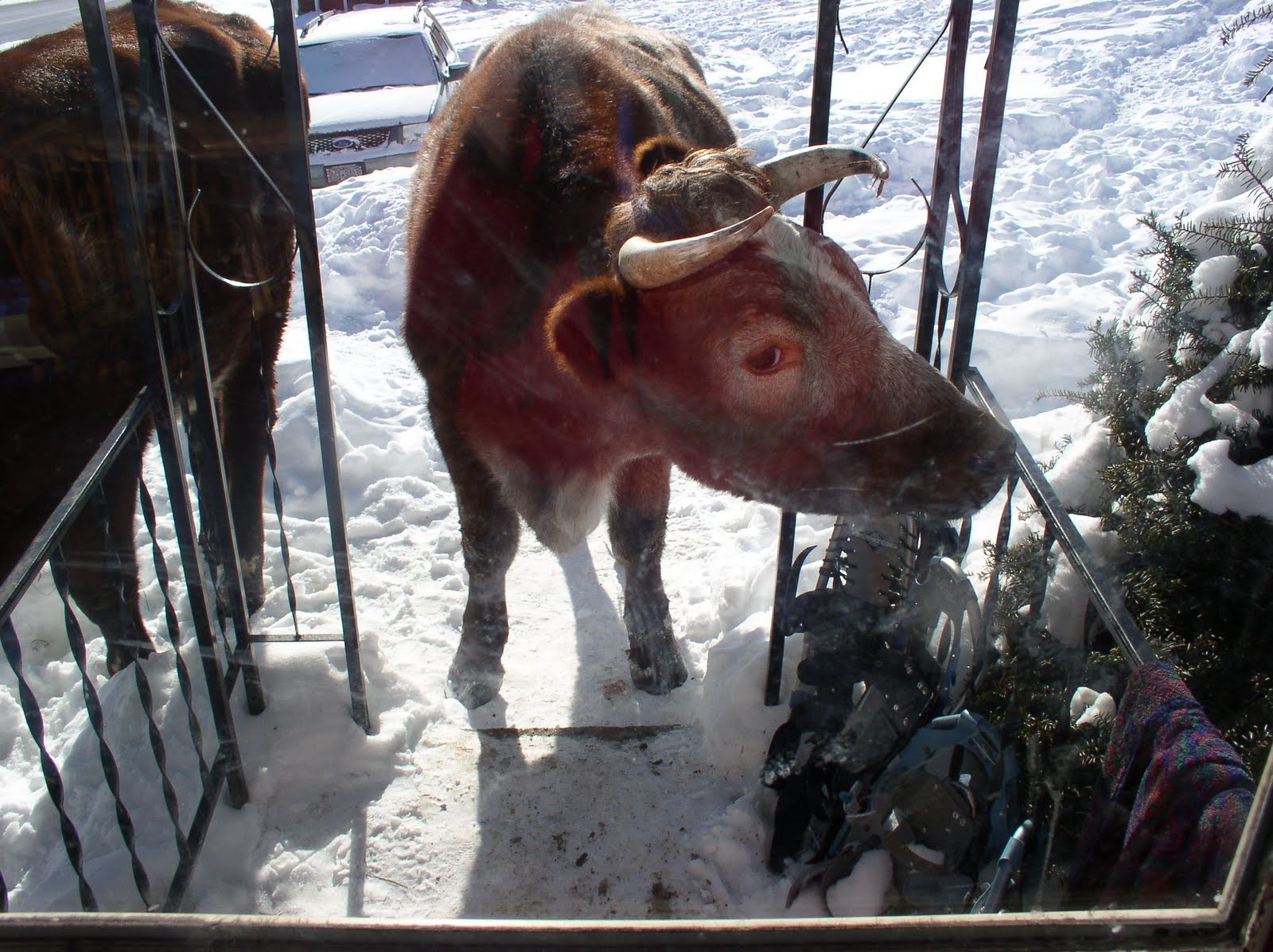 As I am pondering Spinoza’s proofs, Bright and Blaze, the two-year-old Milking Shorthorn steers that my son is training, decide that they are tired of their pen. They have plentiful hay and cool water, in a sun-filled shelter ringed by seemingly redundant ropes of barbed wire—all of which they ignore. Slipping into the barnyard, the 1500-pound, red-brown and speckled pair make their way to the front door of our house. They tip over the wooden bucket in which we crank ice cream, and begin licking the briny dregs.
 Coming into the kitchen for a cup of tea, I see a huge head through the window. Then another. Rather than return to Spinoza, I pull on boots, coat, gloves, and hat, and begrudgingly blink my way into the sunshine. I approach Bright, the largest of the two, with halter in hand. He cavorts away, kicking his heels in the air like a newborn lamb. With large horns. I have to laugh. Is he the intelligent, animate, striving to persevere that Spinoza has in mind?
*
Spinoza’s Ethics is different than I imagined. Rather than the environmental treatise that its contemporary uses imply, the Ethics is an extended apology for “a life of the mind.” God and Nature, mind and body, are what they are such that humans find their greatest happiness when reading and writing, preferably in the company of like-minded friends. According to Spinoza, it is knowledge of God—not chasing steers—that yields the highest human joy. As he writes, “In life… it is especially useful to perfect, as far as we can, our intellect, or reason. In this one thing consists man’s highest happiness, or blessedness.”
Why? The argument goes like this. God is infinite substance, the cause of itself, freely operating according to the laws of its nature—which, for Spinoza, are the eternal laws of nature. God is a thinking being, whose substance also appears in the mode of extension. God’s intellect is thus the immanent cause of every finite and fleeting thing.
Given this scene, humans too exist in God as a part of nature, as one kind of body among many others, constantly affecting and being affected by other bodies. However, humans are the part of nature that is capable of understanding all bodies, including their own, as equally modes of God, that is, “under the species of the eternal.” And understanding bodies in this way, according to Spinoza, yields utmost joy.
Why? For two reasons. First, even though mind and body share in one substance (God, or Nature), Spinoza insists that the knowledge our minds receive about the world through our bodily senses is “mutilated and confused.” It is distorted by our bodily location and our sensory limits. Second, for Spinoza, all of the so-called pleasures associated with the material world are not. Sensory pleasures come and go, leaving in their wake a sadness that confuses and dulls the mind.
Reason, however, can address both sources of discomfort. Using reason, we can “purify” and “heal” our sensory knowledge by forming “adequate ideas.” Using reason, we can also cultivate an ability not to be affected by external, material, or natural causes that might distract us from such understanding. In both cases, then, using our reason answers our own striving to persevere, and thus yields the promised joy.
Not exactly what the environmentalists are after. Where is the care and compassion for the welfare of the natural world?
I contemplate the issue while contemplating my next move with the steers. They are truly huge. Standing beside them, I feel small and weak. I know that they would not intentionally hurt me—my son has trained them well—but there is simply no reason that they need to do what I want them to do. They could overpower me with a twist of the head. They don’t.
I watch as they tussle with one another, roam among the spare bales stacked in the barnyard, and trot away each time I approach. The steers want to be out. It is as if they smell spring. They sense something new and want to participate in it by making new moves of their own. They want to let loose the capacities for cavorting that lie dormant beneath their winter shag. I don’t blame them.
I decide to ditch the halters and try a thin stick. Gently tapping from behind, I steer the steers towards their pen. At the gate, they veer away and go back across the road to the spare hay bales. I move with them and tap them back towards the pen. Back and forth we go. I move with them some more, until finally, they move with me, back into their pen, where they circle their own waiting bale.
I return to Spinoza, and the steers pull my thoughts in a direction that is both new and familiar. Spinoza too could make another move. When confronting the selectivity of our senses and the short-lived duration of sensory pleasures, Spinoza doesn’t have to yoke his reason to an intellectual love of an eternal God.
What if, instead of seeking refuge in an idea of eternal truth, we chose to cultivate a capacity to move with the rhythms of the material world? And with the rhythms of our own desires?
As Spinoza admits, human bodies are acutely impressionable, affected at all levels in myriad ways by a vast array of human, nonhuman, and elemental others. This sensitivity, I would add, is not simply passive. As our bodies are moved by people, places, and things, we learn how to move for ourselves. We learn about the power of our own bodily movement to connect us with other bodies and forces that sustain our ongoing life. That power consists of an ability to create and become new patterns of sensing and responding that align our well being with the challenges and opportunities of the moment.
What if our distinctive humanity lies in this ability to learn from other earth bodies, from the rhythms, cycles, and seasons of bodily nature, about our own capacity for making the movements that make us who we are--able to connect, able to love?
Humans do need an idea of Nature as divine, whole, and worthy of devotion, but we need more as well. We need to submit ourselves to forces and movements larger than ourselves, to which we must respond, and so catalyze a sensory awareness of our own bodily movement and how it is making us able to think and feel and act as we do.
When we do, we will have what we need to recreate our relationship with the "more than human" world (Abram). We will have the capacity to feel the pain and sadness of the natural world as a call to move differently—to find ways of thinking, feeling, and acting that connect us in mutually-enabling ways with the body of earth and bodies of earth, including our own.
It is what a body knows.
It is what my time with Spinoza and the steers is teaching me.
*
Later in the day I walk into the kitchen, and find Blaze peering at me through the window. Again?!
This time, the steers do not let me close enough to tap. Kyra volunteers to help. She is nine, all of four feet tall and seventy pounds. She approaches Blaze gently, the halter behind her back. She scratches him under the chin, and while I blink, slips the halter over his hooked horns. She does the same with Bright. Mesmerized, I help her lead them into their pen. I follow. They follow. This time, we tie them up.
 It will be best for them, I reason. They will be safe from passing cars, in easy reach of food and water. They depend on me to take care of them. Yet, my heart quails. They are tied up, against their will. I feel their pain. So moved, the thought forms. I vow to build a new fence as soon as the ground thaws—a solid wooden fence that will be strong enough to keep them in and large enough to give them room to frolic.
 I need it.
Friday, February 4, 2011
Eat Less? Pass the chips!
Responses to the government’s recently-released recommendations for healthy eating, while varied, are circling around what observers see as a remarkable message. For the first time the report’s writers, withstanding the immense pressure of the food industry, actually recommend that Americans eat less. Why? The report begins with statistics chronicling the heavy toll of diet-related chronic illnesses, primarily those associated with obesity.
Is this difference remarkable? The difference can be deceiving. What might seem like a radical move is couched in a familiar philosophy. The writers assume that a human body is an input-output device, a simple machine, for which “we” as minds can and should make good, meaning “healthy,” choices.
On this mind-over-body understanding of the human self, the report stages its primary recommendation: balance calories to manage weight. It bears repeating. According to this report, the goal of eating is weight management. And the means to that goal: information for the mind given by the report in pie charts, bar graphs, and tables.
In this way the report is typical of our cultural responses to the obesity epidemic: it reinforces a way of thinking about a human self that is itself a contributing factor to the problems it purports to address.
Bodies are not machines. Food is not fuel. Eating is not about energy intake. Physical exercise is not just about energy expenditure. When we act as if they are, we systematically override the cues that our own bodily selves are giving us about what and when and how to eat.
Our relation to food is a matter of desire. This desire for food arises as a movement in our bodily selves that impels us towards what we believe will grant us the pleasure we seek. And that pleasure is not a function of calories or quantity or even quality. Rather, what we move towards is the experience of being nourished, the experience of being nurtured, and as we mature, the experience of nourishing and nurturing ourselves.
Of course, as the report implies, our desire for food is a problem. It is a force that “we” must control.
Yet, what the government and many of us have learned to forget is that our desire for the pleasure of being nourished is actually the most subtle and sophisticated ally we have for determining what eating patterns will benefit our health. This desire is our very own in-built instrument of discernment, guiding our thinking selves to work with our environmental options to secure what we need to thrive.
In order to liberate this ally, however, we do have some work to do. We need to dislodge the mind-over-body habits that cause us to ignore and even malign our bodily selves, and learn to discern, trust, and move with the wisdom in our desire for food.
In short, to make a really remarkable move, we need to ask a question that the report does not dare: how can we get more pleasure from what we are eating?
1. Move.
If we want to feel more pleasure, then we have to be willing to feel. If we want to feel, we have to breathe. In order to breathe, we need to move—move our bodily selves—not for exercise, not to expend calories, but to bring to life a sensory awareness of what it is we really want from food.
For what do we hunger?
2. Look for the signs.
When we open to feel what we are feeling, then we are bound to learn what we don’t want to admit. What we are eating is not giving us the pleasure we want.
Our food selections, while initially pleasing to the eye and even the mouth, too often produce unwanted effects in our bodily selves. Yet, we ignore the signs and keep eating. We take a pill to deal with the “side” effects. We distract our attention, or simply eat more to prove to ourselves that we can. We want so much the pleasure we know can come from eating that we override our sensations of displeasure in pursuit of it.
Yet these sensations of discomfort are allies and friends, guiding us to move in ways that will not recreate those sensations, just as the pain of touching the stove tells us to move our hand higher up the handle.
Every twinge of discomfort is a sign of a potential pleasure we have yet to discover.
3. Open to the arc.
Once we allow ourselves to feel our desires and our displeasures, then our sensory understanding of eating expands. We find that there are multiple pleasures waiting to be enjoyed in every moment of our lives, along an endless, oscillating arc of anticipation and fulfillment.
There is potential pleasure in the imagining, growing, gathering, and preparation of food. There is potential pleasure in the act of welcoming food into our bodily selves. There is immense pleasure as well in arriving at that sweet moment when you know you have had enough.
At every point along this arc, we have some sensory relearning to do, for we have so privileged the moment of sticking something in our mouths over all the other moments of our eating arc that we don’t even notice what we are missing.
Our sense of enough has been particularly hammered. The idea that we can and should manage our calorie intake or go on a diet operates by the same logic that impels us to eat more than our bodily selves are telling us we want. Ignore your own sense of enough. Distrust it. It has nothing to teach you about what is best for you.
The opposite is true.
4. Play.
It is not enough to practice mindfulness of what and how and when we eat. It is not enough either to welcome displeasures or know that our pleasure has an arc. We must also play with different food combinations. We need to try new things, learn as much as we can about what works for us, and experiment with eating patterns and habits and traditions and recipes to discover which ones allow us to feel and find that arc of our desire.
It is to this end that the guidelines like those offered by the government are helpful—as fuel for our imaginations. The report offers us ideas and information that can help us experiment with a range of possibilities, and find the freedom to sense and respond to the movements of our own desiring, discerning selves.
*
While the eating patterns of Americans are not etched in stone, neither are they easily malleable at the level of rational choice.
If we are to eat less, we must want to eat less. And the only way we are going to want to eat less--as every marketer of a diet plan knows--is to know that we are getting more of the pleasure we desire from the act of eating.
Sure, there is pleasure to be gained from feeling healthy and lean, but when under pressure, pummeled by advertisements, and surrounded by colorfully-packaged delivery mechanisms for sugar and salt, we will inevitably and understandably move with our much more fundamental desire for an experience of being nourished and nurtured. It is this desire, then, that we must free from our mind-over-body control, and cultivate as the best resource we have along the path of health and well-being.
The goal of weight management will not fire our imaginations, free us from our self-destructing habits, or galvanize our desire in new directions. What we need is a vision of a greater pleasure whose side effect happens to be greater health and well being. And we need to trust in the wisdom of our bodily selves and desires as our best guides to it.
Is this difference remarkable? The difference can be deceiving. What might seem like a radical move is couched in a familiar philosophy. The writers assume that a human body is an input-output device, a simple machine, for which “we” as minds can and should make good, meaning “healthy,” choices.
On this mind-over-body understanding of the human self, the report stages its primary recommendation: balance calories to manage weight. It bears repeating. According to this report, the goal of eating is weight management. And the means to that goal: information for the mind given by the report in pie charts, bar graphs, and tables.
In this way the report is typical of our cultural responses to the obesity epidemic: it reinforces a way of thinking about a human self that is itself a contributing factor to the problems it purports to address.
Bodies are not machines. Food is not fuel. Eating is not about energy intake. Physical exercise is not just about energy expenditure. When we act as if they are, we systematically override the cues that our own bodily selves are giving us about what and when and how to eat.
Our relation to food is a matter of desire. This desire for food arises as a movement in our bodily selves that impels us towards what we believe will grant us the pleasure we seek. And that pleasure is not a function of calories or quantity or even quality. Rather, what we move towards is the experience of being nourished, the experience of being nurtured, and as we mature, the experience of nourishing and nurturing ourselves.
Of course, as the report implies, our desire for food is a problem. It is a force that “we” must control.
Yet, what the government and many of us have learned to forget is that our desire for the pleasure of being nourished is actually the most subtle and sophisticated ally we have for determining what eating patterns will benefit our health. This desire is our very own in-built instrument of discernment, guiding our thinking selves to work with our environmental options to secure what we need to thrive.
In order to liberate this ally, however, we do have some work to do. We need to dislodge the mind-over-body habits that cause us to ignore and even malign our bodily selves, and learn to discern, trust, and move with the wisdom in our desire for food.
In short, to make a really remarkable move, we need to ask a question that the report does not dare: how can we get more pleasure from what we are eating?
1. Move.
If we want to feel more pleasure, then we have to be willing to feel. If we want to feel, we have to breathe. In order to breathe, we need to move—move our bodily selves—not for exercise, not to expend calories, but to bring to life a sensory awareness of what it is we really want from food.
For what do we hunger?
2. Look for the signs.
When we open to feel what we are feeling, then we are bound to learn what we don’t want to admit. What we are eating is not giving us the pleasure we want.
Our food selections, while initially pleasing to the eye and even the mouth, too often produce unwanted effects in our bodily selves. Yet, we ignore the signs and keep eating. We take a pill to deal with the “side” effects. We distract our attention, or simply eat more to prove to ourselves that we can. We want so much the pleasure we know can come from eating that we override our sensations of displeasure in pursuit of it.
Yet these sensations of discomfort are allies and friends, guiding us to move in ways that will not recreate those sensations, just as the pain of touching the stove tells us to move our hand higher up the handle.
Every twinge of discomfort is a sign of a potential pleasure we have yet to discover.
3. Open to the arc.
Once we allow ourselves to feel our desires and our displeasures, then our sensory understanding of eating expands. We find that there are multiple pleasures waiting to be enjoyed in every moment of our lives, along an endless, oscillating arc of anticipation and fulfillment.
There is potential pleasure in the imagining, growing, gathering, and preparation of food. There is potential pleasure in the act of welcoming food into our bodily selves. There is immense pleasure as well in arriving at that sweet moment when you know you have had enough.
At every point along this arc, we have some sensory relearning to do, for we have so privileged the moment of sticking something in our mouths over all the other moments of our eating arc that we don’t even notice what we are missing.
Our sense of enough has been particularly hammered. The idea that we can and should manage our calorie intake or go on a diet operates by the same logic that impels us to eat more than our bodily selves are telling us we want. Ignore your own sense of enough. Distrust it. It has nothing to teach you about what is best for you.
The opposite is true.
4. Play.
It is not enough to practice mindfulness of what and how and when we eat. It is not enough either to welcome displeasures or know that our pleasure has an arc. We must also play with different food combinations. We need to try new things, learn as much as we can about what works for us, and experiment with eating patterns and habits and traditions and recipes to discover which ones allow us to feel and find that arc of our desire.
It is to this end that the guidelines like those offered by the government are helpful—as fuel for our imaginations. The report offers us ideas and information that can help us experiment with a range of possibilities, and find the freedom to sense and respond to the movements of our own desiring, discerning selves.
*
While the eating patterns of Americans are not etched in stone, neither are they easily malleable at the level of rational choice.
If we are to eat less, we must want to eat less. And the only way we are going to want to eat less--as every marketer of a diet plan knows--is to know that we are getting more of the pleasure we desire from the act of eating.
Sure, there is pleasure to be gained from feeling healthy and lean, but when under pressure, pummeled by advertisements, and surrounded by colorfully-packaged delivery mechanisms for sugar and salt, we will inevitably and understandably move with our much more fundamental desire for an experience of being nourished and nurtured. It is this desire, then, that we must free from our mind-over-body control, and cultivate as the best resource we have along the path of health and well-being.
The goal of weight management will not fire our imaginations, free us from our self-destructing habits, or galvanize our desire in new directions. What we need is a vision of a greater pleasure whose side effect happens to be greater health and well being. And we need to trust in the wisdom of our bodily selves and desires as our best guides to it.
Friday, January 21, 2011
Tales of a Moose Mother
The fire storm unleashed by Amy Chua’s Wall Street Journal op-ed piece, “Why Chinese Mothers are Superior,” (besides being a publicist's dream) swirls around a hot-button question that has dominated discussions of parenting and education since the 1960s: how do you help kids develop a strong self-esteem?
While Chua, a self-named “Tiger Mother,” doesn’t herself claim to have a “superior” method that would work for everyone, she does accuse “American” parents of coddling their children’s egos by protecting them from overly-harsh criticism or demands, in the belief that self-esteem produces achievement. “Chinese” parents, she counters, convinced of their children’s inherent strength, hold high demands and lavish pointed criticism, in the belief that achievement produces self-esteem.
Many of Chua's critics, however, share a common assumption that self-esteem rides on a perception of ourselves as being the best at something—whether it is schoolwork, music prowess, or parenting.
We all want to be the best. Why else would the WSJ choose the provocative “superior” in its title for Chua’s piece? Why else would so many readers lunge for the bait and disagree?
Even those respondents who claim that there is no formula for parenting, that every child is different, and that every relationship must find its own logic, do so from a place of wanting to be the best parent, or the better parent, for their own children at least.
So, what is wrong with wanting to be the best? Nothing. It is as “American” as it is “Chinese” as it is human.
However, there is a problem when we tie our self-esteem to a perception of ourselves as being better than someone else. For when we do, we bind ourselves—and our children—to an obsessive practice of comparing our accomplishments with those of others, ever suspicious and resentful of anyone who appears to be better than we are. We train ourselves and our children to perceive such individuals as threats to our well-being. So cramped and bound, our competitive spirits generate insecurity, fear, and bitterness in us.
Is that what we want for our children? Or for ourselves?
I remember the day that I learned: there are other moves to make.
*
I am about to dive into the pool for my regular workout. I am looking for a lane in which the swimmers are swimming more slowly than I do. I know that I always feel better and more energetic when I am passing others, rather than being passed.
Then I see her—the lone swimmer in her lane—swimming undoubtedly faster than I can. I stand there, mesmerized by the smooth rhythms of her churning limbs and split-staccato of her dashing flip-turns. An inner cry erupts: I want to swim like that!
Ordinarily I would avoid her lane. She is faster than I am. But this time I jump in eagerly, knowing she will lap me many times, and secretly glad. I will have more chances to watch her, and to learn from her how to move with such a graceful, easy flow.
My workout that day was one of my best ever. I hopped out of the pool, suffused with joy and celebrating with gratitude the strength of the woman who was a better swimmer than I was. I was free to affirm my self, and thus, free to learn how to become more.
*
Wanting to be the best is not a problem. This desire to be the best is what motivates us to learn from other people how to do what we want to do better than we are doing it. It is a vital energy that opens us to the benefits of being the social creatures that we are.
At the same time, in order to take full advantage of this energy, we must detach our sense of self-esteem from a perception of ourselves as better than others.
In this process, it helps to remember several crucial facts. First, any measure of “best” is arbitrary. There can be no absolute best—only various sets of hurdles and obstacles designed to pull out aspects of an infinite human potential at a certain time and place. Second, on any measure you choose, there will always be people who do what you do better than you do, and others who don’t. Third, as a result, it makes no sense to tie your self-esteem to being better than anyone at anything. It is simply impossible to be the best at anything other than being yourself.
Once you detach your self-esteem from the idea of being the best, then the path to making the best possible use of your competitive energies lurches into view: celebrate the accomplishments of others, especially, those who seem to be better than you at doing whatever you want to do. Acknowledge them. Applaud them. Open to them. And when you do, you will be free to learn from them all they have to teach you about how to be the best... at who you have the potential to be.
The same holds for our children, and we can help them learn so by being and becoming the best that we can be.
Call it Moose Mothering.
*
I wake in the morning, surrounded by mist. Crawling out of my sleeping bag, I perch on the edge of the lean-to, looking out into the wilderness I know surrounds me. I can see for twenty feet before my vision disappears into shrouds of gray. Geoff and I are here camping, at the foot of Mount Katahdin, in Baxter State Park, hoping to summit today. I am five months pregnant with my first child, wondering at the changes this small being will bring to our lives, wondering what kind of parent I will be.
A rustling to my right turns my head. A moose cow lumbers into view, calmly nosing about in the underbrush, paying no attention to me. I pay attention to her.
As she passes into the clearing in front of the lean-to, a calf prances out of the bush behind her, quickly catching up. He gazes around, meets my eye, glances at his mother, and then sinks his nose into the underbrush too. Two steps behind, three feet below, he is doing exactly what she is doing, making her moves. He lifts his head again, peers around, and returns to his nibbling.
I watch her some more. She is not looking at him. She doesn’t react to his antics. She stays the course of her own nourishment. Yet as I watch her, I know: her every cell is alert and alive to his presence. She smells, hears, and feels where her calf is with every sensory surface. If her calf strayed too far or fell in the way of harm, she would be there in an instant, all heft and hooves.
The thought flares through my mind: it’s perfect parenting. This moose mother is making the movements she would ordinarily do, with an expanded, heightened sense of self. Everything she does is more important than it ever was, for the little one is learning from her how.
At that moment, I vowed to be a Moose Mother, making the moves in my own life that I want my children to make in their own.
*
So, I applaud Amy Chua for having such accomplished daughters! I congratulate her for staging such a stunning book release! (My family memoir won’t be out until June.)
Wednesday, December 22, 2010
Arguing for Peace
At this time of year, many citizens of the western world celebrate the winter solstice, with its returning light, as the coming of peace. The prince of peace is born.
Tell that to my five year old, Kai. He loves to argue. I know, because he told me. A few months ago, when, in response to my “no,” he spun an elaborate argument for why he should be allowed to watch a video, I exclaimed, “You should be a lawyer!” (deftly changing the subject). “You are really good at making arguments!”
I watched as his face softened into a beatific grin. “I love arguing!” In a flash he screwed his smile into a mock grimace and pointed his finger at me: “It’s all your fault!” Indeed, I thought, I’m sure it is.
Still, I wasn’t ready to begin my solstice celebration with an argument. It wasn’t even 7:30 AM when Kai found me in my room. “Kyra’s not being nice!” he complained. He was upset. “She and Jordan are keeping secrets! She whispered something in his ear and she is not telling me what!”
I checked in with Kyra. Sure enough, she had been asking Jordan for help in making Kai’s Christmas gift. I turned to Kai to talk about it, calmly and quietly. “They want to give you something.”
“They are not being nice!”
“Would it be nice if they didn’t want to give you something?”
“They aren’t telling me what they said!”
“They want it to be a surprise!”
“They don’t like me!” And so it continued. Kai was insistent and furious: not telling equals not liking. There was no other equation that made any sense to him. I sighed and sent him along to talk with his dad. I was supposed to be working anyway.
In the kitchen Geoff ran through the same reasonable logic I did with similar results. Suddenly I heard Kai make a new move: “If they tell me, it won’t ruin the surprise, because I won’t know what package it is in!”
The boy is five and he won’t give up. He will argue with a passionate and precise fury for what seems, to an outside observer, to be right there in front of him. He wants to be included, and he is!
Is his passion so hard to understand?
*
I think back to what I have been learning since I realized that he “loves” to argue. One thing is that “arguing” means something different to Kai than it does for me. I don’t like to argue. I prefer peace. I see the two as mutually exclusive. If someone argues with me, I assume that they don’t like me. For Kai, it is nearly the reverse.
Before I understood this about Kai, we had been periodically getting stuck in the same conversation that went something like this:
Kai: “I love you, Mom.”
Mom: “I love you too, Kai.”
“But I love you more than you love me.”
“I love you so so much, Kai!”
“You don’t like me.”
“I love you, Kai!”
“No you hate me.”
And so it would go, with Kai insisting that I hated him, until I would finally resort to something like: “Kai, when you say that it hurts my feelings!” At which point he would be convinced that he was right. I didn’t like him at all. Not one bit. He would start crying. I would then give up, change the subject, and try to get him interested in something else.
It was so confusing to me. How could my best efforts to tell him how much I love him backfire so profoundly? Why, when I was telling him something, was he arguing with me saying that I wasn’t?
But after realizing how he loves to argue, I began to get it. One day, when he told me that he loved me, a new move arose in me. I went with it.
“Oh no, no, no, Kai. I love you!” Instantly his face lit up. It was a game and I was playing.
He came back: “No, no, no, no! I love you!”
“No,” I said, carefully and with great, exaggerated emphasis, “you just don’t understand. I love you!!”
And there we are, “arguing” back and forth for several minutes, our large loud mouths smiling at one another.
It worked. I was so incredibly relieved to have found a way in. We kept having the same conversation, with the same warm feeling of a result. Then it occurred to me. Kai argues with me because he loves me. More to the point: he argues with me because he wants me to argue back with him—or at least, to argue with that part of him that might doubt my love for him or fear his worthiness in receiving it. He doesn’t want to feel that doubt or fear. He wants to be in—in-cluded, in the loop, in the light.
By arguing with me, he is sounding out this darkness inside himself; in wanting me to argue back, he is asking me to help him dissolve it, defuse it, and find his way to more presence, more intention, more love. To help him find his way into the light, I need to move with him into the dark, into his dark.
*
A few days ago, we were having our “No, no I love you” dialogue when suddenly, he stopped. He looked at me intently: “Mom, we don’t have to play this game anymore.”
I peered back at him. “You mean, I can just say, Kai, I love you too!”
He smiled at me, “Yes.”
I saw the light. Or rather, Kai and I saw it together.
Perhaps that is what the morning’s argument is reminding me to celebrate.
Tuesday, November 23, 2010
Give Thanks for Pain? You're Kidding
A question often arises in response to my book, What a Body Knows: What if my body is wrong? It isn't doing what I want it to do--it hurts! Where is the wisdom in that?
While I have addressed the issue indirectly in other blogs (see below), it is time to address it head on. At the heart of the matter is the question of pain: what it is, how we sense it, and how we respond to it.
Pain, together with pleasure, comprise the primary feedback available to our thinking selves about how well the movements we are making in the world are making us.
My aim (or one of them) in writing What a Body Knows was to shift our experience of pain along (at least) four registers, in each case, moving from a mind over body perspective to one that affirms our sensations of pain as resources guiding us along the path of our own unique bodily becoming.
1) Part/ Whole: When we hurt, our mind over body tendency is to identify the pain with one part of ourselves, isolate that part from the rest, and work to make "it" go away. Whether our head hurts, our stomach cramps, our back aches, our hips creak, our heart pines, or our energies flag, we either try to ignore our sensations, or we become obsessed with fixing them. Pain is the problem. "I" must fix "it."
However, when we shift to an experience of ourselves as movement--the movement of creating and becoming patterns of sensation and response (as described in What a Body Knows)--we realize that any manifestation of pain in one part of ourselves always expresses a movement pattern that engages every moment of ourselves, physical to spiritual. A part is part of a whole, and that whole is what is hurting.
The implications are several. Because any pain involves a whole person, any healing must also engage the whole person. Any effective response will involve integrating the part into the whole, understanding the connections among person parts, and discerning as best we can how the movements we are making are creating this pain as a guide to move differently than we are now.
2) New/ Old: When something begins to bother us, we also tend to think of the pain or illness or injury as new--that is, as a departure from our otherwise usual or normal healthy state. Most pain feels accidental. It comes upon us as a surprise that we were not expecting. We experience it as an obstacle to our forward motion.
However, once we understand our bodily selves as movement, we realize that by the time we feel a part of ourselves as pain, the whole-body patterns that that pain is expressing have already been in play for a while and at many levels of our existence. Our thoughts and feelings about ourselves and others, the movements we make as we go about our usual activities, our hopes and fears, as well as our general outlook on the world, are all, to greater and lesser extents, bound up in the pain.
The implication here is that healing involves recreating patterns of sensation and response that have been at work for a long time, slowly creating a situation where we feel a particular point of pain. Healing takes time.
3) Read/ Felt: Further, when people acknowledge the importance of "listening" to their feelings of discomfort, they often talk about reading "the" body or listening to "the" body, as if there is an "I" that exists above and apart from the body who can see it, know it, and fix it.
However, the kind of wisdom that our bodily selves have is not a formula or a schema that "we" can read and then impose upon our bodies, so as to make them do what we want to do, and stop hurting.
The kind of wisdom our bodily selves are is an ability to sense impulses guiding us to move in ways that will coordinate our pleasure, our health, and our well being. This is who we humans are--this impulse to connect with whatever will support us in becoming who we are. We can and must connect with other people, with elements, with our own bodily selves, with ideas, activities, and cultural forms in order to unfold our skills and abilities.
In every case, as we connect in life-enabling ways, we learn something more about how to move in ways that will connect us more effectively with what nourishes our well-being. This is what pain teaches us: not how to deal with it, and not to obsess over it, but how to discern and move with whatever impulse to connect it represents.
Pain is a desire to be free from it. Yet unless we allow ourselves to welcome it as offering us vital information about our selves and situation, we will not fully grasp that desire.
Pain is not holding us back. It is calling us to be free from whatever is holding us back.
4) Responsible/ Participating: Where I am moving with this line of thought is far from the all-too-common self-help theme: you can heal yourself. People seem to think that once they acknowledge their pain and admit that their sensations have something to teach them, then any pain they feel is their fault. They are responsible for healing themselves. When the pain persists, self-judgment can weigh heavily.
Once we shift to an experience of ourselves as movement, however, we realize that pain is not our fault, that "we" are not responsible for our pain, and that "we" cannot heal ourselves. Rather, healing is who we are: it is an ever-ongoing process in which our bodily selves are ever and forever active. In this process, our pain is helping us appreciate how and where our healing energies have more potential for creating us anew. What that "we" can do is learn how to align our mental energies with the trajectories of healing already at work in our bodily selves.
The question then is this: how can we participate in our healing as consciously as possible?
What a Body Knows offers a response: if we cultivate a sensory awareness of how our movements are making us, we have what we need to begin to discern the wisdom in feelings of disease, discomfort, dissatisfaction, and depression.
It is not just a matter of allowing ourselves to feel what we are feeling, though such mindfulness is an important first step. Nor is it a matter of identifying the patterns of mental, emotional, and physical movement that are knotting us. What is most important is being able to open a space in ourselves where we can find in our sensations our core desires, our impulses to connect, and begin to move with them, in ways that do not recreate the pain that troubles us.
Every pain is a potential for pleasure that is yet to unfold.
For more blogs on this topic:
1. about the seemingly pointless pain of the flue: http://www.psychologytoday.com/blog/what-body-knows/201008/what-do-you-do-the-flu
2. about the limits of "listening" to your body
http://www.psychologytoday.com/blog/what-body-knows/200909/the-limits-listening-your-body
While I have addressed the issue indirectly in other blogs (see below), it is time to address it head on. At the heart of the matter is the question of pain: what it is, how we sense it, and how we respond to it.
Pain, together with pleasure, comprise the primary feedback available to our thinking selves about how well the movements we are making in the world are making us.
My aim (or one of them) in writing What a Body Knows was to shift our experience of pain along (at least) four registers, in each case, moving from a mind over body perspective to one that affirms our sensations of pain as resources guiding us along the path of our own unique bodily becoming.
1) Part/ Whole: When we hurt, our mind over body tendency is to identify the pain with one part of ourselves, isolate that part from the rest, and work to make "it" go away. Whether our head hurts, our stomach cramps, our back aches, our hips creak, our heart pines, or our energies flag, we either try to ignore our sensations, or we become obsessed with fixing them. Pain is the problem. "I" must fix "it."
However, when we shift to an experience of ourselves as movement--the movement of creating and becoming patterns of sensation and response (as described in What a Body Knows)--we realize that any manifestation of pain in one part of ourselves always expresses a movement pattern that engages every moment of ourselves, physical to spiritual. A part is part of a whole, and that whole is what is hurting.
The implications are several. Because any pain involves a whole person, any healing must also engage the whole person. Any effective response will involve integrating the part into the whole, understanding the connections among person parts, and discerning as best we can how the movements we are making are creating this pain as a guide to move differently than we are now.
2) New/ Old: When something begins to bother us, we also tend to think of the pain or illness or injury as new--that is, as a departure from our otherwise usual or normal healthy state. Most pain feels accidental. It comes upon us as a surprise that we were not expecting. We experience it as an obstacle to our forward motion.
However, once we understand our bodily selves as movement, we realize that by the time we feel a part of ourselves as pain, the whole-body patterns that that pain is expressing have already been in play for a while and at many levels of our existence. Our thoughts and feelings about ourselves and others, the movements we make as we go about our usual activities, our hopes and fears, as well as our general outlook on the world, are all, to greater and lesser extents, bound up in the pain.
The implication here is that healing involves recreating patterns of sensation and response that have been at work for a long time, slowly creating a situation where we feel a particular point of pain. Healing takes time.
3) Read/ Felt: Further, when people acknowledge the importance of "listening" to their feelings of discomfort, they often talk about reading "the" body or listening to "the" body, as if there is an "I" that exists above and apart from the body who can see it, know it, and fix it.
However, the kind of wisdom that our bodily selves have is not a formula or a schema that "we" can read and then impose upon our bodies, so as to make them do what we want to do, and stop hurting.
The kind of wisdom our bodily selves are is an ability to sense impulses guiding us to move in ways that will coordinate our pleasure, our health, and our well being. This is who we humans are--this impulse to connect with whatever will support us in becoming who we are. We can and must connect with other people, with elements, with our own bodily selves, with ideas, activities, and cultural forms in order to unfold our skills and abilities.
In every case, as we connect in life-enabling ways, we learn something more about how to move in ways that will connect us more effectively with what nourishes our well-being. This is what pain teaches us: not how to deal with it, and not to obsess over it, but how to discern and move with whatever impulse to connect it represents.
Pain is a desire to be free from it. Yet unless we allow ourselves to welcome it as offering us vital information about our selves and situation, we will not fully grasp that desire.
Pain is not holding us back. It is calling us to be free from whatever is holding us back.
4) Responsible/ Participating: Where I am moving with this line of thought is far from the all-too-common self-help theme: you can heal yourself. People seem to think that once they acknowledge their pain and admit that their sensations have something to teach them, then any pain they feel is their fault. They are responsible for healing themselves. When the pain persists, self-judgment can weigh heavily.
Once we shift to an experience of ourselves as movement, however, we realize that pain is not our fault, that "we" are not responsible for our pain, and that "we" cannot heal ourselves. Rather, healing is who we are: it is an ever-ongoing process in which our bodily selves are ever and forever active. In this process, our pain is helping us appreciate how and where our healing energies have more potential for creating us anew. What that "we" can do is learn how to align our mental energies with the trajectories of healing already at work in our bodily selves.
The question then is this: how can we participate in our healing as consciously as possible?
What a Body Knows offers a response: if we cultivate a sensory awareness of how our movements are making us, we have what we need to begin to discern the wisdom in feelings of disease, discomfort, dissatisfaction, and depression.
It is not just a matter of allowing ourselves to feel what we are feeling, though such mindfulness is an important first step. Nor is it a matter of identifying the patterns of mental, emotional, and physical movement that are knotting us. What is most important is being able to open a space in ourselves where we can find in our sensations our core desires, our impulses to connect, and begin to move with them, in ways that do not recreate the pain that troubles us.
Every pain is a potential for pleasure that is yet to unfold.
For more blogs on this topic:
1. about the seemingly pointless pain of the flue: http://www.psychologytoday.com/blog/what-body-knows/201008/what-do-you-do-the-flu
2. about the limits of "listening" to your body
http://www.psychologytoday.com/blog/what-body-knows/200909/the-limits-listening-your-body
Monday, November 15, 2010
Hit by a Hammer: Are you lucky?
On Saturday, a hammer hit me. In the face.
It fell from the top of the ladder, where I had hooked it, about three feet above my head. I was standing at the bottom of the ladder, trying to move it, and wondering why the ladder seemed so heavy. I looked up to investigate. I didn’t see the hammer coming, I felt it.
As the hammer rammed my left cheek bone, I knew exactly what it was. It grazed my lip and clattered to the ground. The whole side of my face was instantly numb, hot, and swelling. I stomped and staggered into the house and went straight to the freezer.
Within twenty seconds, I was sitting on the kitchen floor, ice packed from temple to lip, sobbing at my stupidity. Why this? I was just trying to get something done! I should have been working with someone else. I should have been doing something else. I should have had help… I should have been wearing a tool belt… I should have...I should have...
Within a few minutes, I quieted down and looked up at the circle of my kids’ concerned faces. Leif, at 17 months, angled himself into my lap, wanting to nurse, wanting comfort from the distress of seeing mom cry. I obliged. Comforting him, comforted me. Geoff sat with us.
The ice melted. The swelling slowed. A half hour passed. My lip was enlarged; cheekbone too, but I was OK. I was OK. We all ate lunch, and then Geoff and I together tackled the curled and tattered pieces of clapboard I had been trying to replace on the side of our house. Every time I approached the ladder, I would involuntarily cringe, as a shadow of fear flickered through me.
The afternoon eased, and a warm November wind washed the sky with pastel hues. As I painted the new boards blue, a realization slowly seeped its way into my sensory awareness.
I am so lucky. The thought streamed through the sensory channels chiseled open by pain and self-judgment and fear, and spilled over, spreading through all realms of life. I am so lucky.
In the wake of this thought, came others as well. I was hit in the face with a hammer. With a hammer! In the face! I didn’t lose an eye or a tooth. My skin held fast. I have a small cheek-bone bump and a lovely swath of violet under my eye, but I am OK.
I had been hit in the face with a hammer and all I could feel was this boundless, leaping joy. I felt deeply, deliriously giddy. Life was beautiful--all of it, and not just our house. The weekend just kept getting better. The joy kept multiplying, as I kept seeing and appreciating more in my life of what could have been so much worse.
It got me thinking. I felt lucky because I know: it could have been so much worse. So much of what happens in life that doesn’t go as we planned could have been so much worse.
Perhaps we are lucky, even when we don’t think we are. Perhaps we are. And what if? What if we allowed ourselves to feel lucky, whatever happens? To feel that joy and gratitude every minute—not just when hit by hammers? Through the rosy glow of such emotions, life seems so much better. So good. And it is. Our movements of gratitude make it so, for they open us up to see and sense more of what is endlessly being given. They empower us as well, to act in ways that move us along the paths of what we desire most.
I smiled wryly. Perhaps the hammer knocked some sense into me after all. Or rather, it knocked me along my path of bodily becoming into a newly strengthened pattern of sensation and response—one of appreciation for how lucky I am.
I know this gratitude. I can know this gratitude. And I will. I’ll remember. One hit is enough.
It fell from the top of the ladder, where I had hooked it, about three feet above my head. I was standing at the bottom of the ladder, trying to move it, and wondering why the ladder seemed so heavy. I looked up to investigate. I didn’t see the hammer coming, I felt it.
As the hammer rammed my left cheek bone, I knew exactly what it was. It grazed my lip and clattered to the ground. The whole side of my face was instantly numb, hot, and swelling. I stomped and staggered into the house and went straight to the freezer.
Within twenty seconds, I was sitting on the kitchen floor, ice packed from temple to lip, sobbing at my stupidity. Why this? I was just trying to get something done! I should have been working with someone else. I should have been doing something else. I should have had help… I should have been wearing a tool belt… I should have...I should have...
Within a few minutes, I quieted down and looked up at the circle of my kids’ concerned faces. Leif, at 17 months, angled himself into my lap, wanting to nurse, wanting comfort from the distress of seeing mom cry. I obliged. Comforting him, comforted me. Geoff sat with us.
The ice melted. The swelling slowed. A half hour passed. My lip was enlarged; cheekbone too, but I was OK. I was OK. We all ate lunch, and then Geoff and I together tackled the curled and tattered pieces of clapboard I had been trying to replace on the side of our house. Every time I approached the ladder, I would involuntarily cringe, as a shadow of fear flickered through me.
The afternoon eased, and a warm November wind washed the sky with pastel hues. As I painted the new boards blue, a realization slowly seeped its way into my sensory awareness.
I am so lucky. The thought streamed through the sensory channels chiseled open by pain and self-judgment and fear, and spilled over, spreading through all realms of life. I am so lucky.
In the wake of this thought, came others as well. I was hit in the face with a hammer. With a hammer! In the face! I didn’t lose an eye or a tooth. My skin held fast. I have a small cheek-bone bump and a lovely swath of violet under my eye, but I am OK.
I had been hit in the face with a hammer and all I could feel was this boundless, leaping joy. I felt deeply, deliriously giddy. Life was beautiful--all of it, and not just our house. The weekend just kept getting better. The joy kept multiplying, as I kept seeing and appreciating more in my life of what could have been so much worse.
It got me thinking. I felt lucky because I know: it could have been so much worse. So much of what happens in life that doesn’t go as we planned could have been so much worse.
Perhaps we are lucky, even when we don’t think we are. Perhaps we are. And what if? What if we allowed ourselves to feel lucky, whatever happens? To feel that joy and gratitude every minute—not just when hit by hammers? Through the rosy glow of such emotions, life seems so much better. So good. And it is. Our movements of gratitude make it so, for they open us up to see and sense more of what is endlessly being given. They empower us as well, to act in ways that move us along the paths of what we desire most.
I smiled wryly. Perhaps the hammer knocked some sense into me after all. Or rather, it knocked me along my path of bodily becoming into a newly strengthened pattern of sensation and response—one of appreciation for how lucky I am.
I know this gratitude. I can know this gratitude. And I will. I’ll remember. One hit is enough.
Monday, November 8, 2010
Movement = Play = Love
Every time I turn around these days, Leif is standing on top of a table, grinning broadly. At sixteen months old, my son is a stealth mover, quick and quiet. If I simply look away for an instant, he pulls out a chair whose seat is as high as his chest and levers himself onto its flat expanse, using a dip of his shoulders and head to haul up his legs. He then lifts one leg to the side to bridge the span from chair seat to table top, and pulls up to standing.
Why? He's not usually after any object in particular--he is not even tall enough to see what is up there--though once there he inevitable notices his brother's glass of milk or an uncapped marker. He climbs spontaneously, almost instinctively, whenever a chair enters his field of perception. Or a couch; the toy box; a flight of stairs. A parental leg, or a sister's back.
What motivates him, it seems, is less any retrievable object than the doing of the movement itself--the sheer joy of its accomplishment. He is in a phase where this urge to climb is his movement pattern of choice for connecting with his world and discovering what it has to offer him: what new sights and sensations will this chair-climbing, table-scaling move generate in me?
Leif's play reminds me: movement matters. Moving our bodily selves is not just about strengthening our muscles so that we can hold up our heads. How we move is about how we play. How we play is about how we learn. And what we are born to learn is how to love.
*
I have been watching Leif move since before he was born, and seen a progression not only in the kinds of movements he has made, but in the focus of his play with those movements. At each stage, he is learning and making new movements, for sure, but he is also exploring different qualities of bodily movement itself, motivated, in every case, by an impulse to discover and connect with whatever will provide him with the nourishing nurture he needs to thrive.
At first, Leif's movements seemed random and purposeless. His arms and legs fluttered and flailed. Any patterns were as chaotic as any current, with his physiological makeup banking the flow. The one exception was the movement he made to connect with the stream of sustenance coming from me. That move had purpose.
Yet it was soon evident that Leif's seemingly random movements were giving him all kinds of information about himself and his world. Every movement was a hook, pulling in impressions about how it felt to move that way and what happened when he did. Every movement yielded some new sensation of weight, force, and gravity; space, time, and causality; temperature, pressure, pleasure, and pain. His random movement was both pure play and systematic research at a sensory level about his self and world.
Some of the movements he was making connected him with a range of sensory pleasures that felt good--a nourishing flow, a warm embrace, a facial grin. These movements began to make him. He learned from them, repeated them, and as he did, the locus of his play began to shift. No longer was he playing with movement simply at the level of sensation, he began playing with movement patterns themselves. Aware of the pleasure that mouthing for milk provided, he was soon experimenting with what else he could put in his mouth. Would sucking on it yield the same nourishing connection?
There were other preferred patterns too. The same movement pattern that pulled his knees to his chest could curl him into his dad's arms, roll him over, and help him hold himself up.
His play with these movement patterns, again, began to open new registers of knowledge and new dimensions of play. Suddenly he was using his movement to play with objects, but not because the objects themselves were interesting. What he wanted to know was what his preferred movement patterns could do with whatever new item he could hold in his hand. If I bend my arm at the elbow and hurl my hand forward, what will happen to this ball? Or a sock, a piece of toast, or my brother's truck?
Soon enough, Leif was honing in on particular objects and exploring the different movement patterns he could make and with what results. That spoon could get apple sauce to his mouth. It could also leave a broad smear of it across his chest, make a clanging sound when hit against his cup, and when dropped from the high chair, verify that gravity indeed works.
Suddenly a ball was really exciting, because of all of the different movement patterns it enabled him to make. He could throw it, kick it, sit on it, play toss with it, and put it into his wagon.
This object-oriented play is what we typically mean by the term "play." When we think of play, we think of toys--objects specifically designed to elicit developmentally appropriate patterns of movement.
Even then, however, as most parents know, the best "toys" are found and not made. Leif can spend long minutes with a plain cardboard box, climbing into it and back out again, putting on the lid and taking it off, turning it upside down and sideways, loading it up with other toys, and taking them out again. The box is so exciting precisely because it doesn't preprogram his play. It requires, or enables, him to play at the levels of sensation, movement patterns, and patterns of relating. The possibilities are infinite.
The same is true for table tops. What can't you do on them?
*
The play with the sensory and patterning potentials of movement that I see in Leif is never over. We humans are ever and again mobilizing the movement patterns we know in relation to new contexts, objects, and persons, looking for connections that will yield the sensations of pleasure we associate with nourish and nurture. The sensations of pleasure we associate with love.
The objects with which we play, of course, evolve. As we grow, we move to emotions and sounds, words and imaginary realms, books and songs and dances and cultural forms of all kinds, in an increasingly complicated network of movement patterns. Yet in every realm, we play--making movements we know in order to open us to what we do not. We move to connect in life-enabling ways with what our movement is constantly revealing to us.
Yet, this observation also yields a withering critique of our culture's chronic and characteristic ills. Our realms of play have dwindled to such an extent that we rarely if ever play at a sensory level, or even the level of pattern making. We no longer know what to do with boxes or spoons, a blank sheet of paper or a blank hour. We prefer toys that will tell us which moves to make, and games that remove us to a finite world of someone else's making. We play with objects designed to exercise and reinforce particular sensory and kinetic options--not open new ones. We play with ideas, with information, and with plans for the future, but not with our sensory, movement-making selves. Even when we move, we want to learn someone else's forms, to "play" by someone else's rules.
We claim that we have no time for play, but time is not the issue. The issue is that we have forgotten why movement matters. We no longer value the ability to make new movements, to find our own movements, from within the infinite range of our sensory potential--movements that will connect us in life-enabling ways to the places and persons who matter most.
We have forgotten that the ability and the willingness to discover new sensory moves is very skill that enables us to learn to move with another, dance with another, in a word, learn to love.
When was the last time you climbed onto a table?
Why? He's not usually after any object in particular--he is not even tall enough to see what is up there--though once there he inevitable notices his brother's glass of milk or an uncapped marker. He climbs spontaneously, almost instinctively, whenever a chair enters his field of perception. Or a couch; the toy box; a flight of stairs. A parental leg, or a sister's back.
What motivates him, it seems, is less any retrievable object than the doing of the movement itself--the sheer joy of its accomplishment. He is in a phase where this urge to climb is his movement pattern of choice for connecting with his world and discovering what it has to offer him: what new sights and sensations will this chair-climbing, table-scaling move generate in me?
Leif's play reminds me: movement matters. Moving our bodily selves is not just about strengthening our muscles so that we can hold up our heads. How we move is about how we play. How we play is about how we learn. And what we are born to learn is how to love.
*
I have been watching Leif move since before he was born, and seen a progression not only in the kinds of movements he has made, but in the focus of his play with those movements. At each stage, he is learning and making new movements, for sure, but he is also exploring different qualities of bodily movement itself, motivated, in every case, by an impulse to discover and connect with whatever will provide him with the nourishing nurture he needs to thrive.
At first, Leif's movements seemed random and purposeless. His arms and legs fluttered and flailed. Any patterns were as chaotic as any current, with his physiological makeup banking the flow. The one exception was the movement he made to connect with the stream of sustenance coming from me. That move had purpose.
Yet it was soon evident that Leif's seemingly random movements were giving him all kinds of information about himself and his world. Every movement was a hook, pulling in impressions about how it felt to move that way and what happened when he did. Every movement yielded some new sensation of weight, force, and gravity; space, time, and causality; temperature, pressure, pleasure, and pain. His random movement was both pure play and systematic research at a sensory level about his self and world.
Some of the movements he was making connected him with a range of sensory pleasures that felt good--a nourishing flow, a warm embrace, a facial grin. These movements began to make him. He learned from them, repeated them, and as he did, the locus of his play began to shift. No longer was he playing with movement simply at the level of sensation, he began playing with movement patterns themselves. Aware of the pleasure that mouthing for milk provided, he was soon experimenting with what else he could put in his mouth. Would sucking on it yield the same nourishing connection?
There were other preferred patterns too. The same movement pattern that pulled his knees to his chest could curl him into his dad's arms, roll him over, and help him hold himself up.
His play with these movement patterns, again, began to open new registers of knowledge and new dimensions of play. Suddenly he was using his movement to play with objects, but not because the objects themselves were interesting. What he wanted to know was what his preferred movement patterns could do with whatever new item he could hold in his hand. If I bend my arm at the elbow and hurl my hand forward, what will happen to this ball? Or a sock, a piece of toast, or my brother's truck?
Soon enough, Leif was honing in on particular objects and exploring the different movement patterns he could make and with what results. That spoon could get apple sauce to his mouth. It could also leave a broad smear of it across his chest, make a clanging sound when hit against his cup, and when dropped from the high chair, verify that gravity indeed works.
Suddenly a ball was really exciting, because of all of the different movement patterns it enabled him to make. He could throw it, kick it, sit on it, play toss with it, and put it into his wagon.
This object-oriented play is what we typically mean by the term "play." When we think of play, we think of toys--objects specifically designed to elicit developmentally appropriate patterns of movement.
Even then, however, as most parents know, the best "toys" are found and not made. Leif can spend long minutes with a plain cardboard box, climbing into it and back out again, putting on the lid and taking it off, turning it upside down and sideways, loading it up with other toys, and taking them out again. The box is so exciting precisely because it doesn't preprogram his play. It requires, or enables, him to play at the levels of sensation, movement patterns, and patterns of relating. The possibilities are infinite.
The same is true for table tops. What can't you do on them?
*
The play with the sensory and patterning potentials of movement that I see in Leif is never over. We humans are ever and again mobilizing the movement patterns we know in relation to new contexts, objects, and persons, looking for connections that will yield the sensations of pleasure we associate with nourish and nurture. The sensations of pleasure we associate with love.
The objects with which we play, of course, evolve. As we grow, we move to emotions and sounds, words and imaginary realms, books and songs and dances and cultural forms of all kinds, in an increasingly complicated network of movement patterns. Yet in every realm, we play--making movements we know in order to open us to what we do not. We move to connect in life-enabling ways with what our movement is constantly revealing to us.
Yet, this observation also yields a withering critique of our culture's chronic and characteristic ills. Our realms of play have dwindled to such an extent that we rarely if ever play at a sensory level, or even the level of pattern making. We no longer know what to do with boxes or spoons, a blank sheet of paper or a blank hour. We prefer toys that will tell us which moves to make, and games that remove us to a finite world of someone else's making. We play with objects designed to exercise and reinforce particular sensory and kinetic options--not open new ones. We play with ideas, with information, and with plans for the future, but not with our sensory, movement-making selves. Even when we move, we want to learn someone else's forms, to "play" by someone else's rules.
We claim that we have no time for play, but time is not the issue. The issue is that we have forgotten why movement matters. We no longer value the ability to make new movements, to find our own movements, from within the infinite range of our sensory potential--movements that will connect us in life-enabling ways to the places and persons who matter most.
We have forgotten that the ability and the willingness to discover new sensory moves is very skill that enables us to learn to move with another, dance with another, in a word, learn to love.
When was the last time you climbed onto a table?
Wednesday, September 29, 2010
When the Dish Breaks: An Internet Time Out
I think of myself as a technomoderate. While I sit at a computer for some time nearly every day, I do so selectively. I email regularly, blog periodically, and update my website from time to time. I surf the New York Times daily, and Facebook weekly. While writing, I invariably call upon google or amazon to help me find a source or research an idea. In all, I use the web in moderation, to get the job done, while living most of my life in the real world—or so I thought. Then we spent two weeks at the end of the summer without an internet connection. Two weeks?
One day in August, the satellite dish stopped working. It simply refused to send our signals or receive those from afar. Was it clouds? The skies were clear. Over-grown trees? We trimmed. A shift in dish position? The technicians tried several before concluding that we needed a new transponder. Time required to order, deliver, and install: two weeks.
Two weeks. I wasn’t on vacation, or on the road. I was home, where all of the farmwork, artwork, and bookwork happens. I had proofs in hand for my next book that needed to be done and delivered, electronically. Two weeks?
Immediately, I felt disoriented. How was I to proceed? I routinely rely on my computer connection, I realized, to organize me. It sets my tasks to do, with its in box, out box, and drop box; its pop ups and sidebars; downloads and documents, blog feeds and posts. It is more than a list; it is a desktop with depth, a room in itself. And as I enter my computer’s room, that room enters me, recreates itself inside of me, as my world.
Yet my computer was strangely quiet. It no longer beeped and blinked at me with news of incoming messages. It was as flat as it looked, no longer a portal into realms peopled with friends and family, experts and strangers; and no longer offering a daily array of thickets to explore. To be plugged in to a virtual world is to be oriented by it, and I hadn’t known to what degree.
As I sat there working on my proofs, I began to notice other web-induced dependencies as well. Even though I knew we had no connection, my eyes would still invariably drift over to the mail icon checking for that rousing red dot that signals a waiting note. Nothing.
The drift followed a pattern. It happened when I felt stuck, unsure, bored, overwhelmed, dismayed, or in need of a break. It happened when I was worried by a thought, or by the absence of thoughts. When my brain felt too full or too empty, I looked for the dot, for a quick fix, a quick fill. I couldn’t tolerate a moment of blank space or a moment of unknowing.
I also began to notice that this attention-drift extended beyond my time spent sitting with a screen. When moving about the house, thoughts of that red dot would flash in my brain and body. I would feel a gravitational pull towards the computer. My feet would move, my torso turn, and my head tilt, as expectation welled within. So many of my preferred pathways through the house, I realized, took me within arms length of those computer keys.
I noticed too how the times I thought to tap were similar in their emotional makeup to those I had identified while sitting. It was when I was tired or bored, overexcited or overwhelmed, needing a buzz or needing a break. The patterns of sensing and responding to my own emotions were the same. Only rarely was I impelled to the computer, for example, by an impulse to communicate with a specific person about a particular topic. More often I just wanted a blast of something from somewhere or someone. Anything. Anywhere. Anyone.
As the days wore on, the pings and pangs softened, and it was clear. I had been relying on my computer connection for more than mere orientation. I had been using it to manage my energy and emotions. I relied on those beeps and blinks for comfort and consolation; for a jolt awake or a calming touch. I activated that connection to get myself moving, prop myself up, and keep myself going; to stimulate, placate, and regulate, so I could deliver a steady stream of attention and effort to where it was needed most. It was an unconscious habit and a conscious practice; a reflex and a choice. I did it, because I wanted to, or so I thought. Until I couldn’t.
Within a week of our internet blackout, the sense of disorientation gave way to a sense of profound relief. I was free. No longer preoccupied with the latest thread and flame, I was more mine than before, more connected in a robust sensory way. I was moving inside myself in a sensory space that seemed bigger, spacious, as if cleared of an unwelcome horde. I was more willing to receive and follow my own impulses to move, because I couldn’t not.
I began to wonder: does the internet give me what I so often want from it?
Most of the time, what I most want is presence—I want more energy, more vitality, more fun. I want to feel connected with myself, my work, and with those I love. I want to feel that rush of being in the flow of creating something that has value in a larger world. Wanting so to move and feel myself moving, I move my eyes across a dazzling array of sights (and sounds), looking for something that will move me.
More often than not, what I find exhausts me further. For what I need is not more sitting and staring. I need to bring my senses to life and stir my own physio-spiritual energies, so that I can feel feelings, think thoughts, and be a place where life is at work, creating. I would be better served by dropping to the floor for pushups or a downward dog, rather than trailing another political intrigue.
*
We humans crave movement. We crave sensations of life moving through us, moving as us, creating because of us. It is why we climb mountains and run marathons, plan projects and set goals, dream dreams and make love, have kids and travel the world. We want to live.
Yet we are also cautious and risk-averse. We don’t want to lose the sources of comfort we have in accomplishments past, friends counted, or games won. So we prefer to be moved, pursuing life as a spectator sport. We move virtually, vicariously, forgetting what it feels like to move ourselves. The more we forget, the harder it gets to do otherwise. Until the dish breaks.
*
The technician returned. The dish is fixed. I am connected, but differently. For now I know, once again, that what I most want is to move.
One day in August, the satellite dish stopped working. It simply refused to send our signals or receive those from afar. Was it clouds? The skies were clear. Over-grown trees? We trimmed. A shift in dish position? The technicians tried several before concluding that we needed a new transponder. Time required to order, deliver, and install: two weeks.
Two weeks. I wasn’t on vacation, or on the road. I was home, where all of the farmwork, artwork, and bookwork happens. I had proofs in hand for my next book that needed to be done and delivered, electronically. Two weeks?
Immediately, I felt disoriented. How was I to proceed? I routinely rely on my computer connection, I realized, to organize me. It sets my tasks to do, with its in box, out box, and drop box; its pop ups and sidebars; downloads and documents, blog feeds and posts. It is more than a list; it is a desktop with depth, a room in itself. And as I enter my computer’s room, that room enters me, recreates itself inside of me, as my world.
Yet my computer was strangely quiet. It no longer beeped and blinked at me with news of incoming messages. It was as flat as it looked, no longer a portal into realms peopled with friends and family, experts and strangers; and no longer offering a daily array of thickets to explore. To be plugged in to a virtual world is to be oriented by it, and I hadn’t known to what degree.
As I sat there working on my proofs, I began to notice other web-induced dependencies as well. Even though I knew we had no connection, my eyes would still invariably drift over to the mail icon checking for that rousing red dot that signals a waiting note. Nothing.
The drift followed a pattern. It happened when I felt stuck, unsure, bored, overwhelmed, dismayed, or in need of a break. It happened when I was worried by a thought, or by the absence of thoughts. When my brain felt too full or too empty, I looked for the dot, for a quick fix, a quick fill. I couldn’t tolerate a moment of blank space or a moment of unknowing.
I also began to notice that this attention-drift extended beyond my time spent sitting with a screen. When moving about the house, thoughts of that red dot would flash in my brain and body. I would feel a gravitational pull towards the computer. My feet would move, my torso turn, and my head tilt, as expectation welled within. So many of my preferred pathways through the house, I realized, took me within arms length of those computer keys.
I noticed too how the times I thought to tap were similar in their emotional makeup to those I had identified while sitting. It was when I was tired or bored, overexcited or overwhelmed, needing a buzz or needing a break. The patterns of sensing and responding to my own emotions were the same. Only rarely was I impelled to the computer, for example, by an impulse to communicate with a specific person about a particular topic. More often I just wanted a blast of something from somewhere or someone. Anything. Anywhere. Anyone.
As the days wore on, the pings and pangs softened, and it was clear. I had been relying on my computer connection for more than mere orientation. I had been using it to manage my energy and emotions. I relied on those beeps and blinks for comfort and consolation; for a jolt awake or a calming touch. I activated that connection to get myself moving, prop myself up, and keep myself going; to stimulate, placate, and regulate, so I could deliver a steady stream of attention and effort to where it was needed most. It was an unconscious habit and a conscious practice; a reflex and a choice. I did it, because I wanted to, or so I thought. Until I couldn’t.
Within a week of our internet blackout, the sense of disorientation gave way to a sense of profound relief. I was free. No longer preoccupied with the latest thread and flame, I was more mine than before, more connected in a robust sensory way. I was moving inside myself in a sensory space that seemed bigger, spacious, as if cleared of an unwelcome horde. I was more willing to receive and follow my own impulses to move, because I couldn’t not.
I began to wonder: does the internet give me what I so often want from it?
Most of the time, what I most want is presence—I want more energy, more vitality, more fun. I want to feel connected with myself, my work, and with those I love. I want to feel that rush of being in the flow of creating something that has value in a larger world. Wanting so to move and feel myself moving, I move my eyes across a dazzling array of sights (and sounds), looking for something that will move me.
More often than not, what I find exhausts me further. For what I need is not more sitting and staring. I need to bring my senses to life and stir my own physio-spiritual energies, so that I can feel feelings, think thoughts, and be a place where life is at work, creating. I would be better served by dropping to the floor for pushups or a downward dog, rather than trailing another political intrigue.
*
We humans crave movement. We crave sensations of life moving through us, moving as us, creating because of us. It is why we climb mountains and run marathons, plan projects and set goals, dream dreams and make love, have kids and travel the world. We want to live.
Yet we are also cautious and risk-averse. We don’t want to lose the sources of comfort we have in accomplishments past, friends counted, or games won. So we prefer to be moved, pursuing life as a spectator sport. We move virtually, vicariously, forgetting what it feels like to move ourselves. The more we forget, the harder it gets to do otherwise. Until the dish breaks.
*
The technician returned. The dish is fixed. I am connected, but differently. For now I know, once again, that what I most want is to move.
Monday, September 13, 2010
Hanging a clothesline and other movement matters
It has been three weeks since I did it: I hung a clothesline.
In the end, it was easy. I took the cotton cord Geoff bought at the local hardware store, walked into the backyard, and strung the line between two obliging birch trees. Five minutes later, the deed was done.
I had been waiting to hang the line, however, for months. Despite my best intentions, I couldn’t manage to get out the door. On the one hand, I was so tired of the queasy disease that erupted in my belly every time I pushed the “on” button of our electric dryer. I know too much about how much electricity my dryer consumes (up to 12% of the household tally), in order to do the work that sun and wind can do for free, without cost to the environment, just steps beyond the wall.
On the other hand, I was hemmed in by habit, and by lingering doubts as to whether or not line drying would be as cool or as convenient as plug, press, and spin. Finally, the resistance overrode the ruts, and pushed me out the door with cord, clothespins, and hamper in hand. My kids came along, cheering me on, eager to participate. I wondered how long this festive air would last.
*
To hang my first shirts, I reach into a bag for wooden pins that look exactly like ones my grandparents must have used. Generations collapse. I lift the clothes to the line, and place the clip, then another. Piece by piece, I lift and stretch and smooth.

As the line fills with clothes, niggling doubts flood my mind. I should be using a dryer. I smile at my cultural conditioning. It wasn’t so long ago that everyone hung clothes to dry. Then came the marketing campaigns of the 1950s, urging people to Live Better Electrically. The meaning of a clothesline shifted. No longer a useful implement for drying laundry, it became a waving flag alerting all who could see that those living here were poor, behind the times, and unable to keep up.
Since then, the clothesline has been a social stigma, legally banned in cities, towns, and neighborhoods throughout the United States for being aesthetically unappealing, a drain on property values, a blight to the neighborhood. It is most often a question of class.
Since 2007, Susan Taylor has been fighting her homeowner's association for the right to hang a line. On July 26, 2008, a man died in Verona, Mississippi when his neighbor, tired of asking him not to hang his clothes, shot him.
Yet, as I make my way down the line to the second birch tree, I remind myself. Times are changing, and so is the meaning of the clothesline. Increasingly, the clothesline is a sign of freedom—the freedom to resist patterns of consumption that are fueling our ecological crisis. It is a sign of a commitment to reduce the energy we use to wear and wash, and its attendant costs. I want to stay in touch with my freedom.
Recently, Colorado joined Hawaii, Maine, Vermont, Florida, and Utah in passing a right-to-dry act; other states are following suit. In March 2010, British filmmaker Steven Lake released a documentary, Drying for Freedom, based on the Verona murder and more. Susan Taylor has received national and international media coverage for her three-year battle.
A recent survey from the Pew Foundation found that the percentage of Americans who believe that a clothes dryer is a necessity (rather than a luxury) declined by 17%, a drop in status second only to the microwave.
Once a sign of being unable to afford a dryer, a clothesline is a sign that we can no longer afford the environmental cost of operating one.
*
I empty the laundry basket and step back to survey the array. Shirts of assorted sizes hang shoulder to shoulder; pants jog in the breeze. Sheets flutter, socks flap, and towels hang heavy. There is pleasure in the patterns of shape and color, and in the movement that reveals the movement of the breeze I now sense blowing against my cheeks. The sun is warm. The grass soft beneath my feet.
As the day passes, I peek out the window. The clothes are still there, waving away, like so many Tibetan prayer flags, honoring the earth. They are drying, all by themselves, without the sound of an electric motor. Without chemical odor. So much work is being done for so little. I love it.
Later in the afternoon I go outside again, take a breath, and take down the clothes. They are slightly stiff. Sun-baked and wind-swept. They fold crisply into piles like so many leaves.
I like this. I am surprised at how much I do. It is the relief of not hearing the noise. It is the occasion to go outside. It is the smell of the fresh clothes. It is the money and energy and earth I am saving. But more than any of these, what makes the experience remarkable to me is the reminder it yields about movement.
Now, as I do laundry, I can move. I reach and twist, bend over, sink down, and rise again, folding and unfolding a bodily self that has spent more than enough of the day sitting at a computer. It is the movement of walking outside, of responding to the whims and whorls of nature, of being present to this place. It is the movement of aligning my efforts with the rhythms of day and night, sun and rain, heat and cold, in ways that pace my efforts and nourish my sensory self.
*
This clothesline and my unexpectedly enthusiastic response to it have got me thinking. So many of our labor and time saving devices work to save us labor and time by reducing our opportunities for moving our bodily selves. Yet in the name of granting us pleasure, they deprive us of a primary source of it—moving our bodily selves. In the name of protecting us from the inconveniences of the natural world, they separate us from its nourishing effects.
When we move we breathe; when we breathe we feel; when we feel we have resources for thinking and feeling in new ways. We bring our senses to life. We bring sense to life.
Of course, we want to believe that our labor and time saving devices are giving us the freedom to move however we want to, whenever we want, to get that pleasure pure and unhampered by practical concerns.
However, the reality is that once we separate our immense capacity to move our bodily selves from our requirements for living, our bodily movement no longer carries the same significance it once had. Movement is then about entertainment or recreation or physical health; we no longer perceive it or value it as essential to our mental and spiritual well being, or as a key to creating a mutually enabling relationship with the natural world. Movement drops as a priority in our lives, falling in rank below the “necessary” tasks of school and work, screen time and the effort of maintaining all of our time and labor saving devices. We find it difficult to motivate ourselves to move, and cannot figure out why.
*
I have been looking over my blog entries for the past two and a half years. I see a pattern. Every fall, I have made a new move, reinventing my blog to focus on a different aspect of my project. I spent the first nine months laying out the structure of What a Body Knows, before devoting a year to telling Farm Stories, and another to Making Connections between my work in What a Body Knows and cultural conversations in the news.
It is time to string a new line. The sense of needing to make a change is overriding my habitual approach. In the next few months, I will be focusing more specifically on movement—human movement, bodily movement.
I want to explore how we are moving and what we are creating when we do. I want to investigate what movements we evolved to make and why we can; what movements we have the potential to make and why we should. I want to explore how vital our practices of movement are for creating a mutually enabling relationship to the natural world. I want to write about dance.
It’s time to hang some new thoughts, air them out, and give them time to flap in the breeze.
In the end, it was easy. I took the cotton cord Geoff bought at the local hardware store, walked into the backyard, and strung the line between two obliging birch trees. Five minutes later, the deed was done.
I had been waiting to hang the line, however, for months. Despite my best intentions, I couldn’t manage to get out the door. On the one hand, I was so tired of the queasy disease that erupted in my belly every time I pushed the “on” button of our electric dryer. I know too much about how much electricity my dryer consumes (up to 12% of the household tally), in order to do the work that sun and wind can do for free, without cost to the environment, just steps beyond the wall.
On the other hand, I was hemmed in by habit, and by lingering doubts as to whether or not line drying would be as cool or as convenient as plug, press, and spin. Finally, the resistance overrode the ruts, and pushed me out the door with cord, clothespins, and hamper in hand. My kids came along, cheering me on, eager to participate. I wondered how long this festive air would last.
*
To hang my first shirts, I reach into a bag for wooden pins that look exactly like ones my grandparents must have used. Generations collapse. I lift the clothes to the line, and place the clip, then another. Piece by piece, I lift and stretch and smooth.

As the line fills with clothes, niggling doubts flood my mind. I should be using a dryer. I smile at my cultural conditioning. It wasn’t so long ago that everyone hung clothes to dry. Then came the marketing campaigns of the 1950s, urging people to Live Better Electrically. The meaning of a clothesline shifted. No longer a useful implement for drying laundry, it became a waving flag alerting all who could see that those living here were poor, behind the times, and unable to keep up.
Since then, the clothesline has been a social stigma, legally banned in cities, towns, and neighborhoods throughout the United States for being aesthetically unappealing, a drain on property values, a blight to the neighborhood. It is most often a question of class.
Since 2007, Susan Taylor has been fighting her homeowner's association for the right to hang a line. On July 26, 2008, a man died in Verona, Mississippi when his neighbor, tired of asking him not to hang his clothes, shot him.
Yet, as I make my way down the line to the second birch tree, I remind myself. Times are changing, and so is the meaning of the clothesline. Increasingly, the clothesline is a sign of freedom—the freedom to resist patterns of consumption that are fueling our ecological crisis. It is a sign of a commitment to reduce the energy we use to wear and wash, and its attendant costs. I want to stay in touch with my freedom.
Recently, Colorado joined Hawaii, Maine, Vermont, Florida, and Utah in passing a right-to-dry act; other states are following suit. In March 2010, British filmmaker Steven Lake released a documentary, Drying for Freedom, based on the Verona murder and more. Susan Taylor has received national and international media coverage for her three-year battle.
A recent survey from the Pew Foundation found that the percentage of Americans who believe that a clothes dryer is a necessity (rather than a luxury) declined by 17%, a drop in status second only to the microwave.
Once a sign of being unable to afford a dryer, a clothesline is a sign that we can no longer afford the environmental cost of operating one.
*
I empty the laundry basket and step back to survey the array. Shirts of assorted sizes hang shoulder to shoulder; pants jog in the breeze. Sheets flutter, socks flap, and towels hang heavy. There is pleasure in the patterns of shape and color, and in the movement that reveals the movement of the breeze I now sense blowing against my cheeks. The sun is warm. The grass soft beneath my feet.
As the day passes, I peek out the window. The clothes are still there, waving away, like so many Tibetan prayer flags, honoring the earth. They are drying, all by themselves, without the sound of an electric motor. Without chemical odor. So much work is being done for so little. I love it.
Later in the afternoon I go outside again, take a breath, and take down the clothes. They are slightly stiff. Sun-baked and wind-swept. They fold crisply into piles like so many leaves.
I like this. I am surprised at how much I do. It is the relief of not hearing the noise. It is the occasion to go outside. It is the smell of the fresh clothes. It is the money and energy and earth I am saving. But more than any of these, what makes the experience remarkable to me is the reminder it yields about movement.
Now, as I do laundry, I can move. I reach and twist, bend over, sink down, and rise again, folding and unfolding a bodily self that has spent more than enough of the day sitting at a computer. It is the movement of walking outside, of responding to the whims and whorls of nature, of being present to this place. It is the movement of aligning my efforts with the rhythms of day and night, sun and rain, heat and cold, in ways that pace my efforts and nourish my sensory self.
*
This clothesline and my unexpectedly enthusiastic response to it have got me thinking. So many of our labor and time saving devices work to save us labor and time by reducing our opportunities for moving our bodily selves. Yet in the name of granting us pleasure, they deprive us of a primary source of it—moving our bodily selves. In the name of protecting us from the inconveniences of the natural world, they separate us from its nourishing effects.
When we move we breathe; when we breathe we feel; when we feel we have resources for thinking and feeling in new ways. We bring our senses to life. We bring sense to life.
Of course, we want to believe that our labor and time saving devices are giving us the freedom to move however we want to, whenever we want, to get that pleasure pure and unhampered by practical concerns.
However, the reality is that once we separate our immense capacity to move our bodily selves from our requirements for living, our bodily movement no longer carries the same significance it once had. Movement is then about entertainment or recreation or physical health; we no longer perceive it or value it as essential to our mental and spiritual well being, or as a key to creating a mutually enabling relationship with the natural world. Movement drops as a priority in our lives, falling in rank below the “necessary” tasks of school and work, screen time and the effort of maintaining all of our time and labor saving devices. We find it difficult to motivate ourselves to move, and cannot figure out why.
*
I have been looking over my blog entries for the past two and a half years. I see a pattern. Every fall, I have made a new move, reinventing my blog to focus on a different aspect of my project. I spent the first nine months laying out the structure of What a Body Knows, before devoting a year to telling Farm Stories, and another to Making Connections between my work in What a Body Knows and cultural conversations in the news.
It is time to string a new line. The sense of needing to make a change is overriding my habitual approach. In the next few months, I will be focusing more specifically on movement—human movement, bodily movement.
I want to explore how we are moving and what we are creating when we do. I want to investigate what movements we evolved to make and why we can; what movements we have the potential to make and why we should. I want to explore how vital our practices of movement are for creating a mutually enabling relationship to the natural world. I want to write about dance.
It’s time to hang some new thoughts, air them out, and give them time to flap in the breeze.
Wednesday, August 11, 2010
What Do You Do with the Flu?
Sometimes, what our bodily selves know is not obvious. So it was with the case of the flu I contracted two weeks ago. It was a Monday evening. The symptoms began as soon as I pressed “publish” on my last blog entry. My skin felt hot and prickly. It hurt to move. I felt generally strange, askew in myself. I rushed to get everything and everyone washed and put to bed as soon as possible, so I could be too.
Tuesday morning was worse. I stood up and nearly passed out. Nausea churned my stomach; I broke into a cold, clammy sweat. Not good. I felt as if I were turned inside out. My skin ached and pulled when I moved. My head reverberated with a glistening pain. I set my sights on bed, wondering. Why this? Why now? The blog had been the last of several assignments I needed to complete before diving in to a major project I was hungry to do. Does my bodily self know anything? My mind was blank.
As I crawled into bed, a wave of relief washed through me. I don’t have to go anywhere, do anything, be anyone. I don’t have to fight. I can rest. The flash of relief was soon swallowed by a fierce discomfort. I don’t want to be here. My bodily self was a hostile environment, and I wanted out. Now.
I doubled back and set out to heal myself. I tried the cycle of breaths. I tried circular breathing. I tried colors and lights and flooding myself with feelings of love. I couldn’t move the pain. None of my methods, tried and true, were working. The pain would ebb ever so slightly, only to crash back at the slightest break of concentration. I couldn’t find a way to sink inside it and through it to a deeper wellspring of health, as I so often do. Something else was going on.
Meanwhile, my mind clamored relentlessly. Hopelessly obsessed with the unanswered emails in my inbox, my mind kept composing “I’m sick!” messages I was too ill to send.
I kept asking myself: what does my body know? What am I supposed to do with this pain? I had no ideas. No insights. Just empty pointless rambling. It was as if the pain were a wall separating my chattering mind from the silent knowing of my sensory self. Bereft of its sensory ground, my mind was mindless, lost, in exile. It was running in circles, unable to connect with any insight, unable to move my bodily self in any way.
One thought broke through: maybe my mind is always this dependent, always this unable to function without its sensory ground.
As the morning progressed, so did the dis-ease. Wrapped in fleece, piled under two down comforters, on a balmy summer day, I convulsed with cold. I tried to eat. I am still nursing. Two bites and I couldn’t swallow another. It was strange. I had no congestion or altered digestion; no sore throat, cough or other tubal ailment. I had never known that this layer of my sensory self could register so much pain without involving the rest. What was going on?
I checked in with a nurse to make sure I wasn’t missing anything obvious. She recommended Tylenol. I never take Tylenol. The bottle at the bottom of our bathroom drawer sported an expiration date of 2003. I took two. Within twenty minutes I felt the numbing effects. My body fell silent and I fell asleep, hoping my bodily self would heal without me.
That night I was too hungry to sleep, too nauseous to eat. I lay awake, too hot and too cold, head pounding, perched on my side, trying to make room for a restless toddler who couldn’t understand why the milk wouldn’t come.
One stream kept me going. Water. I could drink. I wanted to drink. I had to drink. Bottle after bottle of clear, cool, cleansing water. Usually it makes me sick to drink water on an empty stomach. It didn’t.
On Thursday morning, the pain finally, suddenly, let go. A large metallic sheet dropped from the back of my head, and slid away. The sky opened up above me. My bodily self began to reappear. I sunk in and began to reconnect with my sensory self.
I felt weak; echoes of the pain trembled at the edges my awareness. Yet joy steadily gathered. Food was revolting, but I cast about, trying to imagine something I would want. Saltines and ginger ale? Geoff went to the corner store and bought the only box of saltines on the shelf. It was dusty; the crackers stale. I popped them into the oven, nibbled a few and stopped, wanting to want to eat.
Hours later, a first breath of hunger returned. It was the sweetest sensation I have ever felt. Oh to be hungry! To want to nourish myself! To be able to give myself the pleasure of nourishing myself! To be able to feel and move with the sensations of meeting this life-enabling desire!
This sweet hunger—it is what my body knows.
I was careful. The hunger was fragile. I paid attention, wanting always to pay such attention.
Then, as I began to eat, small amounts, crackers and cheese, I felt the hum. My bodily self was humming. Humming. I lay down and closed my eyes to investigate. There was a glow, a vibrating halo, emanating from the shape of my bodily self. Currents of energy crossed and swirled, in shimmering colors and complex textures. My bodily self was humming in response to the food, in celebration of its own healthy hunger, in its return to consciousness. My mind rested in its embrace.
Thoughts welled—the sweet insights for which I had been yearning. This hum is me. It is the movement that is making me. It is not just a hum that I hear; it is the hum through which I hear—the medium in which any awareness that “I” have, any ideas or imaginings, appear as ripples and waves, patterns of possibility. Any thought that I have and am is a vibrational echo of this bodily hum.
Soon I was swimming in gratitude at this inexplicable gift. The fever had ignited a new sensory awareness—a register of possible experience I would mine again and again for insights. Already I knew: it was what I needed to complete the project I had been so hungry to begin.
What does a body know? How to hum. How to heal. How to transform pain into understanding. How to dance.
Tuesday morning was worse. I stood up and nearly passed out. Nausea churned my stomach; I broke into a cold, clammy sweat. Not good. I felt as if I were turned inside out. My skin ached and pulled when I moved. My head reverberated with a glistening pain. I set my sights on bed, wondering. Why this? Why now? The blog had been the last of several assignments I needed to complete before diving in to a major project I was hungry to do. Does my bodily self know anything? My mind was blank.
As I crawled into bed, a wave of relief washed through me. I don’t have to go anywhere, do anything, be anyone. I don’t have to fight. I can rest. The flash of relief was soon swallowed by a fierce discomfort. I don’t want to be here. My bodily self was a hostile environment, and I wanted out. Now.
I doubled back and set out to heal myself. I tried the cycle of breaths. I tried circular breathing. I tried colors and lights and flooding myself with feelings of love. I couldn’t move the pain. None of my methods, tried and true, were working. The pain would ebb ever so slightly, only to crash back at the slightest break of concentration. I couldn’t find a way to sink inside it and through it to a deeper wellspring of health, as I so often do. Something else was going on.
Meanwhile, my mind clamored relentlessly. Hopelessly obsessed with the unanswered emails in my inbox, my mind kept composing “I’m sick!” messages I was too ill to send.
I kept asking myself: what does my body know? What am I supposed to do with this pain? I had no ideas. No insights. Just empty pointless rambling. It was as if the pain were a wall separating my chattering mind from the silent knowing of my sensory self. Bereft of its sensory ground, my mind was mindless, lost, in exile. It was running in circles, unable to connect with any insight, unable to move my bodily self in any way.
One thought broke through: maybe my mind is always this dependent, always this unable to function without its sensory ground.
As the morning progressed, so did the dis-ease. Wrapped in fleece, piled under two down comforters, on a balmy summer day, I convulsed with cold. I tried to eat. I am still nursing. Two bites and I couldn’t swallow another. It was strange. I had no congestion or altered digestion; no sore throat, cough or other tubal ailment. I had never known that this layer of my sensory self could register so much pain without involving the rest. What was going on?
I checked in with a nurse to make sure I wasn’t missing anything obvious. She recommended Tylenol. I never take Tylenol. The bottle at the bottom of our bathroom drawer sported an expiration date of 2003. I took two. Within twenty minutes I felt the numbing effects. My body fell silent and I fell asleep, hoping my bodily self would heal without me.
That night I was too hungry to sleep, too nauseous to eat. I lay awake, too hot and too cold, head pounding, perched on my side, trying to make room for a restless toddler who couldn’t understand why the milk wouldn’t come.
One stream kept me going. Water. I could drink. I wanted to drink. I had to drink. Bottle after bottle of clear, cool, cleansing water. Usually it makes me sick to drink water on an empty stomach. It didn’t.
On Thursday morning, the pain finally, suddenly, let go. A large metallic sheet dropped from the back of my head, and slid away. The sky opened up above me. My bodily self began to reappear. I sunk in and began to reconnect with my sensory self.
I felt weak; echoes of the pain trembled at the edges my awareness. Yet joy steadily gathered. Food was revolting, but I cast about, trying to imagine something I would want. Saltines and ginger ale? Geoff went to the corner store and bought the only box of saltines on the shelf. It was dusty; the crackers stale. I popped them into the oven, nibbled a few and stopped, wanting to want to eat.
Hours later, a first breath of hunger returned. It was the sweetest sensation I have ever felt. Oh to be hungry! To want to nourish myself! To be able to give myself the pleasure of nourishing myself! To be able to feel and move with the sensations of meeting this life-enabling desire!
This sweet hunger—it is what my body knows.
I was careful. The hunger was fragile. I paid attention, wanting always to pay such attention.
Then, as I began to eat, small amounts, crackers and cheese, I felt the hum. My bodily self was humming. Humming. I lay down and closed my eyes to investigate. There was a glow, a vibrating halo, emanating from the shape of my bodily self. Currents of energy crossed and swirled, in shimmering colors and complex textures. My bodily self was humming in response to the food, in celebration of its own healthy hunger, in its return to consciousness. My mind rested in its embrace.
Thoughts welled—the sweet insights for which I had been yearning. This hum is me. It is the movement that is making me. It is not just a hum that I hear; it is the hum through which I hear—the medium in which any awareness that “I” have, any ideas or imaginings, appear as ripples and waves, patterns of possibility. Any thought that I have and am is a vibrational echo of this bodily hum.
Soon I was swimming in gratitude at this inexplicable gift. The fever had ignited a new sensory awareness—a register of possible experience I would mine again and again for insights. Already I knew: it was what I needed to complete the project I had been so hungry to begin.
What does a body know? How to hum. How to heal. How to transform pain into understanding. How to dance.
Monday, July 26, 2010
Radical Homemaking: A revolution in progress?
Forty-five minutes from now my cultured milk will be ready for the next stage in the cheddaring process. It’s time to write, for I’ve been stirring thoughts while stirring this foamy white elixir that my son and daughter pulled a couple of hours ago from the teats of our three cows.
I am thinking about an excellent book I just read by Shannon Hayes called Radical Homemakers: Reclaiming Domesticity from a Consumer Culture. At the heart of the book are a set of home visits Hayes made to twenty families and individuals whom she describes as radical homemakers. These are people who are—how can I say it—like us. It has been five years since Geoff and I packed our belongings, sold our house, and left work, friends, and family to make art on a deserted farm in upstate New York.
Indeed, Hayes’ critique of contemporary culture lands close to home. In pursuit of affluence, she writes, we Americans of the western world have created an economic system that is ravaging the health of our selves, our communities, and the planet. In this “extractive economy,” women and men leave home to work for wages they spend to fill their emptied homes with food and domestic goods they no longer know how to make. These goods are generally produced in bulk, far away, by strangers working under exploitative conditions, as part of a production and distribution process that extracts resources from the earth, and leaves polluted air, soil, and water in its wake.
Page after page Hayes shells out the statistics: despite our relative affluence, we are not happier, healthier, or richer. We are depressed, stressed, and restless. Our local communities are weak; our planet is dying. Many of the jobs available to us are not what we consider meaningful work, and yet, because of those jobs, we don’t have time in our lives to do what matters most to us. “The extractive economy,” she insists, “is terminal” (58).
There must be a better way—or many better ways—and Hayes sets out to document what some intrepid explorers are discovering. These radical homemakers, as she describes, are transforming home from a place of consumption to a place where women, men, and children work together to grow, make, and create what is vital to their living.
I get up from my computer and check on my cheese, where it waits on the stove. The milk is still warm, a balmy 90 degrees. I add a half-teaspoon of rennet and stir for a minute, slowly, as not to slosh. I set the timer again. Another forty-five minutes and I should have a nice firm curd.
None of the radical homemakers Hayes describes milk a cow, but in the end, Hayes’s concern is not with the practical activities of homemaking themselves. She maps the phenomenon in general terms, describing three overlapping, cyclical phases: radical homemakers redefine wealth in terms of family, community, good food, pleasure, and health. They reclaim skills lost in the increasing dependence on corporations for our livelihood, including nurturing relationships, setting realistic goals, redefining pleasure, and cultivating courage. They work to rebuild society, engaging in civic, artistic, and entrepreneurial activities often in their communities. In these ways, Hayes insists, radical homemakers are building a bridge from an extractive economy to one that is “life-serving,” where the goal (she cites David Korten) is “to generate a living for all, rather than a killing for a few” (13).
As I reflect on this book, I am struck by how dangerous it is. Isn’t Hayes promoting a nostalgic escape to a romanticized home life that never existed? Isn’t she advocating poverty and deprivation for all? Doesn’t she risk perpetuating gender stereotypes that have trapped women in domestic drudgery, denying them the opportunity to share their talents with a larger public?
I chew on the thought as check on my cheese. The curd should be forming now, firm to the touch, floating in a halo of whey. I am making this recipe with three gallons of milk—a bit more than half of this morning’s catch. The rest we will skim and drink, churning its cream into butter and ice cream, making cottage cheese, yogurt, and mozzarella too. Later.
I turn back to Hayes, a radical homemaker herself. She is well aware of the dangers. A Ph.D. from Cornell who graduated with fistfuls of ambition, she is wrestling with these issues herself. It is why she is writing the book. It is why she lays out the historic, economic, and cultural contexts that enable her readers to appreciate how radical the work of homemakers is. As she explains, the history of the United States is a history of a shifting balance of power from homes to corporate institutions, spurred by industrialization, the rise of advertising, and the shift to a consumer culture. By embracing home as central to their living, then, radical homemakers are saying no to corporate dominance, and yes to good old American values of democracy, self-reliance, family, local community, and quality of life. Ambitious indeed.
Nevertheless, the question lingers: is it enough for homemakers to know that what they are doing is radical in these ways? Hayes admits, the radical homemakers who are “truly fulfilled” expand their “creative energies outward,” beyond their homes, in that third phase of rebuilding society. Home becomes the philosophical and practical base for “deeper social accomplishments”; “the fertile ground” that feeds a “deeper fulfillment” (250). As important as this rebuilding phase of homemaking is to her thesis, Hayes spends five pages on it, versus sixty plus pages on the phases of redefining wealth and reclaiming skills.
What is it, then, about radical homemaking that allows us to feel this “deeper fulfillment” more than we would in any other way of living? Is it really about working in the home—or about moving beyond it?
The timer goes off. I stroll to the stove. The curd is done. I smile as it pushes back against my finger. I take out a long knife and cut the curd, back and forth. The knife clicks on the edge of the pan, tapping out a rhythm I consciously repeat. I finish the checkerboard, make some diagonal moves, turn the stove to low, give a good firm stir to the mass, and go back to my desk. It’s coming. So is my blog.
I think about my latest book, What A Body Knows: Finding Wisdom in Desire. In it I talk about the cultural epidemic of depression (that Hayes also describes) as evidence of a dissatisfied desire for spirit. Humans, I argue, have a need for a sense of vitality, direction, and belonging that allows us to affirm that our lives are worth living. In the west we undergo a mind over body sensory education that leads us to believe that we will secure the affirmation we seek when we find the right belief, the right practice, or the right community—the right something outside of ourselves to fill our inner lack. We aren’t finding it.
What we need instead, I counter, it to cultivate a sensory awareness of the movements that are making us. When we do, we learn to participate consciously in the process of naming and bringing into being a world we love that loves us. It is this participation, I argue, in our own bodily becoming, that will yield the sense of affirmation we seek.
I trot back to the stove and give the cut curd another stir. So, then, is it helpful to think about radical homemaking as a way to express a desire for spirit? How are the movements of radical homemaking making the people who make them?
From the stories Hayes tells, it is clear: the movements that these people are making in their lives, as they redefine, reclaim, and rebuild, are making them into the people they want to be. The movements they are making in every case are addressing acute sensations of discomfort that these people have had. In most of the stories, there is some catalyst—a lost job, a sick child, a divorce, an illness—that breaks them open so that they are able to feel discomfort with their lives, and feel that discomfort as an indictment of corporate dominated forms of work, health care, food production, education, or government.
Further, not only were all of these persons able to feel their discomfort as an indictment of corporate culture, they were also able to find in that discomfort impulses to move differently—they were able to discern what I would call the wisdom in that (frustrated) desire. Instead of wishing the pain away, they were able to feel and receive the impulse to re-center their lives around home-making as a way to name and make real a world in which they want to live.
In this sense, these acts of homemaking are not a nostalgic escape nor a retrenchment in gender roles; they represent creative responses to untenable situations that align with the life conditions that the failure of those situations have enabled them to appreciate as having value. Here Hayes’ analysis is brilliant, for she demonstrates time and again how the move to radical homemaking is what the overwhelming success of corporate power is itself producing in many of us—its own overcoming.
What is it then, about radical homemaking that yields the “ecstasy” that Hayes’ recounts? It is not necessarily the activities of homemaking itself—even at the level of general skills. Rather, the pleasures of gardening or canning, home schooling or baking bread, nurturing relationships or redefining pleasure emerge as a result of how well those movements address the discomfort that the people who are making them have felt: the sense of alienation and isolation; the frustration with work, health, and educational options; the plastic glaze of industrialized food; the stifled creativity.
It is true: in so far as these feelings of discomfort are characteristic of contemporary society and even epidemic in proportion, then the activities of homemaking may prove radical as well to others feeling the same frustrations. Given the kind of challenges we as a society face, the tasks of home making can indeed provide us with opportunities for discovering patterns of relating to ourselves, one another, and the planet that are life-affirming.
However, the power that home has as a site of resistance—and pleasure—is rooted elsewhere: in how the acts of home making encourage people to cultivate the kind of sensory awareness that enables them to participate more and more consciously in the process of sensing and responding to their feelings of discomfort, frustration, and despair as impulses to move differently than cultural norms prescribe. It is this kind of sensory awareness that our dependence on corporate powers discourages us from cultivating.
Here lies the ecstasy Hayes identifies. When people are present in their lives, engaged in actions that require them to cultivate a keener awareness of what their bodily selves know, they will feel that sense of vitality, direction, and belonging that makes life worth living.
I pop back in to check on the cheese. The curds are cooked, wrinkled and squeaky, adrift in a growing sea of golden whey. I pour the curds into cheesecloth, wrap the ends around a wooden spoon and let them hang from the pot. The whey will go to the chickens, or the tomatoes. Then one more hour until salting and pressing, and two months at least before eating. It’s a process, for sure. It takes time.
Is this cheesemaking a radical act? I ponder its pleasures. Sure, I love the sensory dimensions of the seemingly miraculous transformation from liquid to solid. I appreciate the variations and complexities, the possibilities for error and discovery. I also appreciate how I am securing our dairy independence from forms of industrial farming that leave cows to stand all day on concrete, in their own manure, shot through with antibiotics to keep them from getting sick. Milk is a resource we have, in abundance. It makes sense to use it. I appreciate the ability to nourish myself and my children with untreated, local milk products, that come from healthy cows. Our family of seven (mostly) vegetarians saves over a hundred dollars a week by making from milk all that we do.
Then again, I know that in making this cheese I am enabling my kids to do what they want to do--milk their cows--and thus realizing a vision of family where we all work to ensure that each one of us gets what we need to become who we are. I know too, in making these moves, I am making myself into the philosopher and dancer I want to be—ever growing in my understanding how the movements we make in every moment of our lives make us who we are. It’s why we’re here.
Besides--or because--of all these reasons, the cheese is simply, incredibly delicious. Let the revolution continue.
I am thinking about an excellent book I just read by Shannon Hayes called Radical Homemakers: Reclaiming Domesticity from a Consumer Culture. At the heart of the book are a set of home visits Hayes made to twenty families and individuals whom she describes as radical homemakers. These are people who are—how can I say it—like us. It has been five years since Geoff and I packed our belongings, sold our house, and left work, friends, and family to make art on a deserted farm in upstate New York.
Indeed, Hayes’ critique of contemporary culture lands close to home. In pursuit of affluence, she writes, we Americans of the western world have created an economic system that is ravaging the health of our selves, our communities, and the planet. In this “extractive economy,” women and men leave home to work for wages they spend to fill their emptied homes with food and domestic goods they no longer know how to make. These goods are generally produced in bulk, far away, by strangers working under exploitative conditions, as part of a production and distribution process that extracts resources from the earth, and leaves polluted air, soil, and water in its wake.
Page after page Hayes shells out the statistics: despite our relative affluence, we are not happier, healthier, or richer. We are depressed, stressed, and restless. Our local communities are weak; our planet is dying. Many of the jobs available to us are not what we consider meaningful work, and yet, because of those jobs, we don’t have time in our lives to do what matters most to us. “The extractive economy,” she insists, “is terminal” (58).
There must be a better way—or many better ways—and Hayes sets out to document what some intrepid explorers are discovering. These radical homemakers, as she describes, are transforming home from a place of consumption to a place where women, men, and children work together to grow, make, and create what is vital to their living.
I get up from my computer and check on my cheese, where it waits on the stove. The milk is still warm, a balmy 90 degrees. I add a half-teaspoon of rennet and stir for a minute, slowly, as not to slosh. I set the timer again. Another forty-five minutes and I should have a nice firm curd.
None of the radical homemakers Hayes describes milk a cow, but in the end, Hayes’s concern is not with the practical activities of homemaking themselves. She maps the phenomenon in general terms, describing three overlapping, cyclical phases: radical homemakers redefine wealth in terms of family, community, good food, pleasure, and health. They reclaim skills lost in the increasing dependence on corporations for our livelihood, including nurturing relationships, setting realistic goals, redefining pleasure, and cultivating courage. They work to rebuild society, engaging in civic, artistic, and entrepreneurial activities often in their communities. In these ways, Hayes insists, radical homemakers are building a bridge from an extractive economy to one that is “life-serving,” where the goal (she cites David Korten) is “to generate a living for all, rather than a killing for a few” (13).
As I reflect on this book, I am struck by how dangerous it is. Isn’t Hayes promoting a nostalgic escape to a romanticized home life that never existed? Isn’t she advocating poverty and deprivation for all? Doesn’t she risk perpetuating gender stereotypes that have trapped women in domestic drudgery, denying them the opportunity to share their talents with a larger public?
I chew on the thought as check on my cheese. The curd should be forming now, firm to the touch, floating in a halo of whey. I am making this recipe with three gallons of milk—a bit more than half of this morning’s catch. The rest we will skim and drink, churning its cream into butter and ice cream, making cottage cheese, yogurt, and mozzarella too. Later.
I turn back to Hayes, a radical homemaker herself. She is well aware of the dangers. A Ph.D. from Cornell who graduated with fistfuls of ambition, she is wrestling with these issues herself. It is why she is writing the book. It is why she lays out the historic, economic, and cultural contexts that enable her readers to appreciate how radical the work of homemakers is. As she explains, the history of the United States is a history of a shifting balance of power from homes to corporate institutions, spurred by industrialization, the rise of advertising, and the shift to a consumer culture. By embracing home as central to their living, then, radical homemakers are saying no to corporate dominance, and yes to good old American values of democracy, self-reliance, family, local community, and quality of life. Ambitious indeed.
Nevertheless, the question lingers: is it enough for homemakers to know that what they are doing is radical in these ways? Hayes admits, the radical homemakers who are “truly fulfilled” expand their “creative energies outward,” beyond their homes, in that third phase of rebuilding society. Home becomes the philosophical and practical base for “deeper social accomplishments”; “the fertile ground” that feeds a “deeper fulfillment” (250). As important as this rebuilding phase of homemaking is to her thesis, Hayes spends five pages on it, versus sixty plus pages on the phases of redefining wealth and reclaiming skills.
What is it, then, about radical homemaking that allows us to feel this “deeper fulfillment” more than we would in any other way of living? Is it really about working in the home—or about moving beyond it?
The timer goes off. I stroll to the stove. The curd is done. I smile as it pushes back against my finger. I take out a long knife and cut the curd, back and forth. The knife clicks on the edge of the pan, tapping out a rhythm I consciously repeat. I finish the checkerboard, make some diagonal moves, turn the stove to low, give a good firm stir to the mass, and go back to my desk. It’s coming. So is my blog.
I think about my latest book, What A Body Knows: Finding Wisdom in Desire. In it I talk about the cultural epidemic of depression (that Hayes also describes) as evidence of a dissatisfied desire for spirit. Humans, I argue, have a need for a sense of vitality, direction, and belonging that allows us to affirm that our lives are worth living. In the west we undergo a mind over body sensory education that leads us to believe that we will secure the affirmation we seek when we find the right belief, the right practice, or the right community—the right something outside of ourselves to fill our inner lack. We aren’t finding it.
What we need instead, I counter, it to cultivate a sensory awareness of the movements that are making us. When we do, we learn to participate consciously in the process of naming and bringing into being a world we love that loves us. It is this participation, I argue, in our own bodily becoming, that will yield the sense of affirmation we seek.
I trot back to the stove and give the cut curd another stir. So, then, is it helpful to think about radical homemaking as a way to express a desire for spirit? How are the movements of radical homemaking making the people who make them?
From the stories Hayes tells, it is clear: the movements that these people are making in their lives, as they redefine, reclaim, and rebuild, are making them into the people they want to be. The movements they are making in every case are addressing acute sensations of discomfort that these people have had. In most of the stories, there is some catalyst—a lost job, a sick child, a divorce, an illness—that breaks them open so that they are able to feel discomfort with their lives, and feel that discomfort as an indictment of corporate dominated forms of work, health care, food production, education, or government.
Further, not only were all of these persons able to feel their discomfort as an indictment of corporate culture, they were also able to find in that discomfort impulses to move differently—they were able to discern what I would call the wisdom in that (frustrated) desire. Instead of wishing the pain away, they were able to feel and receive the impulse to re-center their lives around home-making as a way to name and make real a world in which they want to live.
In this sense, these acts of homemaking are not a nostalgic escape nor a retrenchment in gender roles; they represent creative responses to untenable situations that align with the life conditions that the failure of those situations have enabled them to appreciate as having value. Here Hayes’ analysis is brilliant, for she demonstrates time and again how the move to radical homemaking is what the overwhelming success of corporate power is itself producing in many of us—its own overcoming.
What is it then, about radical homemaking that yields the “ecstasy” that Hayes’ recounts? It is not necessarily the activities of homemaking itself—even at the level of general skills. Rather, the pleasures of gardening or canning, home schooling or baking bread, nurturing relationships or redefining pleasure emerge as a result of how well those movements address the discomfort that the people who are making them have felt: the sense of alienation and isolation; the frustration with work, health, and educational options; the plastic glaze of industrialized food; the stifled creativity.
It is true: in so far as these feelings of discomfort are characteristic of contemporary society and even epidemic in proportion, then the activities of homemaking may prove radical as well to others feeling the same frustrations. Given the kind of challenges we as a society face, the tasks of home making can indeed provide us with opportunities for discovering patterns of relating to ourselves, one another, and the planet that are life-affirming.
However, the power that home has as a site of resistance—and pleasure—is rooted elsewhere: in how the acts of home making encourage people to cultivate the kind of sensory awareness that enables them to participate more and more consciously in the process of sensing and responding to their feelings of discomfort, frustration, and despair as impulses to move differently than cultural norms prescribe. It is this kind of sensory awareness that our dependence on corporate powers discourages us from cultivating.
Here lies the ecstasy Hayes identifies. When people are present in their lives, engaged in actions that require them to cultivate a keener awareness of what their bodily selves know, they will feel that sense of vitality, direction, and belonging that makes life worth living.
I pop back in to check on the cheese. The curds are cooked, wrinkled and squeaky, adrift in a growing sea of golden whey. I pour the curds into cheesecloth, wrap the ends around a wooden spoon and let them hang from the pot. The whey will go to the chickens, or the tomatoes. Then one more hour until salting and pressing, and two months at least before eating. It’s a process, for sure. It takes time.
Is this cheesemaking a radical act? I ponder its pleasures. Sure, I love the sensory dimensions of the seemingly miraculous transformation from liquid to solid. I appreciate the variations and complexities, the possibilities for error and discovery. I also appreciate how I am securing our dairy independence from forms of industrial farming that leave cows to stand all day on concrete, in their own manure, shot through with antibiotics to keep them from getting sick. Milk is a resource we have, in abundance. It makes sense to use it. I appreciate the ability to nourish myself and my children with untreated, local milk products, that come from healthy cows. Our family of seven (mostly) vegetarians saves over a hundred dollars a week by making from milk all that we do.
Then again, I know that in making this cheese I am enabling my kids to do what they want to do--milk their cows--and thus realizing a vision of family where we all work to ensure that each one of us gets what we need to become who we are. I know too, in making these moves, I am making myself into the philosopher and dancer I want to be—ever growing in my understanding how the movements we make in every moment of our lives make us who we are. It’s why we’re here.
Besides--or because--of all these reasons, the cheese is simply, incredibly delicious. Let the revolution continue.
Subscribe to:
Posts (Atom)

 Posts
Posts

