To wean: to withhold mother’s milk from; to detach from that to which one is accustomed or devoted
From Old English & Germanic roots (wen-): to desire, to strive for; to hope, expect, imagine; to win; a pleasure
From the Latin (ven-): love, as in Venus, the Goddess of Love; or in Old Norse, Venr, a god of fertility
*
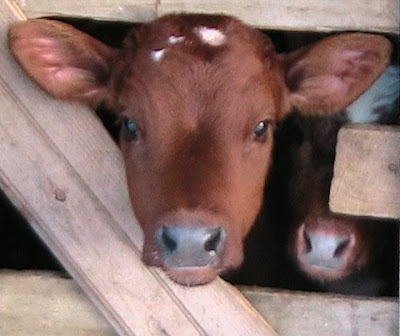
We have weaned the bull calves. Now nearing three months, they are old enough and able enough to chew, swallow, rechew, and swallow again the grains and grasses that will support their next increments of growth.
The weaning went smoothly. The calves didn’t seem to mind. Every feeding for several days in a row, Jordan and Jessica would give each calf his same half gallon of liquid, warm and white, while slowly lowering the milk to water ratio until no milk remained. Meanwhile, the calves were tempted round the clock with sweet molasses covered baby grain and plenty of tasty hay.
One good weaning enables another. With the calves weaned, we are once again in the milk, and nearly weaned ourselves from the dairy aisle at the grocery store. We no longer need to purchase milk, cream, ice cream, yogurt, butter, or ricotta cheese. We have our own—or at least, the raw materials with which to make what we need.
Weaning is good for us, no question.
But what about for the calves? Is weaning good for them too? Are we depriving them of what they most desire—the glorious elixir of a mother’s milk?
I am not into deprivation. I nursed three of my children to age three. Then there was a time when it was time, for both of us. I know too that mother cow when the time is ripe will turn her tail on a growing calf and nudge its nose away. But still, would it be better to delay the (pain of the) inevitable?
Researching the roots of the word “to wean” pushed my thinking along. It is easy to think of weaning as “withholding,” or as “detaching from something desired.” Whole fields of psychology have been built on the task of curing our primordial wounds, often rendered as a loss of the mother.
Yet the nub of the word itself comes from Old English, Germanic, and Latin words meaning “desire,” “hope,” “strive for,” and even “love.” Is this a contradiction?
I think again. Perhaps weaning is not about denying our desire as much as it is about enabling our desire to evolve in line with our growing selves.
There is wisdom in desire. I have been writing about it for months, OK years. Part of that wisdom, as I suggest, lies in the fluidity of desire. Desire moves—it moves us, it is itself a movement towards what we believe will grant us the pleasure we seek. At the same time, this movement is not arbitrary. There is a rhythm to it. As we move towards what we desire, we learn whether or not we were right. We create patterns of sensation and response to guide us in the future.
In other words, as we get the nourishment we need to grow, what we need to grow changes in line with the growth our nourishment has enabled.
So what does that have to do with weaning? As desire evolves, what we want changes. Desires we have had in the past fall away. No deprivation about it. No forced detachment. We simply don’t want what we once did. We wean.
Take the bulls. They don’t seem to miss the milk at all. They just started eating more grain, with its belly-filling bounty, and chewing more crunchy hay, with its long-lasting, teeth-resisting flavor. Weaning means having the opportunity to enjoy the qualities of these foods—foods that the calves need to stimulate their own capacity to transform food to energy to muscle and bone.
Here on the farm we have weaned ourselves from aspects of contemporary culture that once seemed indispensable—and not only Ben & Jerry’s. We don’t play video games or eat fast foods. We rarely visit a restaurant or a movie theater. We don’t have a television. It is not that we are trying to deprive ourselves of things to which we were attached. Rather, the desire for these things has fallen away as other activities have emerged for us as more desirable, more enabling, and simply put, possible here in a way they never were when we lived in the suburbs.
Like raising a pair of bulls as oxen! Only here has it become possible, desirable, and even easy. The kids are finding in themselves a conviction they never had to wean themselves of technologies that harm the earth, so as to make more of what they love about this place for everyone.
To wean: to find our freedom and align ourselves with the ever-evolving wisdom in our desires.
Showing posts with label farm family. Show all posts
Showing posts with label farm family. Show all posts
Tuesday, February 10, 2009


Tuesday, January 27, 2009
A Fierce Gratitude
It has been over a week since I wrote about “The Blanket Business.” Little did I know we had more to learn. When the temperatures plunged, the animals were fine—blanketed and not. There was one beast, however, whose blanket was not enough: the well house pump.
I should have guessed. Ever since we moved here, the pump has had a mind of its own. Located 200 yards up the hill behind our house in a cockeyed shack, eight feet down a rickety loose-runged ladder, at the base of a looming pressure tank, is a metal casket, the size of a basketball: our vital link to the bountiful waters below. When it froze once before, we developed our current practice of light bulb and blanket. But last weekend the light bulb had died, and the blanket alone was not enough.

*
We wake up on a frigid morning to a tell-tale sign: a limp stream falling from the kitchen faucet. Minutes later, Geoff is trudging up the hill with a new light bulb and a hair dryer, while I, having contracted the stomach bug, writhe on the couch. We stay connected with walkie-talkies. Two hours later, he is down again. The pump seems warm, but still no water. We decide to wait to see if the sun’s rise will change anything. He goes to play the piano. Why not? We have a concert coming up. Might as well make something beautiful amidst the uncertainty. I take a nap. The kids are playing.
When I wake up, Geoff is on his way back up the hill. Lo and behold, the pump is working! We have water--what a delight! We drink and wash and flush and hoard... until dinner time. Suddenly the flow slows to a trickle again. We stack our dishes next to the sink and go to bed. The temperature is below zero. Even if we thaw out the pump again, it will freeze overnight. We will deal tomorrow. Time to sleep.
The next morning’s light does a world of good for our spirits, but the water is not running. Geoff spends more time at the bottom of our well house. This time, nothing. We realize that we are over our heads and decide to call in the experts. Then there is nothing to do but wait—and melt icicles on the wood stove for our thirsty animals.
While waiting, I decide to dance. Why not? We have a concert coming up. Might as well create some beauty amidst the chaos. Between exercises, I pop out to gather more icicles.
After lunch, just as we are beginning to wonder whether we will be facing another waterless night, the cavalry arrive. Thirty seconds with a blow torch and our pump and tank are frost free. Amazing. Still the water won’t flow. Maybe there is ice in the pipe to the house?
The only problem is that there are two pipes leading out from the pump. One goes to the house and the other to some underground location where water to the barn once flowed. We don’t know which one is which! Our experts cut one. Thaw it. Snake it. Put water through it. No water in the house. They cut the other, thaw it, snake it, and pour water through. No water in the house.
Maybe the ice cube is where the main enters the house? Geoff musters his resolve to investigate. We don’t have a basement under our kitchen where the main is located. He will have to crawl ten feet through a space no more than two or three feet tall, past ancient beams, deserted spider webs, and recent rat poop. He does. Nope, the main is not frozen. So what?
We try some other faucets. Wait a minute! We do have water after all—in the bathroom and laundry room and upstairs—just not in the kitchen sink! Our experts identify the pipe leading from well house to house and turn off the other one. Our water pressure surges as never before—though still not through the kitchen tap.
Finally, at the end of our rope, we open the cabinet below the kitchen sink. There, are our new blue and red PEX pipes leading down into the crawl space. We touch them. They crackle. Frozen stiff. When the pump succumbed, so did they in a cascade of failures. Mystery solved, but not resolved.
We do chores and make dinner with water from the bathroom. Eat first. After the kids go to bed, Geoff goes back into the crawl space with the hairdryer. For fifteen minutes he massages those PEX pipes. Then, miracle of miracles: WATER! From the hot tap, from the cold tap, and into the dishwasher!
We spend the next forty-five minutes washing dishes, joyfully. Never before has it ever been this fun to wash dishes. What a luxury.
Between rinses, we think back over the two-day ordeal. Simply knowing that there was no water streaming into the house made it so difficult to do anything. Even having all the water we needed to drink, just knowing that we had no flow was so unsettling. It was hard to focus on anything else.
Yet, at the same time, the disorientation forced our attention on what was most vital to do. Suddenly, it seemed as if there was no time to waste. Nothing to waste. Everything was precious. We could only do something that was most vital—art.
We set out to make beauty—to transform the situation into a catalyst for creating something new. It wasn’t that we were trying to compensate for loss or fill in the gaps. Rather, we were responding to the urgency we felt to make something more out of the moment than it seemed to be giving. What we ended up making was a fierce gratitude—for water, for our abundance, and for life on the farm. For our dish-washing ability. Vital arts indeed.
Friday, January 16, 2009
The Blanket Business
It snowed just in time. The earth and her plants are tucked and snug under a blanket of soft white. Others of us are shivering in our boots. Forecasters predict that the temperature tonight will plunge to 20 below. Mother Nature’s limbo: How low can you go?
Here in the house, we will be toasty, thanks to a cheering wood stove, back-up oil burner, and stacks of blankets. But what about the animals? Those barns are mere windbreakers at best. All the heat those creatures will have is heat they make by themselves and for themselves with the food and water we provide. Will they be warm enough?
I am not worried about the chickens. Their downy fluff is what a body wants. The cats will curl into faceless furballs, wedged in the cracks between bales of hay. Nor am I worried about the three Jersey cows. They don’t even seem to notice the weather, stalking through snow in fingers-deep fur-coat fashion. I want to crawl in too. Which leaves Marvin and the baby bulls. Will they be OK?
I’ve been having long blanket discussions with the kids.
Jessica usually precipitates hers. “Mom, do you think I should put a blanket on Marvin?” She knows that I know what the Vet told us both: A healthy horse with a good winter coat and good nutrition should be fine in winter weather. Put a blanket on him and he will lose his own. Horses are that sensitive.
Still, when the thermometer drops to such abysmal depths, Jessica and I have come up with a compromise. Put on a blanket if it will be below 10 degrees at night. Take it off during the day if it’s sunny. We made it up, but even so, it seems just right for us. Jessica and I leave Marvin his coat until the cold starts making us feel uncomfortable. We need the blanket. Who knows what Marvin thinks. He seems warm enough, and furry too.
As we work out our plan, I recognize a parenting paradox with which I am quite familiar. We want those in our care to have the challenge and exposure they need to test their mettle, grow strong, and unfold what they have to give. But we also want to protect them from storms that might prove too overwhelming, with the opposite effects. In search of that perfect balance, we take the best information we have, and then guess and check. We make it up and feel our way through. Fingers crossed.
Jordan and I have worked out a different scenario for the baby bulls. Of course, the bulls came with their very own calf blankets (see New Arrivals!), but that was four weeks ago. They have grown; the bulls are bursting their buckles. Besides, Jordan wants his oxen-to-be to emit thick and winter-proof coats. He doesn’t want to coddle them with blankets.
I have some doubts. “Aren’t they too young to face that cold all by themselves?” Jordan doesn’t think so. He tells me a story.
“Mom, every morning when I bring them milk, they are eager and energetic, raring to go and not shivering at all.” I am moved a bit.
“But tonight will be very, very cold,” I offer.
“Well,” he explains, “they need each other! Mom, when I put on their blankets the other night, Bright got out of his; but Blaze was still in his blanket and Bright couldn’t curl up with him. So Bright was cold. If the calves have their blankets on, they can’t keep each other warm!”
He’s got me now. The calves will be warmer without their blankets. Brilliant, just brilliant. And just what I needed to hear. Why?
Jordan found it. A perfect solution to the paradox of parenting.
He found another logic. It is never just a choice between blankets or cold, protection or exposure. Risks are real. But in the face of undeniable risks, the greatest protection lies in the relationships we create to meet them. It all works when we respond to risks by creating the relationships that enable us to experience them as strengthening. The exposure makes growing the relationships necessary, desirable, and even possible. It is what we have been doing since moving here to the farm.
Jordan and I are no longer at odds over what will be best for the calves. We never were. We want the same thing: their health, his happiness. We now share a vision for how that can happen.
As he goes to bed, I am thinking about the calves, and I can tell that he is too. “I gave them lots of extra bedding and hay,” he says.
“Good.” I reply
“The digestion of dry hay generates heat,” he continues. “It will help make them warm.” And so I learn, every day. I smile and give him a hug. So our calves will spend the night eating and snuggling to stay warm. Things could be worse.
Wednesday, January 7, 2009
Cultivating Values
Sometimes I wonder why I, as a philosopher of religion and dancer, am writing a blog about life on a farm. How did I get here? Then I think again. Despite what it seems, this blog is not just about farming. It is about issues I have been working on for years: it is about the relationships we must to cultivate with ourselves and with others in order to survive as individuals, communities, and a planet.
How so? We are on the verge of an ecological crisis whose urgency is increasingly apparent. Voices from all over the world--scientists, philosophers, journalists, religious leaders, and scholars of religion--are all calling for changes not only in the way we transport our bodies, grow our food, and heat our homes, but in the values we rely on to guide us in doing so.
While our addiction to fossil fuels bears much of the responsibility for the warming of the planet, the deterioration of food-producing soil, and the pollution of water, air, and earth, so too do the values that have been guiding our use of them--values that privilege the individual human as the mastermind of the created order, existing over and above all others.
Instead, as commentators like Wendell Berry, Bill McKibben, Michael Pollan, and Sallie McFague aver, we need to cultivate values of interdependence, interconnectedness, and community. We need to value our relationships to each other and to the natural world as essential to our individual health and well being. Such ecological values, many argue, will foster care and compassion towards others, a sense of responsibility and a willingness to sacrifice. In cultivating such values, we will become better humans, and better citizens of this precious planet. Harvard scientist E.O. Wilson goes so far as to say that our spiritual well-being is at stake.
I agree. Still, I find that something is missing from these discussions of ecological values--something that I am learning from our life on the farm. What?
*
This past week we had quite a scare. Jessica comes in from chores, reporting an observation that concerns us all. Her Jersey heifer, Precious, has a swath of blood-streaked mucous on her tail--a sign of being in heat. According to our calculations, however, Precious should be seven months pregnant and two months shy of giving birth. We are counting on the milk she will make--for her calf and for us. How could she be in heat?
Our future is suddenly in flux. Will we have milk? Especially this summer during those two months when we give Daisy (our two-year old) a health-preserving break before she gives birth to her second calf?
The milk shortage we are currently experiencing due to our thirsty bull babes (see New Arrivals!) is already challenging. The thought of relinquishing our dairy independence completely is downright disheartening. Sure, we can always go to the store and grab a bottle (as well as a pound of butter, a carton of ice cream, yogurt, cream, and cheese and all the other goods we make from Daisy’s donations), but it feels so good not to be spending our dollars in support of fossil-fuel-driven agricultural practices that deplete our soils and warm our earth. We are completely dependent upon Daisy for this pleasure, as well as for her delicious milk. In this moment we know viscerally how dependent we are.
So what is it? Precious, are you pregnant?
*
What is missing from debates over ecological values is what a body knows. The model of ethics in play relies on the same mind over body sense of ourselves as individuals that critics critique. Somehow it is assumed that we simply need to articulate these new values, recognize their relevance, and then impose them on our wayward selves. It is diet plan logic. Just come up with a plan and stick to it. Tighten your belt. You have no choice. As Bill McKibben insists, the costs of doing nothing are and will be greater than the pain of making changes.
Nevertheless, the challenge is ever evident. People don’t just switch values, even if they can argue themselves blue in the face about why such values are rational, practical, and even life-saving. Scare tactics only go so far. People resist change unless the need for it strikes them in the gut. Thus critics aim to communicate a visceral sense of urgency by showing time-lapse photographs of the ice caps melting, and of polar bears swimming for miles in search of a solid surface. We are moved indeed, but not far enough. The polar bears, as endearing as they are, are too far from home.
In the shift to a fossil fuel economy, we have lost more than the family farm. We have lost the living contexts within which values of interdependence, interconnection, and community are necessary. The same life ways that are negatively impacting our environment are ones that also separate us from the experience of our sensory selves--from what our bodies know.
To cultivate ecological values, we need to know in our own sensory selves why those values are, dare I say, valuable. Our values grow in us. They take shape as patterns of sensation and response. We develop a sense of what to notice, how to evaluate it, and how to respond. If we are constantly making movements in our lives that reinforce our sense of ourselves as minds living in and over our bodies, our ability to embrace ecological values is limited.
We are the movements that are making us. Here on the farm the movements we are making are making us. They are making us into a family of persons needed to run the farm, yes, and into persons who appreciate our dependence on one another for sustaining our common project. We are members of a calf-caring team.
Yet even more, the challenges are providing us with an immediate sensory experience of our absolute dependence on the natural world--its elements, plants, animals, and other humans--for every aspect of our living. This is no mere “inter” dependence. We are nothing more or less than moments in greater currents of life that sustain our every waking moment.
*
Jessica decides to make some further observations. I go to the computer to research signs of early labor. What could it be? Was Precious ever pregnant? Will she give birth to a premature calf? Sounds messy. And dangerous.
Jessica enters the house, a burst of hope. “Dandelion is in heat! She and Precious have been sleeping in the same place. Maybe it’s not Precious... but Dandi.”
The sense of apprehension releases. It looks like we will have milk after all.
*
The change we need cannot be limited to imposing new values on our excesses. We need an experience of doing the work that is required to make and produce what we take for granted as given.
Milk hits closer to the gut than polar bears.
I am not suggesting that everyone should move to the country or buy a cow. But we will need to seek out adventures and experiences that give us a sensory education to our absolute dependence on the natural world for our food, our water, our warmth, our health, and our life. Such sensory education will help us grow the values that can guide us beyond this time when our current practices are no longer sustainable.
Tuesday, December 30, 2008
Bottle to Bucket
We have been having a lovely holiday week here at the farm. For Christmas, Santa brought a huge new wheel barrow filled with tools: a pitchfork and manure shovel, a feed bucket for Marvin and a water bucket for the chickens, and a new 75 foot section of hose. We even had our periodic thaw to help us with water transport!
Then there are the calves. A few days ago, Jordan walks into the house at the end of chore time, obviously frustrated. "I am beginning to question Blaze's intelligence," he quips.
I stop and listen. "Why?"
"Well, he refuses to drink from a bucket! I even tied him up and put the bucket right in front of him, and he just stands there--obviously hungry--and moos." Jordan sighs. "He won't drink from the bucket unless I put my fingers in there so he can suck on them." I now see Jordan's dripping hand. Meanwhile, Bright happily slurps his quotient of Daisy milk from a bucket without a fuss.
So what is with Blaze?
I have some sympathy for the little creature. It is not the easiest transition to make. A calf is born wanting to suck, head up, preferably on some soft and resilient oblong protrusion that hangs from the sky and dispenses sweet warmth. The sucking motion in this tipped-up position is beneficial. It stimulates the salivary glands and aids digestion; exercises head and neck muscles; and connects the calf with a source of heat and protection: mom. I imagine Blaze asking: So what's this puddle in pail?
I think back to what I have written in What a Body Knows (and sketched on April 1 in this blog): nurture and nourish are forever entwined. Perhaps it is no different for cattle. It is not merely milk that Blaze wants. He wants to suck. He wants to nuzzle. He wants his mom.
"I don't think it is a problem to feed him on a bottle for a while," I suggest.
"But it isn't convenient," Jordan replies. "It is hard to hold the bottle for Blaze while giving the bucket to Bright. It would be so much easier if he just drank from a bucket!" I recognize this logic all too well. Parenting by convenience. Oh how I know! Still, I also know that a calf, like a child, is a force of nature. If you oppose it, even if you win, you lose. Jordan knows too.
I remind him. "Well, you know from riding--when you want to stop a horse, what do you do? You don't sit back and yank on the reins. You tug and release, tug and release, tug and release. Try that with Blaze. If he rejects the bucket, give him the bottle for a feeding or two, then give him the bucket again. Give him a little time to get used to the idea." Jordan nods.
 *
Meanwhile, I am still wrestling with calf care issues of my own--related to the kids and their ability to work together (see Dec 17). I am still seeing faces that pout and hearing voices that complain of being left out.
The Family Council I described in the last post had been highly successful as far as it went. We had worked out a framework for a different way of thinking: our calf-caring team. We had staged a shift to a more harmonious way of being. Yet feeling that shift and making it happen was proving another matter.
In our councils, the format is simple. Each person has a chance to speak. More than that, each person has a chance to be heard by the very persons who are provoking concern. In that hearing, I guide the listeners to mirror the speakers--restate what the person said, don't respond, just say it again, let them know that you really get what they are saying. It is a basic relationship tool for enhancing communication. And it works. You can see the tension melt from young shoulders who feel finally released, finally heard.
But hearing only goes so far. A shift towards resolution needs to occur, and it does when persons involved recognize that they share a common desire. In this case, it was obvious to the kids. They each wanted the calves; they wanted the calves to be healthy and happy and well tended; they wanted to be the ones to help. In the end, after everyone shared and was heard, the kids could see, even without my prodding, that they all wanted the same thing: to be recognized by the others as an important, necessary, and effective member of the calf-caring team.
It wasn't quite enough. I too had to tug and release. Tug and release. I had to give the kids time to get used to the idea. To feel it. To live it. So we kept talking.
As the week progressed, we realized more: it has to do with trust. Building trust. Blaze has to learn to trust Jordan. The kids have to learn to trust one another--really trust each other to want what they say they want. Let it sink in. So we work on that trust. Tug and release. Letting it be real.
*
A couple of days later, Jordan and Jessica come in together at the end of chores, smiling broadly. "Blaze did it!" Jordan announces.
"He drank from the bucket!" Jessica adds.
"Perhaps he is intelligent after all," Jordan grins. I never had any doubts.
"These calves are teaching me patience," Jordan adds with a triumphant sigh.
Me too.
Happy New Year to All!
Then there are the calves. A few days ago, Jordan walks into the house at the end of chore time, obviously frustrated. "I am beginning to question Blaze's intelligence," he quips.
I stop and listen. "Why?"
"Well, he refuses to drink from a bucket! I even tied him up and put the bucket right in front of him, and he just stands there--obviously hungry--and moos." Jordan sighs. "He won't drink from the bucket unless I put my fingers in there so he can suck on them." I now see Jordan's dripping hand. Meanwhile, Bright happily slurps his quotient of Daisy milk from a bucket without a fuss.
So what is with Blaze?

I have some sympathy for the little creature. It is not the easiest transition to make. A calf is born wanting to suck, head up, preferably on some soft and resilient oblong protrusion that hangs from the sky and dispenses sweet warmth. The sucking motion in this tipped-up position is beneficial. It stimulates the salivary glands and aids digestion; exercises head and neck muscles; and connects the calf with a source of heat and protection: mom. I imagine Blaze asking: So what's this puddle in pail?
I think back to what I have written in What a Body Knows (and sketched on April 1 in this blog): nurture and nourish are forever entwined. Perhaps it is no different for cattle. It is not merely milk that Blaze wants. He wants to suck. He wants to nuzzle. He wants his mom.
"I don't think it is a problem to feed him on a bottle for a while," I suggest.
"But it isn't convenient," Jordan replies. "It is hard to hold the bottle for Blaze while giving the bucket to Bright. It would be so much easier if he just drank from a bucket!" I recognize this logic all too well. Parenting by convenience. Oh how I know! Still, I also know that a calf, like a child, is a force of nature. If you oppose it, even if you win, you lose. Jordan knows too.
I remind him. "Well, you know from riding--when you want to stop a horse, what do you do? You don't sit back and yank on the reins. You tug and release, tug and release, tug and release. Try that with Blaze. If he rejects the bucket, give him the bottle for a feeding or two, then give him the bucket again. Give him a little time to get used to the idea." Jordan nods.
 *
Meanwhile, I am still wrestling with calf care issues of my own--related to the kids and their ability to work together (see Dec 17). I am still seeing faces that pout and hearing voices that complain of being left out.
The Family Council I described in the last post had been highly successful as far as it went. We had worked out a framework for a different way of thinking: our calf-caring team. We had staged a shift to a more harmonious way of being. Yet feeling that shift and making it happen was proving another matter.
In our councils, the format is simple. Each person has a chance to speak. More than that, each person has a chance to be heard by the very persons who are provoking concern. In that hearing, I guide the listeners to mirror the speakers--restate what the person said, don't respond, just say it again, let them know that you really get what they are saying. It is a basic relationship tool for enhancing communication. And it works. You can see the tension melt from young shoulders who feel finally released, finally heard.
But hearing only goes so far. A shift towards resolution needs to occur, and it does when persons involved recognize that they share a common desire. In this case, it was obvious to the kids. They each wanted the calves; they wanted the calves to be healthy and happy and well tended; they wanted to be the ones to help. In the end, after everyone shared and was heard, the kids could see, even without my prodding, that they all wanted the same thing: to be recognized by the others as an important, necessary, and effective member of the calf-caring team.
It wasn't quite enough. I too had to tug and release. Tug and release. I had to give the kids time to get used to the idea. To feel it. To live it. So we kept talking.
As the week progressed, we realized more: it has to do with trust. Building trust. Blaze has to learn to trust Jordan. The kids have to learn to trust one another--really trust each other to want what they say they want. Let it sink in. So we work on that trust. Tug and release. Letting it be real.
*
A couple of days later, Jordan and Jessica come in together at the end of chores, smiling broadly. "Blaze did it!" Jordan announces.
"He drank from the bucket!" Jessica adds.
"Perhaps he is intelligent after all," Jordan grins. I never had any doubts.
"These calves are teaching me patience," Jordan adds with a triumphant sigh.
Me too.

Happy New Year to All!
Wednesday, December 17, 2008
New Arrivals!
Friday night the storm is raging--wind-rain-snow all at once. When we wake on Saturday, so does the golden sun, streaming through ice covered tree branches, dancing across dazzled white lawns, and illuminating a wafer thin full moon, hovering just above the horizon. It is beyond beautiful. And cold. It is the day we are to pick up our baby bulls.
It takes us half an hour to de-ice the car--scraping and melting and scraping frozen sheets from its surfaces. Thank goodness it isn't a plane. Geoff crawls through the side doors to jimmy open the front ones. Finally the windows are clear and Geoff and Jordan are on their way. The rest of us stay behind to finish the pen preparations—washing grain and water buckets, and fluffing up bedding hay.
An hour later, the car drives up, as if it were an ordinary day. This time, however, the car is carrying cattle. The two rows of back seats are down and covered with blankets. And there are our bulls, of the Milking Shorthorn breed, cruising in casual comfort. Jordan has named them Bright and Blaze—two names, easy and related, and not to be confused with the handful of verbal commands they will have to learn to become a team of oxen.
Will I know which is which?
I peek in the front door. It is obvious. Blaze, the smaller of the two, is standing up, his red head gently bumping the ceiling. His brown eyes are fixed on me. Who are you? he asks. His face is flecked with white (or premature gray?) and marked with a large white cyclone splotch. Jordan reports Blaze rode on all fours the whole trip, lurching back and forth, surfing the winding roads of rural NY.
Curled up behind him towards the back is the slightly larger and redder bull Jordan has named Bright. He does not look so happy. He reminds me of Ferdinand. Each one has on a calf coat—somewhat like the ones you see on small dogs but larger—fastened around his front and back legs.
My first impression: oh they are so cute!
We open the trunk door and Jordan wraps his arms around Blaze, who has stepped over Bright to get to the door first. Jordan makes it a few steps before Blaze wriggles away, landing on his back in the snow, legs sticking in all directions, Jordan’s arms still around his neck. The two of them freeze there for an instant, wondering what comes next, before Blaze flips himself over and peeks curiously into the barn. Geoff carries Bright, and soon the two of them are nosing around their new home. Spacious! Cold! Nice view! And all these small people!
Blaze scampers about, running in crazy circles, kicking up his hind legs. He buzzes and hums with energy. Bright mopes in the corner and coughs slightly. I feel a grip of maternal worry. Already? They haven’t even been here five minutes!
So what are we going to do with these fine furry beasts?
Feed them. Steer them. Train them.
The feeding is introducing an element of competition to our otherwise overly abundant milk flow. The bulls drink cow milk, of course. They are only babies—4 and 5 weeks old. And the cow milk we have to give them is Daisy’s. We have been milking a little more than a gallon at each milking, twice a day. Each calf needs to drink a half-gallon, morning and night.
You can do the math. We are scraping the bucket! Still, we have a plan. We are feeding Daisy more grain and hay over the next few weeks to boost her flow, and then in another month or so, we will wean the calves to grain and hay themselves. At this morning’s milking, Jordan squeezed out nearly two gallons. Thank you, Daisy! Then in March, Precious is due to give birth and we will be milking two cows! So we are consoling ourselves. It is only a temporary hardship.
As for steering, it turns out that the best time to do so is right before puberty, which occurs around six months. Before then, the male hormones the bulls produce are actually helpful, fueling healthy growth. Only with puberty does testosterone turn testy. We will be sure to call the Vet in three months. Before then, the bulls will be bulls.
As for training, it has already begun, though it is not clear who is training whom. Ostensibly, humans train cattle, the first step being to shower them with affection--a resource we have in ample supply. In fact, figuring out how to allocate all that attention has been our first challenge. Each of the children wants to be with the calves, caring for the calves, feeding the calves, leading the calves, and not one of them wants to be left out. Each one of them is also convinced that the others want to leave him or her out. So one child slips out to the barn to give the calves a secretive pat, and the others howl with the injustice of it all.
It is a high quality problem, really, and one whose value I appreciate. How are the kids supposed to know already how to work together to take care of baby bulls?
When similar issues arose last spring with our horse, Marvin, I quickly figured out that I could respond with acute and exasperated frustration—my heart wretched and my face blue—or I could embrace the moment as an opportunity to learn. Let’s work together on working together!
We gather in a Family Council. Forty-five minutes of concentrated chat time later, we are on our way—each child knowing that he or she is an essential member of a calf-caring team, with Jordan as our captain. Each one appreciating the others as enabling him or her to have bulls at all.
Last night Jessica comes in from the barn after giving Marvin some hay. "Did you pat the calves?" I ask. "No," she replies, "I didn’t want Jordan to feel left out." I smile. OK, so we still have some small adjustments to make. I reply, "Jessica, if you are out there, it is fine to pat the calves. They need all the love we can give them."
So who is training whom?
Once again, the farm is making its family.
(See "Forward to the Farm," Oct 15)

It takes us half an hour to de-ice the car--scraping and melting and scraping frozen sheets from its surfaces. Thank goodness it isn't a plane. Geoff crawls through the side doors to jimmy open the front ones. Finally the windows are clear and Geoff and Jordan are on their way. The rest of us stay behind to finish the pen preparations—washing grain and water buckets, and fluffing up bedding hay.
An hour later, the car drives up, as if it were an ordinary day. This time, however, the car is carrying cattle. The two rows of back seats are down and covered with blankets. And there are our bulls, of the Milking Shorthorn breed, cruising in casual comfort. Jordan has named them Bright and Blaze—two names, easy and related, and not to be confused with the handful of verbal commands they will have to learn to become a team of oxen.
Will I know which is which?

I peek in the front door. It is obvious. Blaze, the smaller of the two, is standing up, his red head gently bumping the ceiling. His brown eyes are fixed on me. Who are you? he asks. His face is flecked with white (or premature gray?) and marked with a large white cyclone splotch. Jordan reports Blaze rode on all fours the whole trip, lurching back and forth, surfing the winding roads of rural NY.
Curled up behind him towards the back is the slightly larger and redder bull Jordan has named Bright. He does not look so happy. He reminds me of Ferdinand. Each one has on a calf coat—somewhat like the ones you see on small dogs but larger—fastened around his front and back legs.

My first impression: oh they are so cute!
We open the trunk door and Jordan wraps his arms around Blaze, who has stepped over Bright to get to the door first. Jordan makes it a few steps before Blaze wriggles away, landing on his back in the snow, legs sticking in all directions, Jordan’s arms still around his neck. The two of them freeze there for an instant, wondering what comes next, before Blaze flips himself over and peeks curiously into the barn. Geoff carries Bright, and soon the two of them are nosing around their new home. Spacious! Cold! Nice view! And all these small people!
Blaze scampers about, running in crazy circles, kicking up his hind legs. He buzzes and hums with energy. Bright mopes in the corner and coughs slightly. I feel a grip of maternal worry. Already? They haven’t even been here five minutes!
So what are we going to do with these fine furry beasts?
Feed them. Steer them. Train them.
The feeding is introducing an element of competition to our otherwise overly abundant milk flow. The bulls drink cow milk, of course. They are only babies—4 and 5 weeks old. And the cow milk we have to give them is Daisy’s. We have been milking a little more than a gallon at each milking, twice a day. Each calf needs to drink a half-gallon, morning and night.
You can do the math. We are scraping the bucket! Still, we have a plan. We are feeding Daisy more grain and hay over the next few weeks to boost her flow, and then in another month or so, we will wean the calves to grain and hay themselves. At this morning’s milking, Jordan squeezed out nearly two gallons. Thank you, Daisy! Then in March, Precious is due to give birth and we will be milking two cows! So we are consoling ourselves. It is only a temporary hardship.
As for steering, it turns out that the best time to do so is right before puberty, which occurs around six months. Before then, the male hormones the bulls produce are actually helpful, fueling healthy growth. Only with puberty does testosterone turn testy. We will be sure to call the Vet in three months. Before then, the bulls will be bulls.
As for training, it has already begun, though it is not clear who is training whom. Ostensibly, humans train cattle, the first step being to shower them with affection--a resource we have in ample supply. In fact, figuring out how to allocate all that attention has been our first challenge. Each of the children wants to be with the calves, caring for the calves, feeding the calves, leading the calves, and not one of them wants to be left out. Each one of them is also convinced that the others want to leave him or her out. So one child slips out to the barn to give the calves a secretive pat, and the others howl with the injustice of it all.
It is a high quality problem, really, and one whose value I appreciate. How are the kids supposed to know already how to work together to take care of baby bulls?
When similar issues arose last spring with our horse, Marvin, I quickly figured out that I could respond with acute and exasperated frustration—my heart wretched and my face blue—or I could embrace the moment as an opportunity to learn. Let’s work together on working together!
We gather in a Family Council. Forty-five minutes of concentrated chat time later, we are on our way—each child knowing that he or she is an essential member of a calf-caring team, with Jordan as our captain. Each one appreciating the others as enabling him or her to have bulls at all.
Last night Jessica comes in from the barn after giving Marvin some hay. "Did you pat the calves?" I ask. "No," she replies, "I didn’t want Jordan to feel left out." I smile. OK, so we still have some small adjustments to make. I reply, "Jessica, if you are out there, it is fine to pat the calves. They need all the love we can give them."
So who is training whom?
Once again, the farm is making its family.
(See "Forward to the Farm," Oct 15)

Subscribe to:
Posts (Atom)

 Posts

