Showing posts with label desire. Show all posts

Wednesday, March 16, 2011

Spinoza and the Steers

I spent last week reading Spinoza, rounding up steers, and reveling in the early spring.

Benedict de Spinoza (1632-77) was a Dutch philosopher whose masterwork, Ethics, presents arguments for the nature of God and human using the form of geometric proofs—axioms, propositions, definitions, explanations, and all. I decided to spend some time with him after coming upon his name, yet again, in another work of environmental philosophy. Contemporary writers, like Jane Bennett and David Abram, are appealing to Spinoza for help in anchoring concepts of the natural, material world that will encourage human compassion for the earth as a whole.

Two of Spinoza’s claims in particular are in constant rotation. For one, he uses the phrase “God, or Nature,” maintaining that God and Nature share one, infinite "substance." Second, he insists that every body, human and otherwise, insofar as it exists in God/Nature, is animated by its own “striving to persevere.” Every body, animal, vegetable or mineral, at every scope and scale, acts so as to increase its power of action.

Citing these two ideas, philosophers conclude that humans ought to honor other earth bodies as having agency and intelligence, and so desist from acting as if only humans matter.
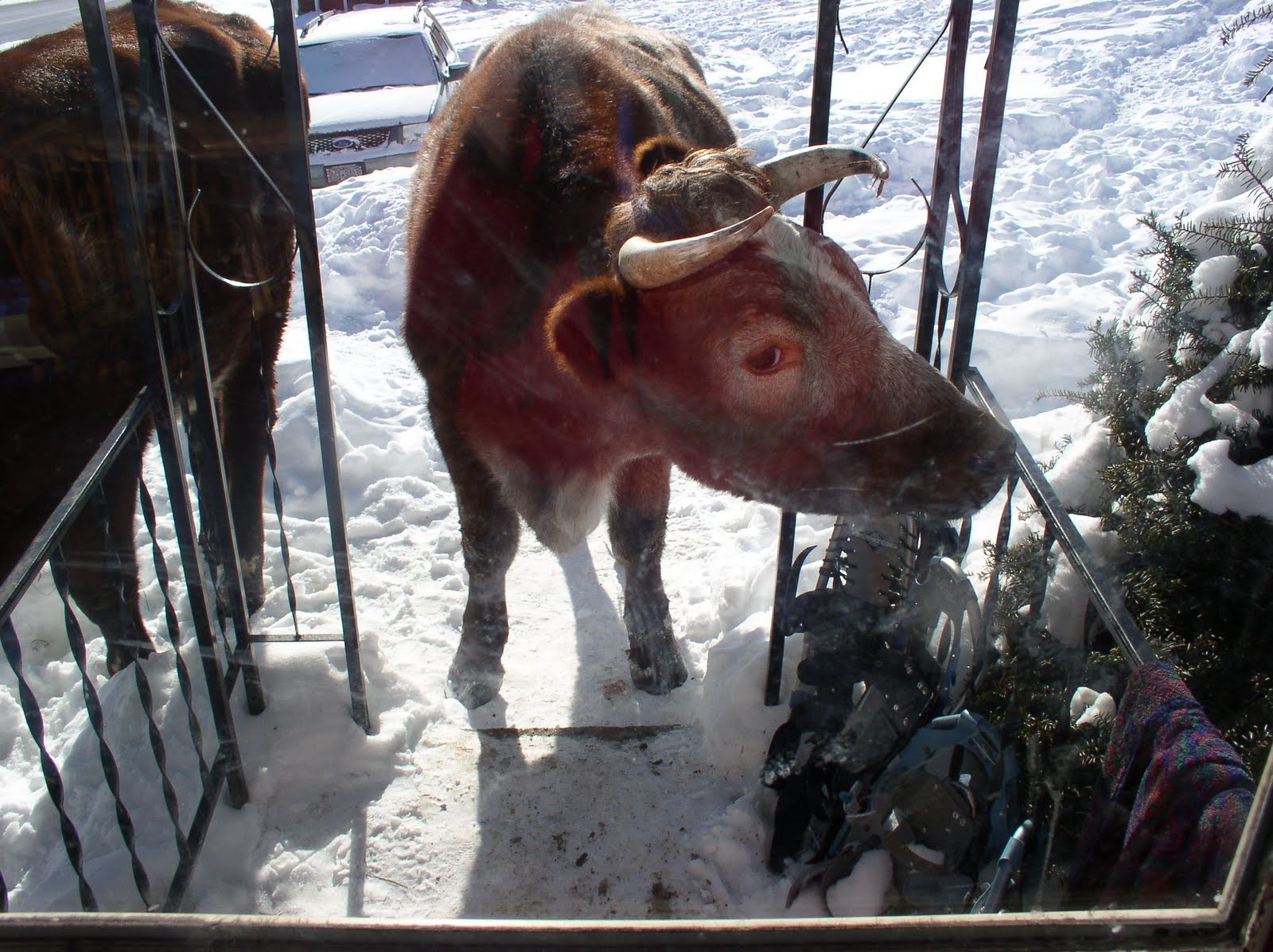
As I am pondering Spinoza’s proofs, Bright and Blaze, the two-year-old Milking Shorthorn steers that my son is training, decide that they are tired of their pen. They have plentiful hay and cool water, in a sun-filled shelter ringed by seemingly redundant ropes of barbed wire—all of which they ignore. Slipping into the barnyard, the 1500-pound, red-brown and speckled pair make their way to the front door of our house. They tip over the wooden bucket in which we crank ice cream, and begin licking the briny dregs.

Coming into the kitchen for a cup of tea, I see a huge head through the window. Then another. Rather than return to Spinoza, I pull on boots, coat, gloves, and hat, and begrudgingly blink my way into the sunshine. I approach Bright, the largest of the two, with halter in hand. He cavorts away, kicking his heels in the air like a newborn lamb. With large horns. I have to laugh. Is he the intelligent, animate, striving to persevere that Spinoza has in mind?
*
Spinoza’s Ethics is different than I imagined. Rather than the environmental treatise that its contemporary uses imply, the Ethics is an extended apology for “a life of the mind.” God and Nature, mind and body, are what they are such that humans find their greatest happiness when reading and writing, preferably in the company of like-minded friends. According to Spinoza, it is knowledge of God—not chasing steers—that yields the highest human joy. As he writes, “In life… it is especially useful to perfect, as far as we can, our intellect, or reason. In this one thing consists man’s highest happiness, or blessedness.”

Why? The argument goes like this. God is infinite substance, the cause of itself, freely operating according to the laws of its nature—which, for Spinoza, are the eternal laws of nature. God is a thinking being, whose substance also appears in the mode of extension. God’s intellect is thus the immanent cause of every finite and fleeting thing.

Given this scene, humans too exist in God as a part of nature, as one kind of body among many others, constantly affecting and being affected by other bodies. However, humans are the part of nature that is capable of understanding all bodies, including their own, as equally modes of God, that is, “under the species of the eternal.” And understanding bodies in this way, according to Spinoza, yields utmost joy.

Why? For two reasons. First, even though mind and body share in one substance (God, or Nature), Spinoza insists that the knowledge our minds receive about the world through our bodily senses is “mutilated and confused.” It is distorted by our bodily location and our sensory limits. Second, for Spinoza, all of the so-called pleasures associated with the material world are not. Sensory pleasures come and go, leaving in their wake a sadness that confuses and dulls the mind.

Reason, however, can address both sources of discomfort. Using reason, we can “purify” and “heal” our sensory knowledge by forming “adequate ideas.” Using reason, we can also cultivate an ability not to be affected by external, material, or natural causes that might distract us from such understanding. In both cases, then, using our reason answers our own striving to persevere, and thus yields the promised joy.

Not exactly what the environmentalists are after. Where is the care and compassion for the welfare of the natural world?

I contemplate the issue while contemplating my next move with the steers. They are truly huge. Standing beside them, I feel small and weak. I know that they would not intentionally hurt me—my son has trained them well—but there is simply no reason that they need to do what I want them to do. They could overpower me with a twist of the head. They don’t.

I watch as they tussle with one another, roam among the spare bales stacked in the barnyard, and trot away each time I approach. The steers want to be out. It is as if they smell spring. They sense something new and want to participate in it by making new moves of their own. They want to let loose the capacities for cavorting that lie dormant beneath their winter shag. I don’t blame them.

I decide to ditch the halters and try a thin stick. Gently tapping from behind, I steer the steers towards their pen. At the gate, they veer away and go back across the road to the spare hay bales. I move with them and tap them back towards the pen. Back and forth we go. I move with them some more, until finally, they move with me, back into their pen, where they circle their own waiting bale.

I return to Spinoza, and the steers pull my thoughts in a direction that is both new and familiar. Spinoza too could make another move. When confronting the selectivity of our senses and the short-lived duration of sensory pleasures, Spinoza doesn’t have to yoke his reason to an intellectual love of an eternal God.

What if, instead of seeking refuge in an idea of eternal truth, we chose to cultivate a capacity to move with the rhythms of the material world? And with the rhythms of our own desires?

As Spinoza admits, human bodies are acutely impressionable, affected at all levels in myriad ways by a vast array of human, nonhuman, and elemental others. This sensitivity, I would add, is not simply passive. As our bodies are moved by people, places, and things, we learn how to move for ourselves. We learn about the power of our own bodily movement to connect us with other bodies and forces that sustain our ongoing life. That power consists of an ability to create and become new patterns of sensing and responding that align our well being with the challenges and opportunities of the moment.

What if our distinctive humanity lies in this ability to learn from other earth bodies, from the rhythms, cycles, and seasons of bodily nature, about our own capacity for making the movements that make us who we are--able to connect, able to love?

Humans do need an idea of Nature as divine, whole, and worthy of devotion, but we need more as well. We need to submit ourselves to forces and movements larger than ourselves, to which we must respond, and so catalyze a sensory awareness of our own bodily movement and how it is making us able to think and feel and act as we do.

When we do, we will have what we need to recreate our relationship with the "more than human" world (Abram). We will have the capacity to feel the pain and sadness of the natural world as a call to move differently—to find ways of thinking, feeling, and acting that connect us in mutually-enabling ways with the body of earth and bodies of earth, including our own.

It is what a body knows.

It is what my time with Spinoza and the steers is teaching me.
*
Later in the day I walk into the kitchen, and find Blaze peering at me through the window. Again?!

This time, the steers do not let me close enough to tap. Kyra volunteers to help. She is nine, all of four feet tall and seventy pounds. She approaches Blaze gently, the halter behind her back. She scratches him under the chin, and while I blink, slips the halter over his hooked horns. She does the same with Bright. Mesmerized, I help her lead them into their pen. I follow. They follow. This time, we tie them up.

It will be best for them, I reason. They will be safe from passing cars, in easy reach of food and water. They depend on me to take care of them. Yet, my heart quails. They are tied up, against their will. I feel their pain. So moved, the thought forms. I vow to build a new fence as soon as the ground thaws—a solid wooden fence that will be strong enough to keep them in and large enough to give them room to frolic.

I need it.

Thursday, December 24, 2009

Mary and Mrs. Claus

I woke up this morning in the dark, a deep, deepening dark. For a fraction of an instant I wondered. Will this darkness end? Will it ever be light again? Is it true that I (along with the rest of the hemisphere) am poised to swing back on a grand arc of time toward the sun? Or might this darkness engulf me in an eternal night?

The dark is pregnant with possibilities.
*
Many tell the Christmas story, and many of those tellings focus on the Christ child. He was conceived. He was carried. He is born. He lives, a divine Presence, with us.

Nevertheless, hidden within all those passive verbal constructions following his name is the one without whom he wouldn’t have happened: Mary.

For me, the Christmas story is about Mary.

Mary conceives. Whether you translate virgin as “young maiden” or “without sex,” the thrust of the story is the same. Young Mary needed no other human person to begin her journey into motherhood. The mother matter was between her and god, a purely personal relationship: god is with her, in her full bodily self, and she opens to say yes. Yes to desire. Yes to her self. My soul doth magnify the lord. Her innermost sensory self is where god will be grown.

Mary carries. In saying yes to her god-self, she says yes to entering the darkness. She is pregnant for the first time. She is not wed. The outcomes are far from clear. Will she live? Will her bodily self know what to do? Will her baby live? Will she be shunned into eternal night? Or embraced by the arms of welcoming kin? How could her sparkling yes not be shrouded with fear, doubt, despair, and loneliness?

Only Joseph is with her as they set out together for Bethlehem, leaving behind hearth and home, riding for miles, for hours, for days, nine months pregnant, on the back of a donkey. What sustains her through the taxing physical, emotional, spiritual ordeal?

Jesus, of course, moves in the darkness too, but his is a warm uterine wrap. He is along for a rhythmic ride, waiting for the waves of her contractions to wash him onto the sands of an air-born world. In her dark night, it is his movement within her that comforts her. He is alive. She can feel it. She has reason to believe.

Mary gives birth. She is waiting in a stable, dark and cold. Joseph is there, but what does he know about birth? What does she know? A sweet smell of coarse hay mixes with animal breath.

There, Mary labors. Wave after wave, she slowly opens to release the life in her. She gives birth to a curled infant, unbelievably small, who, however cry-free he may be, is helpless. He is completely dependent on her. She is the one who holds him, warms him, wipes him, and feeds him rich milk from her body.

He is present with her—and with us—because of what her body knows. She creates patterns of sensing and responding in relation to him that let him live, with her, with us.
*
The birth we celebrate at Christmas is more than a beginning. It is the end of a long journey in which Mary gives birth to herself as a birth-giver. She is the one who opens in the darkness, to the darkness, willing to conceive (of) a light that would not appear for months to come. She is the one who carries it as it quickens, and brings it forth, as a new life beginning. She is the one whose bodily movements enable him to live.

The movements she makes in conceiving, carrying, and birthing make her into someone who can and does participate consciously in the rhythms of her bodily becoming.

He is with us because of what her body knows.
*
There are times in all of our lives when darkness threatens to engulf us. Whether it is fear or anxiety, depression or despair, we wonder whether the light will ever return, or whether indeed, we will be dwell forever in eternal night.

It is to such moments that the Christmas story speaks. For we remember Mary. We remember her, in her bodily self, opening to sense and receive the quickening of new life in her.

With Mary, we affirm the creative power of our own bodily selves—a power to open to the movement of the divine in us, that is continuing to create and become, despite the darkness that overwhelms. When we open to this power, we will find the arms that embrace us, the relationships that sustain us, the Presence of light with us.

For our bodily selves were pulled into existence by the rhythm of light and dark, day and night, that enables all things to grow. As long as we breathe and beat and wake, that rhythm is alive in us. We can cultivate a sensory awareness of it, opening to receive the movements that are making us. We so participate in bringing into being a world we love that loves us.

The American dancer, Ruth St. Denis, wrote a poem called “Eternal Mary.” The last stanza is this: “We are all Mary/ Waiting to conceive/ And bear the Christ Child.”

This, for me, is the meaning of Christmas.
*
How did the story of a young woman delivering Presence morph into a tale about an old man delivering presents? It is a topic for another day.

Still, I wonder. Whose sack is it from which he pulls his gifts? Who remembers which child got which gift from year to year? Who gave him directions?

I suspect that if we want the full story, we will have to ask Mrs. Claus.

Thursday, October 22, 2009

Parenting, Writing, Blogging, and other Radical Acts

I just can’t do this!! The thought blasts through my brain at least once each day in those hours before Geoff comes home. It’s my fault, for sure. There is so much I want to do, so much I have to do, and so much being asked of me moment to moment by the four of our kids I agreed to home school this year that I go through the day feeling like I have one foot on the accelerator and the other on the brake. I lurch and buck and careen, and yes, sometimes crash.

This arrangement seemed like a good idea at first. I have an infant. My 12 and 8 year-old daughters, Jessica and Kyra, were begging to learn at their own home-spun pace. I would do my work in the cracks, around the edges, and after Geoff and our 14 year-old arrive home; 4 year old Kai would come along for the ride.

As for the reality: I’ll be discussing the "Declaration of Independence" with Jessica, interjecting asides to Kyra on short cuts for multiplying nines, while trying to nurse and nap infant Leif, when Kai demands, with every amp of his ample wattage: SOMEBODY PLAY WITH ME NOW! At least I am sitting down.

If all the pieces of the mighty puzzle line up and I manage to write down a thought, it is highly unlikely that I will succeed in placing a second before someone wakes up, gets hungry, has a question, or needs a wipe. By our 3:30 hand-off, my work is curdled into an icky pit in my stomach. It wants out. I want out, now!

It is confusing. All of our best decisions have landed me here. How come it is so hard?
*
Michael Chabon and Ayelet Waldman are in the news again, this time with his contribution to the burgeoning genre of Parenting Lit. In twin memoirs (hers appeared in the spring), this team of mom and pop writers tell tales of what they are learning from life with their four children, ages 14, 12, 8, and 6. At back to back desks, they weave the personal and the public, family and work, coupling and parenting into vibrant texts, written and lived.

Reading about their life, a pang of recognition hits: Geoff and I are making similar moves. We aim to co-parent and co-create, side by side reinventing family life, though in rural New York rather than Berkeley, California. We moved here to create a way of living, of being family, that works for us, for our kids, for him, for me, where each person receives what he or she needs to become who he or she is. So why does their situation sound so idyllic?

The stories of Michael and Ayelet remind me: though I may feel like I am alone in the trenches, I am not. A veritable rash of writers, male and female, are sharing their kid-funded knowledge in books and blogs to a chorus of critics and congratulators. So what of it?
*
I ponder the question as I spread peanut butter on home-made bread for a hungry Kai. Last week’s news offers a key. In addition to reviews of Chabon’s book, we have been feasting on reports about how much has changed in family life since the 1970s. Marriage is at an all time low; single moms and stay at home dads at all time highs. More parents cross the chasm between workplace and home than ever before, while childhood stretches towards twenty and beyond.

While the realities are shifting dramatically, however, it is also evident that the ideals shading family life are not so quick to turn. We are still contending with visions of the good mother and providing father, as well as those of passionate life-long love and a happy childhood, that loom over us as critic and judge.

Wiping the counter for the third time in an hour, I think back to Tuesday's article on toxic parents as a case in point. As the author writes, “whining about parental failure, real or not, is practically an American pastime that keeps the therapeutic community dutifully employed.” In the deluge of responses the article produced, a pattern emerged of kids protesting narcissistic parents and parents complaining about ungrateful kids. Lurking in the shadows was an ideal of parenting that hardly anyone seems able to attain. Why?

In the light of these reports, the significance of Parent Lit appears. We, as a culture, are in the process of reinventing family life. That reinventing is happening household by household, and reading and writing about such experiments is helpful and necessary, though not without its dangers.

Hearing stories about how other parents tackle inherited expectations of rearing and raising reminds us that there are options. We have options, and we are not alone in wanting to find them. Ways of being family that worked for someone at sometime in some context may not work now for me or for you. I write to find my freedom.

Sharing stories is also necessary, given the nature of the change. We are exiting an era in which cultural authorities did not pay much attention to children as having anything to offer discussions of who they should be and become. Such reflections were the provenance of experts wielding scientific tools over and against nubile bodies. Stories remind us that we have something to learn from (our) children about how best to relate to them. I write to remember the creativity involved in creating relationships.

Writing about experiences is also dangerous for we run the risk of suggesting that one size fits all. There is a temptation to celebrate sentimentally our kids’ eternal cuteness, and another to wax nostalgic for childhoods lost. When changes breed fear and doubt, we tend to cling to the way things were. Sides polarize and we forget what anyone who cares enough to engage in these discussions shares: desire. We share a desire to do the best for our children, for each other, for ourselves, and, for the worlds in which we live. I write to find the wisdom in my desire.

Reading and writing, we learn to trust our dissatisfaction as teaching us how to move in ways that will not recreate the pain we feel. I write to discern what it is my body knows.
*
Yesterday morning I lost it. I was shredded to a pulp by competing pulls on my attention. During precious writing time, I return to the scene. What do I find? It’s the ghost of the good mother, haunting me: It is your job to meet your children’s needs. This all-too familiar noose of a notion strangles me. I erupt in anger when I can’t, furious with myself. Furious with them.

Of course, I know theoretically that I cannot meet my children’s needs. Even if I had only one child, I would not be able to meet his or her every need. But still, I want to. Why? Because I want to be a good mother! But is that what being a good mother means? It’s what I have learned to believe.

The tip of my pen draws out the hook. If I am to slip free of this need to meet my children’s needs, I have to let go of a lingering expectation that my parents should meet mine. They can’t. They don't exist to meet my needs.

I reflect back again on the blog complaints of narcissistic parents and ungrateful kids and see two sides of the same ideal that is haunting me. To the parent caught up in needing to meet needs, the frustrated child appears as a living, breathing reminder that the parent has failed. To the kid encouraged to believe in this ideal, the defensive parent appears as an obstacle to happiness. When the frustrated parent (inevitably) lashes out at the (unhappy) child, the child complains (rightfully) of abuse. A cycle of escalating disappointment (and sometimes horrific violence) sinks its teeth into the relationship and shakes. What do we want to create?

I return to the place of my pain and affirm the desire at its core. I want to meet my children’s needs. A new move appears. I want to meet their needs because I want them to have what they need to become who they are. The pain releases; another impulse appears. I write it down. I want to help my children learn to meet their own needs, and to do so, in part, it is my job to demonstrate to them how I meet my own.
*
Today is different. I make new moves. Leif falls asleep in my lap. I lay him on the couch and turn to the older three. Recess everyone! They run outside into the bright fall air to invent some game involving horses, harnesses, and humans.

I sit at my desk and begin to write. My heart fills with gratitude. I adore my kids. They are teaching me how.

Sunday, September 27, 2009

Who’s In Charge of Me: You or Me?

“What does everyone want for lunch?” I turn to my kids one by one, making sure to ask Kai last. Kai is four. We all joke that his middle name is “I want what you’re having.”

If Jordan is having pasta, Jessica a grilled cheese, and Kyra oatmeal, Kai will want some of each. All together. Sometimes mixed. If there are five cereal boxes in the cabinet, he will want some of each, in the same bowl. If there are four cartons of ice cream in the freezer (our record is eight), he will want some of each. And if you refuse, you will regret it. It takes longer to quiet his response than to honor his obviously reasonable request.

Options on the table, I focus on Kai: “OK Kai, what will it be?”
*
There is much discussion these days about social influences on human behavior. Spurred by the publication of the book Connected, we are being asked to consider whether happiness is contagious and whether our friends make us fat (as in this NYTimes Magazine article). Books on the food industry by David Kessler, Michael Pollan, and others are teaching us how food is manufactured (with high levels of salt, sugar, and saturated fats), marketed (as the ultimate pleasure), and sold (in packages with promises placed at eye level) in ways that cause us to buy and eat more than we should of foods we think we want that are not good for us.

The message reverberates: you are being deceived, manipulated, or otherwise adversely influenced by others.

We greet the words with a measure of relief. It is not just me. For too long we have been led to believe that whatever is wrong is our individual fault. If I am fat, I should eat less. If my relationships don’t last, I should commit more. If I am depressed, I should pull myself up and decide to be happy. Yet, as the record reveals, in all of these cases will power doesn’t seem to work.

Now, however, given the new evidence, we can blame someone else. Perhaps more to the point, we can now turn to someone else to help us achieve the results we want. So we rely on the city council to ban soda machines from schools, or a pharmaceutical company to pop us a mood-altering pill. Someone else will take care of me.

Is it true?

No, but the answer is not to swing back to blame the individual either. For these strategies for curing a problem—whether targeting will power or external influences—are flip sides of the same coin. Both perpetuate the same way of thinking about our human selves that lies at the roots of the problems themselves.

How so? Both approaches assume that our minds—our thinking, judging, executive selves—are the strongest resource we have for getting what we want. Both assume that our minds are in charge, or at least should be. Both assume that our minds work by exercising a power over our bodies, mastering or controlling our desires for food, for sex, or for happiness. If our individual mind is not up to the task, then we can rely on a collective mind to limit our choices.

Whether we place our faith in the individual mind or the collective mind, the logic is the same: mind over body. Yet this logic itself is part of the problem. We have learned to think and feel and act as if we were minds living over and against bodies. In the process, we have learned to ignore what our bodies know. We have cut ourselves off from the sources of wisdom in our desires--wisdom capable of guiding us to make decisions that will enable our health and well being.
*
Kai looks at me. He pauses, feeling my question hanging in the air. He looks around at his siblings and back at me. “I want a grilled cheese with tomato.”

“Please,” I reply.

“Please,” he repeats. I smile. No one else asked for a grilled cheese with tomato. Kai is finally making his own request. He is learning to discern for himself what he wants: he remembers having it on a day when Geoff had one too. Now the desire is his.

I start making the sandwich and decide to make half. Even though he was quite clear in his request, it is likely that he will begin to eat the sandwich and then see something around him that he wants even more. I will have to remind him that this is what he wanted; and he will reply, "But Mommy, it isn’t what I want!"
*
Kai is teaching me about our desires—about how malleable, teachable, and ultimately creative they are. For the fact that we can be and are influenced by what surrounds us—however frustrating it might be for a meal maker—is precisely what enables us as individuals to discover and become our singular selves.

We are connected, and we are singular. We are singular because we are connected. For what defines our singularity is the unique mesh of bodily relationships we are and create with the people, places, and things that are supporting us in becoming who we are.

How then are we to find our way?

It is not by blaming ourselves, nor blaming the social influences upon us for our actions. It is not by revving up our mental will to master our bodies, nor seeking external solutions.

Rather, we need, as best we can, to open up the sensory awareness that the unique matrix of relationships that we are has enabled us to develop. We need to feel what we are feeling so that we can learn over time to make decisions that align with the trajectories of our health and well being.

We need options. We need information, and we need to be willing to participate consciously in the process of finding the wisdom in our desires. It is the process of doing so that yields the greatest possible pleasure.

In following posts, I will describe how.

Thursday, September 3, 2009

Making Connections

A crispy edge cuts the air. Red hues creep across the leaves. School begins today. The seasons are changing, and so is this blog.

Over the summer I have done interviews about my book What a Body Knows with radio personalities around the country—men and women, Christian and new age, conservative and liberal, credentialed and not. Many times I have been heartened by the words: People need to hear this. Some people. Some where. I am starting to listen.

Not a day goes by when I don’t hear some report or read some news piece and think about how my work could offer a different perspective and enrich the discussion.

Hence the new focus of this blog: I plan to make connections with articles and authors, books and blogs that are concerned with issues raised in What a Body Knows. It is time to map the range and reach of my emerging philosophy of bodily becoming, and provide a place for others to do the same. Chime in! Here goes.
*
On August 18, Natalie Angier, one of my favorite science writers, published a fascinating column in the New York Times about how the “Brain is a Co-Conspirator in a Vicious Stress Loop.” In its August 17th issue, Time magazine weighed in with a cover story by John Cloud on "Why Exercise Won't Make You Thin."

Both stories miss what links them together and what What a Body Knows teaches: that bodily movement is the key to helping us find wisdom in our desires.

Take the stress loop. As Angier reports, researchers have discovered among deliberately-stressed (i.e., shocked, bullied, and nearly-drowned) rats, that the rodents were “cognitively predisposed to keep doing the same things over and over.” The centers of the brain governing habit formation bloomed. Provided with a bar they could press for a food pellet or a squirt of sugar water, the stressed rats “had difficulty deciding when to stop pressing the bar,” even when they no longer wanted to eat.

Angier links these findings back to the allostasis of our dynamic stress response system, which is designed to maintain control by causing marked changes in blood pressure, heart rate, muscle activity, and the like. As she says, we “dance to the beat.”

Meanwhile, Cloud reports that exercise does not lead to weight loss. The reasons are many, but one rises above the rest. Most exercise does not burn enough calories to make a difference. Even when we burn some calories, we tend to overcompensate for whatever we have burned, rewarding ourselves for our efforts and eating more than we otherwise would have done.

Angier characterizes the stress loop as “vicious” and “sinister,” though she admits it might be helpful in a crisis for shunting as many behaviors as possible to “automatic pilot.” Cloud laments that exercise is of little value in the fight against obesity, though reminding us that it is still good for our general health.

What is missing from these discussions, and what links them together, is what our bodies know.

In the case of Angier, for example, heightened habit formation is not the problem. Nor is stress itself. The problem is that we get stuck in stress because the habits we form are ones that reinforce the causes of the stress. In What a Body Knows, I call it cereal box logic. In responding to our sense of frustration or dissatisfaction, we resort to the same strategies that got us into trouble in the first place.

The fact, then, that our stress responses are making us more stressed is a sign of our bodily wisdom not stupidity. For this finding indicts the mind-over-body thinking, feeling, and acting that most people raised in American culture rely upon to cope. As I have described in earlier posts, this mind-over-body sense of ourselves is what we are taught, what we master, who we believe we are. It is one way of sensing ourselves, but not the only one.

If we were to adopt a stress response that shifted our experience of ourselves away from a mind-over-body sense, then the repetition of it would work to release us from the self-reinforcing stress cycle.

Doing so, however, is not a matter of willpower. Nor is it simply a matter of "relaxing." It involves cultivating a sensory awareness of our bodily selves regardless of what we are doing. It involves moving to breathe and breathing to move (see posts in Jan-Feb 2008), engaging in the kinds of bodily movement that draw our attention down and out and through our sensory selves.

Here is where exercise comes in, and its crucial role in our relationship to food. The value of exercise in this relationship has little or nothing to do with burning calories. More important is the bodily movement itself. Bodily movement has the potential for drawing our awareness out of our minds and into our bodies, and so that the loops of our mind-over-body stress responses loosen and fall. When they do, we stop pushing the bar for that extra squirt of sugar water. We don't have to--we don't want to--for we know a deeper pleasure, the pleasure of feeling and finding our own sense of enough.
*
I spent last week at the Washington County Fair. My three older children were there for the week, showing their Jersey cows. The fair overloads the senses. Barn fans whirr with an incessant, fly-chasing drone. Milk-machine-powering generators hum. The screams of truck and tractor engines pulling harder than they should punctuate the afternoon. Voices crest and collide. Dust and dirt swirl and stick. It is a stressful situation for a new mother, namely me, with infant in tow. I empathize with Angier's rats.

After a few hours, a feeling of disease slides over me. I start retreating from my sensory self. I start thinking about the caramels in the candy tent. I can’t stop thinking about the caramels in the candy tent. And the butterscotches. The coffee treats. Then I know. It is time for a walk.

I leave the fair grounds, striding hard through the surrounding fields packed with parked cars. The attendants look at me strangely, wondering where I am going. No where. Just around—around the largest perimeter I can make. Striding. Breathing. Releasing. Being. Becoming. Feeling. Knowing. Dropping into my bodily self.

Suddenly my thoughts shift. I am the movement that is making me. Visions of caramels fade into pictures of what I really want. To write that article. To connect with this friend. To make plans for the school year. Back in myself, I head back to the fair, reconnected, ready to begin again.
*
What connections can you make?

Tuesday, July 21, 2009

Looking Into the Future

I am looking into Leif’s newly eye-locking five-week-old eyes these days, and wondering. What does he see? Does he see me? Or just beady black circles ringed with blue, white, peach, and brown?

Does he see a Face that goes with the Taste and the Voice? Or just shadowy, shifting shapes? Is he looking at my eyes because it is there that he sees me looking at him? I have no idea. All I know is that he likes this play of images on his visual field. He smiles.

So why do I look into his eyes? I am looking for the future—for his future. What will he look like? Who will he be?

In some moments, he resembles each of my other four children so much that I blurt out the wrong name, and run to the family albums, desperate to find something to distinguish him from the others besides blankets, backgrounds, and the length of my bangs. I want to see him.

I look at the other children again, trying to see who they were, what they looked like in their past. Somehow the process doesn’t work in reverse. I can’t see who they were, only who they are—as if they have always been. I can recall photographs, but only rarely can I remember moments of sheer presence that imprinted themselves on me. So where was I in my children’s past? What was I seeing? And where will I be in their future?
*
On July 10 and 11 Geoff and I participate in an annual Vermont happening: a three-day conference for renewable energy, sustainable living, and great music called SolarFest. We go as a family to join those who gather outside, in large tents and barns, to share new developments in earth-friendly living. We are looking to learn about new technologies for building, motoring, and powering that promise greater responsiveness to the life-enabling rhythms of the natural world. It is Leif’s first big outing in the world and he spends most of it curled like a bean inside a slinky black sling that hangs from Geoff’s shoulders.

We are looking for the future in the present. Leif is the future in the present. He will see it, make it, live in it. What will it be?

Through much of modern western history, humans have pursued technological invention for the purpose of protecting ourselves from the vicissitudes of nature. Our ideal has been to erect hermetically sealed buildings, impervious to earthquake or hurricane, lit day and night with incandescent rays, whose filtered air circulates at the same temperature year round. We have idealized a freedom from the rhythms of the natural world, going so far as to separate ourselves from the nature in our needs and desires. We have convinced ourselves that we have a right not to want—a right to have everything we want, easily and effortlessly. Now.

Change is coming, for we realize that our labor-saving, time-saving, life-protecting technologies are killing us. We have forgotten that we are earth too. We have forgotten what a body knows. Immured from the rhythms of the natural world, we are more likely to manufacture toxic thoughts, feelings, and actions. Our bodily selves are increasingly weak, sick, static, and depressed. Our relationships wither. The world warms.

Even so, the solution is not to reject technology, but rather to align our uses of it with the life-enabling rhythms of the earth in us and around us. And an important step in doing so is to cultivate a sense of what those rhythms are—a sensory awareness of our bodily selves that will enable us to find the wisdom in our desires.

Or so I try to convey in the workshop I teach on Friday to those who assemble in the large white tent pitched among tall growing grasses beyond a stonewall with forest and fields in view.

Later in the afternoon Geoff appears on stage, making music with piano and plectrum sounds. Shiny flat solar panels arrayed alongside the stage transform sunrays into electrical currents that push waves of sound through amplifiers and speakers into the open air. Energy to art.

Halfway through his set he calls me up on stage. While he plays, I read a few pages from What a Body Knows where I describe how an impulse to dance arises in me after months of careful, sustained attention to the sights, sounds, and rhythms of our land. It was a mystical moment—as I danced, the land came alive in me as what was enabling me to move at all. I close with a song I wrote, Dance Your Life.

Leif sleeps through it all, doing his part to conserve energy and enable art. There will be much work for him to do soon enough.
*
His gaze focuses on mine. I ask him again. What will your future be? How do I let the life-enabling future in you live?

He is wearing one of his eco-onesies. Whether due to his name or our farm life or the changing times, many of the gifts people have given us feature eco-themes—think green, free range, save the planet, hug a tree. Or the onesies are made of organic fibers, natural dyes, packed in recycled and reused containers. They come in earth tones, decorated with plant and animal themes. Leif is a nursing, napping beacon of change, blazoned with emblems of life.

Our eyes lock. Something happens. A current passes between, igniting a burst in my heart. Does he feel the same thing? I smile. He smiles. I smile again. The energy within me rises and crests, inspired to care, ready and willing to act, wanting the best that can be. For him.

I want to let Leif live. I want to let nature live in him and around him, enabling him. For he is enabling me to be someone who cares about the future with an intensity that funds radical action. For his sake, for my sake, I want to learn new ways to move that remain faithful to the earth within and without. I want to bring my senses to life, through music and art, and so bring sense to life, appreciating the wisdom of my body and his, of the ecosystem we are, as our guide.

Dance Your Life, Leif!

Thursday, April 30, 2009

Cucumbers in a Cup

It is an interesting time of year to be nine months pregnant. I am heavy with new life. So is the earth. Everywhere I turn, surfaces I see are sticking out, popping up, swelling forth. So is my belly.

The skin of my abdomen is taut and hard, yet yields to the touch and moves on its own accord, rocked by internal rhythms of its own beating and breathing. Dandelions poke. Violets unfold. Iris blades pierce the air.

The shell of winter is cracking, crumbling, shifting, and rearranging its pieces. Something else is coming forward in shape and shade, opening and being opened, seeing and being seen by the light of the sun. The bumps have different sizes—knee or hand, back or elbow.

Even so, as revelations shout forth, the mystery of it all only increases. I can no longer see the ground for the greening grass. Silvery leaves block my view of branches, bark, and the arc of a hill. What was so clear and reassuringly bare in winter recedes behind layers into depths.

Nor can I see what will become of what is appearing to me. I can see the life force in stems and petals, exposed and expressed. I can feel the pulse animating vessels and veins. I bear witness to beauty unfolding.

But what will happen to all these seeds? What will the story of each one be? Will it bend in the breeze or break with the snap of a dry twig? Will it unfurl in all its resplendence or disappear into the mouth of a bug? And what about the latest leaf on the LaMothe/Gee family tree—what will its story be?

Each bump and bang, each movement given, deepens the mystery. At this very moment I may know as much as I will ever know about this life inside of me.


The tomato seeds we planted a few weeks ago are now sprouts, some of them six inches tall. Following the directions, we put three seeds to a cup, prepared to “thin” the seedlings as needed. But thin is a devious word—a euphemism for kill. I find it devastating. Seeds that worked so hard to rupture their skins, emit roots, and reach for the sun must be mercilessly plucked by some hand of fate—mine—and left to die.

At first I waited. I just couldn’t face up to the task of playing eternal judge. I know it is good for the plants that remain to have a cup to themselves. Still. The plucked ones smell so good, so green, so worthy.

Then, as some plants grew faster than the others, the task seemed easier. For here was a clear reason, a definitive principle to apply: sacrifice the smaller. I am still stymied, however, when the plants are the same size. How do I separate twins? Each one has an equal claim. I just want to transplant one of them to another cup.
*
It is a time of life, and a time of death. We know two people who have died in the past week: the ever-glowing mother of childhood friends, plucked by cancer. The twenty-two year old brother of friend, broken by a motorcycle accident. Life cut off too early.

What will my story be? What will the story of my children be?
*
This child will be my fifth, and I still don’t know what it means to be a mother. With every birth, the answer seems farther away.

I moved here to the farm to be a mother, or so it seems. I was nine months pregnant, again. I was also here to be a dancer and a philosopher, and to create a way of living that would allow me to weave these three threads of my life so as to think thoughts differently, and think different thoughts.

One thing I had learned during my tenure in the academic world was to look for what was hidden by reason’s clearest revelations. So many tomes of western philosophy and theology—including my favorite books—were written by middle-class white men, educated and often single, cared for by mothers, sisters, servants, and sometimes wives, largely left alone to write. Their tracings of human experience can be luminous in shape and shade, expressing and exposing vital currents of life full and formed.

Even so, I found that each revelation deepened the mystery: how did this life become what it is? How did these thoughts emerge? Where were the wombs?

I wanted to write about this becoming—the bodily becoming that happens as a helpless infant unfolds into a thinking/feeling adult and learns to love. I wanted to hold our western traditions accountable to the rhythms of nurturing life.

I wanted to be a mother—to participate consciously in the process of bodies becoming who they are—and to allow this action to pull my thinking and dancing into new shapes and shades, new stories about what is possible. I wanted to be a mother in order to be a better philosopher—to expose and express what bodies know.

So we moved. So I wrote. Perhaps it should not surprise me. By accident and coincidence, it turns out that my first television interview about What a Body Knows will air on Mother’s Day. When I am nine months pregnant. Of course.
*
I still haven’t thinned the tomato twins. I know I am going to have the same problem too, in another week or so, with the cucumbers. We planted cucumber seeds in cups to celebrate Eostre—the dawning of desire, its rupture into yearning, and the hard work and patience needed to tend its fruition. We planted two seeds to a cup. Each is growing. How am I to choose which should live and which should die? Who am I to write the sentence that spells life or death?

I am going to get some more cups.

Monday, April 20, 2009

Back to the Farm

We aren’t waiting any more, at least, not for what we thought we were waiting. The vet stopped by last week to steer our bull calves and we had him examine our Jersey cow, Precious. The news stopped us in our tracks.

“No,” he announced, after reaching his plastic-gloved arm into her body up to his elbow, “she isn’t pregnant.” We all stood there, silent.

Of course Precious was pregnant! We had seen the signs! We had waited and hoped and planned and prepared—for nine months! We had believed! But no, the expert evidence was in: she wasn’t pregnant.

Jessica was visibly distressed. She wanted that calf. We all did. She wanted to name it, love it, and milk its mom.

The swelling presence, moments before, of what would be was now a gnawing absence of what might have been. We all felt the pain of thwarted desire.

April is the cruelest month.
*
I just returned from a conference at Syracuse University on the Politics of Love. Philosophers and theologians, a political theorist, an historian, and a psychoanalyst, from Europe and America, were gathered to ponder common questions. What is love? What is politics? Might we develop a politics that is guided by love? That expresses love? Or that at least encourages love among concerned parties? Are love and politics even compatible?

As the papers unfolded, participants discussed concepts of love (as union or separation, public or private, eros or agape, miracle or gift), practices of love (as reconciliation and forgiveness), and various critiques of love (as masking, justifying, and even requiring violence). The discussions were animated and provoking, even passionate. It was clear: these people love their work.

Still, it seemed to me that something was missing—something that I moved to the farm to find. What?

I moved to the farm to learn about love by living a life that would enable me to do so. Yet the conference discussion seemed to assume that love simply is—that we can know it when we see it, choose it when we want it, and apply it whenever to wherever we think it is needed.

Is it so easy to get into love, or get love into us? How does it happen? Do we fall in love, grow into love, erupt with love, or will ourselves to it? Is loving simply a matter of deciding and committing? Or rather, could it be a matter of learning to discern the wisdom in our desire?

Our ability to live in love, as I have come to believe, is a matter of cultivating a sensory awareness of the movements that are always already making us. It is what our bodies know.
*
The day after the vet visited, Precious was showing signs of heat for the first time in months. Perhaps it was his muscled arm that stimulated her sensory space of want. Regardless, it was obvious: she was wanting. She was popping up on Daisy and Dandelion, heedless of their common sex; and when Jordan did the heat-testing trick of jumping up on her back, she stood uncharacteristically still.

The sperm doctor we called arrived hours later in his semen-bearing white truck. This time around we chose a bull named Echo. “She has an extra curl in there,” he confirmed while administering the dose, slowly and steadily. “She might need a bull.” He told us of a prize-winning Jersey not far from here. “A few weeks with him,” he said, “should be enough to get things going.”

For Precious, getting life started is a job best left to mother nature. And a bull.
*
How do we get love started?

Love is a primal force. Yes, it can sometimes be irrational and destructive, but the fact is, we could not and would not exist without it. Love is essential for human life—not necessarily to start life, but at the very least, to keep it going. We are beneficiaries of love long before we can debate its merits, given the gift of being carried in the womb long before we can think what a gift might be.

For without a loving touch we cannot grow. Our brain cells will not fire. Sensations of openness and pleasure will not unfold to guide us along our way. Without attention from our caregivers, we cannot learn to create the relationships we need to support us in becoming who we are.

It is not that we receive all that we desire from our caregivers. We rarely do. But if we survive, we have received enough— enough to know we want more. Our sense of it is stimulated. We want more of that pleasure we feel when becoming who we are. More of that love.
*
Back on the farm, I remember. This is why we are here: to create the conditions in which love can thrive as the most important thing, horizon and guide of every moment. So too, this process is a bodily one. Love is sensory. We can think it and analyze it, but “love” is not what it is unless we also feel it, move with it, and allow it to move us.

We learn to love when we open the sensory spaces that allow us to respond to each moment in ways that create the mutually enabling relationships with ourselves, each other, and the world we need to thrive.

It is What a Body Knows.
*
Echo’s sperm weren’t able to surf the curl. It looks like we are going to need that bull.

Friday, April 10, 2009

Celebrating Eostre

We are waiting, as we have been for the past two weeks.

Jessica’s Jersey cow, Precious, is due to give birth—over due. At first, we were expecting a calf around March 25. Then we realized that we had misremembered the day the deed was done. Replacing the incorrect June 19 with June 25, we recalculated: back three months, forward five to seven days, and arrived at a new due date, April 1. We also realized that the “normal” gestational period for a Jersey can expand from 283 days to 291, taking us through the first week in April. Up to now.

So we are really ready!

Precious, however, seems to have other ideas.

Is she pregnant at all? It seems so. She has not come into heat regularly over the past nine months, and if you palpate her belly alongside her ribs, you can feel the lumps of what must be curled limbs. And they move.

On the other hand, her udder is still small—not yet bursting with the milk that her calf will need right out of the chute. The muscles of her tailbone have not yet sunk. She walks comfortably, munching the greening grass. As our farmer neighbor says: If she isn’t trying, nothing is wrong.

Is she waiting? Or is it just we humans who are drenched with anticipation?
*
Sunday will be Easter, and I have been researching the pagan threads woven through this most important of Christian holidays. A spring celebration of Jesus’ death and resurrection dates back to the second century, when it was primarily a ritual of baptism. Those seeking to join the Christian community would undergo a 40-day period of isolation, education, and prayer before being born again with the sun/son into the body of the church as a member. This ritual of new beginnings wasn’t called Easter, however.

The name Easter, or “Eostre,” dates to the seventh century, when Christian missionaries purportedly subsumed the spring celebrations of an Anglo Saxon goddess by the same name within their own Paschal rites. As Venerable Bead (679-735 BCE) writes, the month of April, or “Eostremonath,” was named after a goddess of fertility (think “estrus” and “estrogen”), spring, and the dawning of a day (think “east”). The newly-converted Anglo Saxon Christians, Bede claimed, were now borrowing this “time-honoured name” to describe the “joys of the new rite” the missionaries had introduced.

Whether or not there actually was such a goddess is difficult to verify through other means, though few suspect Bede of lying. What is clear is that the Christian missionaries to England had been instructed by their pope, Gregory, in a letter of 601 BCE, to allow the “heathens” to continue worshipping in their own temples and practicing their own rituals as long as those temples were purged of “idols” and those rituals redirected to the Christian God. Bede may be confirming, then, the continuation of pagan practices under the auspices of a spring celebration of Jesus’ resurrection, now named “Easter.”

There are no bunnies in the Bible. No colored eggs or hot cross buns. But there is evidence that Anglo Saxons considered the hare an exemplar and symbol of fertility; that they decorated and exchanged eggs in celebration of the vernal equinox (as did many cultures), and that crosses on sweet breads may have represented the horns of a bull honored—or sacrificed—in the name of a a god or goddess, like Eostre.
*
We are not interested in sacrificing any bulls this Easter. (Come on, Precious! Give us a heifer!) But it is hard not to celebrate the new beginnings sprouting up around us. There is a sense of irresistible relief and joy that comes when the grip of cold breaks and new life peeks out from its hiding places.

At the same time, however, that joy is woven through with a sense of tremendous yearning for all the things yet to emerge. Spring is a time when desire wakes up—the sap runs, fluids flow, and we want what will be.

So what are we celebrating? And why?

We are celebrating the seeds. The return of desire, the return of hope and promise for what is not yet.

And we celebrate the seeds for there is work to be done. Hard work. We must plant and protect, warm and water, and watch vigilantly for signs of sickness. We must, in short, wait, and we will need all the good will and determination, all the patience and attention, that our celebration will stir in us.
*
Perhaps it is fitting that my book, What a Body Knows, is out just now, on the eve of Eostre’s festival. For this book is all about desire—and about how we deal with our own. The book is not about “getting what you want” as much as it is about how we sense and respond to the sensations of longing that surface in us.

There is work to be done here, and it is the work of opening a sensory space where we can feel our desires, and welcome the feelings of frustration that so often signal their arrival as guiding us to move in ways that will align our pleasure and well being. It is the work of waiting for an impulse to move, and following it through.

We are waiting. Waiting for Precious to calve. Waiting for spring to come. Waiting for What a Body Knows to make its way into the world. Waiting to be born.

Perhaps we need to celebrate Easter so that we will have the energy and focus to wait for the harvest, the birth, the becoming. It will happen, we remind ourselves. It will happen. The spring we thought would never arrive has finally come, and so will the birth we desire.

Come on, Precious!

Thursday, March 26, 2009

Shaking Medicine

A song flew into my ear this morning, slipping through the window I had cracked hours before. I opened my eyes to find a room still dark, and a first-blush of dawn sliding across the sky. I heard the bird sing again. Perhaps it was that first-of-the-season, spring-signaling red wing blackbird that Kyra spied the other day. Or maybe it was one of the many starlings making nests under our eaves. The song floated through once more. I smiled. You can’t stop spring.
*
The tomato plants we planted in the paper cups left over from our Genesis concert are popping their heads up to take a peek around. It has been just over a week since Jessica, Kyra, Kai and I filled those cups on a sunny stoop, lined them in shoe boxes, and began our watering routine. Tiny weed heads sprouted first, but now furry fronds are finally poking out and lifting their chins to the world. They are so fragile, so indomitable--the force of life breaking out, breaking forth, breaking free.
*
Everyone seems to be doing it—the birds, the cows, the rooster and the duck. The rooster and the duck? We haven’t decided whether the rooster thinks he is a drake, or whether the duck imagines herself a hen, but whichever way it is, these two feathered friends flock together. The ardent force of their lonely loins seems to overcome any differences, except for yesterday. When our duck decided to go for a swim with a couple of wild mallards in the pond across the street, our rooster paced the shore crowing with concern. He did not appreciate the competition.
*
We are waiting for Precious’ calf to come. While Precious was due on the 24th (we think), she is not yet showing signs of being ready to pop. She has not yet "bagged out": her udder is small and slack. Nor are the muscles around her tail soft and sunken. We know, however, the birth is going to happen. It will.

Meanwhile my small traveler is thrusting about with a life of its own. I can barely imagine the choreography it is taking to make such tattoos on my belly. The lumps and bumps, pressing and receding, fill me with delight in anticipation of what is coming: a new being, happening now, happening every day, happening soon.
*
I went to a terrific conference this weekend at Duke University on the healing powers of music and dance. The keynote speaker was Bradford Keeney, a scholar and shaman who has traveled the world studying bodily movement in healing traditions from Africa and South America, through North America to Japan.

Keeney applauds western cultures for how well we have appropriated the meditative strands of non-western religions. As he notes, the Relaxation Response, made handy by Herbert Bensen and others, is now a ready cure relied on for many ills: migraines to mental illness, cancers to colds.

However, Keeney insists, we have missed the other arc in the rhythm of healing. In addition to relaxing deeply, we also need to wake ourselves up, arouse our senses, and raise and release the creative energy stuck in our bodies by engaging in vigorous bodily movement. Shaking medicine he calls it.

Shaking medicine, as he defines and practices it, is all about (what I have described as) cultivating a sensory awareness of our bodies as the movement that is making us. Shaking we learn what our bodies know about how to participate in the rhythms of our own becoming. We tap our healing energy, and let it happen through us.
*
Shaking, healing, springing forth. Healing happens, spring happens, with a force that cannot be stopped. It is what our bodies do; it is what the earth does. It is our very life, constantly being born, constantly recreating itself, until the day we die.

Is it a coincidence that I heard Keeney speak on the eve of spring?

In every moment, the thrust of life is charging through us, breathing, beating, breaking forth. With every movement we are creating ourselves, singing and dancing ourselves into existence, creating the relationships with others that will support us in becoming who we are. As we do, we heal. We find ourselves moving in ways that do not recreate the patterns of pain and hurt in which we are stuck. It is what our bodies know.

Spring is here, and we remember the regenerative power lodged in our lungs and limbs. Catching songs in our ears, we hear new life. Stretching in the sun, we dance.
*
When I was gone, Jordan decided it was time to plant potatoes. He hoed six furrows, twenty feet long. He marshaled Jessica to help him cut potatoes into two-eyed chunks, and urged Geoff to buy another bag. Kyra counted the 100 pieces they made. Then, followed by Kai, all four kids went out to push their potato promises into the softened earth. The thoughts of nourishing their bodies nourished their souls. Aligning their energies with the growing, thrusting force of spring, their enthusiasm was contagious. The movements they were making were making them.

What should we plant? How should we move? What shall we sing?
What will grow if we do?

*
For more information about Keeney, see this article or this interview.

Tuesday, March 17, 2009

Yoking, Yearning & Yoga

Kyra is drawing explosive, volcano flower sunbursts.

Jessica is plotting plant patches for her garden.

Kai wants to ride one of the puffy white clouds that dangle in the blue.

And Jordan is training his bull calves.

As I move through the postures of my yoga routine, the thought forms: it’s all yoga. Yoga: the Sanskrit word for “union,” and a root form of our “yoke,” means to join or connect, to form a bond. In yoga, a practitioner breathes into bodily shapes that draw our sensory selves into the present, so we can unite with ourselves, unite with what is. In all these activities too, these kids are joining and connecting, creating the relationships that will support them in unfolding what they have to give.

Isn’t this what life is about?
*
It is not easy to form a yoke.

In order to train his bull calves, Jordan first had to make one: a crossbar pierced by two semi-circle bows that would embrace the calves’ heads. Choosing a slice of birch, he carved a curvy bracket with his draw knife, drilled four holes, and began a regime of linseed oil application. A yogurt container stuffed with an old rag lives by our sink.

Then for the bows, he needed a special kind of hard but bendable wood. After a couple of scouting trips around the farm, he found the perfect shagbark hickory tree—big enough that he needed help felling it. After he and Geoff lopped off the limbs and dragged it back home, Jordan split the log into sixteenths and took out the heart to make two four foot lengths of one-inch chunk. It was hard. Would the wood bend?

We devised an apparatus for the top of our wood stove: on top of a water-filled spaghetti pot with vented lid, we placed with an upside down funnel, on which sat a PVC joint holding a five foot length of PVC piping. It looked like the stove had sprouted rabbit ears. Into the pipe went the bow. After a steamy soak, Jordan took out the wood, held the ends, and bended it like licorice around his knee. One bow bowed, the other quickly followed. Minutes later the bows were as hard again as the wood they were. After drilling some more holes and gathering the proper pins, Jordan’s yoke was ready to go yoking.

At first, the bull calves weren’t so sure about the yoke, but they liked the attention, the nose and neck scratches, and the walks around the yard. By now they seem quite comfortable, pleased to play this pulling game for a few minutes every day. Jordan guides them around the yard with his stick yelling “Gee!” to go right, and “Haw!” to head left. Then he says “Whoa!” and stands in front of them to block their way, his stick a wall. Good thing they are only calves.

The smile on his face when he came in today says it all: “Oh they were so good today!”

Kai agrees.


*
A yoke is the piece of wood, carved and shaped.

A yoke of oxen is what the calves will become when they pull as one.

To yoke is to join or connect these independent powers in the service of a common goal—becoming one force for action.

The questions arise: What kinds of yokes are we creating for ourselves? With what or whom are we joining? What kind of relationships do we want to create?

What are we yearning to do?

These kids seem to know.

Tuesday, February 10, 2009

The Meaning of Weaning

To wean: to withhold mother’s milk from; to detach from that to which one is accustomed or devoted

From Old English & Germanic roots (wen-): to desire, to strive for; to hope, expect, imagine; to win; a pleasure

From the Latin (ven-): love, as in Venus, the Goddess of Love; or in Old Norse, Venr, a god of fertility
*
We have weaned the bull calves. Now nearing three months, they are old enough and able enough to chew, swallow, rechew, and swallow again the grains and grasses that will support their next increments of growth.

The weaning went smoothly. The calves didn’t seem to mind. Every feeding for several days in a row, Jordan and Jessica would give each calf his same half gallon of liquid, warm and white, while slowly lowering the milk to water ratio until no milk remained. Meanwhile, the calves were tempted round the clock with sweet molasses covered baby grain and plenty of tasty hay.

One good weaning enables another. With the calves weaned, we are once again in the milk, and nearly weaned ourselves from the dairy aisle at the grocery store. We no longer need to purchase milk, cream, ice cream, yogurt, butter, or ricotta cheese. We have our own—or at least, the raw materials with which to make what we need.

Weaning is good for us, no question.

But what about for the calves? Is weaning good for them too? Are we depriving them of what they most desire—the glorious elixir of a mother’s milk?

I am not into deprivation. I nursed three of my children to age three. Then there was a time when it was time, for both of us. I know too that mother cow when the time is ripe will turn her tail on a growing calf and nudge its nose away. But still, would it be better to delay the (pain of the) inevitable?

Researching the roots of the word “to wean” pushed my thinking along. It is easy to think of weaning as “withholding,” or as “detaching from something desired.” Whole fields of psychology have been built on the task of curing our primordial wounds, often rendered as a loss of the mother.

Yet the nub of the word itself comes from Old English, Germanic, and Latin words meaning “desire,” “hope,” “strive for,” and even “love.” Is this a contradiction?

I think again. Perhaps weaning is not about denying our desire as much as it is about enabling our desire to evolve in line with our growing selves.

There is wisdom in desire. I have been writing about it for months, OK years. Part of that wisdom, as I suggest, lies in the fluidity of desire. Desire moves—it moves us, it is itself a movement towards what we believe will grant us the pleasure we seek. At the same time, this movement is not arbitrary. There is a rhythm to it. As we move towards what we desire, we learn whether or not we were right. We create patterns of sensation and response to guide us in the future.

In other words, as we get the nourishment we need to grow, what we need to grow changes in line with the growth our nourishment has enabled.

So what does that have to do with weaning? As desire evolves, what we want changes. Desires we have had in the past fall away. No deprivation about it. No forced detachment. We simply don’t want what we once did. We wean.

Take the bulls. They don’t seem to miss the milk at all. They just started eating more grain, with its belly-filling bounty, and chewing more crunchy hay, with its long-lasting, teeth-resisting flavor. Weaning means having the opportunity to enjoy the qualities of these foods—foods that the calves need to stimulate their own capacity to transform food to energy to muscle and bone.

Here on the farm we have weaned ourselves from aspects of contemporary culture that once seemed indispensable—and not only Ben & Jerry’s. We don’t play video games or eat fast foods. We rarely visit a restaurant or a movie theater. We don’t have a television. It is not that we are trying to deprive ourselves of things to which we were attached. Rather, the desire for these things has fallen away as other activities have emerged for us as more desirable, more enabling, and simply put, possible here in a way they never were when we lived in the suburbs.

Like raising a pair of bulls as oxen! Only here has it become possible, desirable, and even easy. The kids are finding in themselves a conviction they never had to wean themselves of technologies that harm the earth, so as to make more of what they love about this place for everyone.

To wean: to find our freedom and align ourselves with the ever-evolving wisdom in our desires.

Wednesday, November 26, 2008

Wanting Oxen

Jordan wants oxen—a team of oxen. Which means two. We have known of this desire for the past several months, beginning in June or so.

At first his pleas were intermittent, somewhat serious, somewhat exploratory. We nodded in assent, agreeing with how useful they would be—at some far and distant time. But then his pleas grew more frequent and impassioned. His head would dip with the intensity of the emotion.

Where his desire came from, we have no idea. It wasn’t that he saw a team of oxen at work and wanted to do the same. None of his friends or our friends work with oxen. There was no particular book or video that he sparked his attention. Nonetheless, the idea grabbed him, and refused to let go. All Jordan knows is that he must own them, raise them, train them and use them to do farm work. He wants a form of farm power that does not pollute the environment like a tractor does. He wants to perfect an older method, one with a greater connection to the land. But there is something else too—more primal. It is as if his life, and the life he wants to lead, depends upon it.

In August, Jordan decided to make a yoke for the oxen he hoped to have. He hiked up into our land, scouting for the right kind of wood. He chose a piece of red pine—the best option he could find—and began hewing it with a hatchet—the best tool we had. Discovering that the wood was rotten in one place, he went in search of another prime piece. After achieving the rough shape of the yoke, he wanted a drawknife to finish it off. We ordered one over the web, paid for with money he had saved.

As his October birthday approached, his request was singular and unequivocal. Oxen for my birthday. That is all he wanted. I gave him a book—one about training oxen—thinking that some more information might grant the project a more realistic hue. The gift had the opposite effect. He read the book cover to cover, honing his desire with every turn of the page. He wanted two bull calves, of the same breed, born less than a month apart. Maybe Devons (the traditional American breed), or Milking Shorthorns. Jerseys would be OK too, though Devons and Jerseys are a bit harder to train than the Shorthorns: they have a higher “tractability” score. He needed to make another yoke.

It was becoming clear. This was no whim. Feeling the inevitability, I finally responded to yet another ox-chat by saying: “Call your 4H leader. Ask.” He did. A month went by.

A week ago, we received a call from another 4H member, Katie. Katie raises Milking Shorthorns. “May I speak with Jordan?” she asked. I handed over the phone and watched Jordan’s face open into a radiant beam of light. He put down the phone.

“She has two bull calves, born a week apart. She will give them to me when the weather warms a bit, and she’ll tell me more at the next 4H meeting.” He was stunned. Deeply quiet.

Watching him, hearing the news, an unexpected joy released in me. (Where did that come from?) I was delighted! Happy too. Jordan would have his oxen! Kyra and Jessica were leaping and cavorting, happy for their brother, happy for themselves. They set about making yokes for some toy bulls we have in our plastic animal collection.

Two more big bovines?! I rationalize my excitement. First of all, Jordan would be taking care of them. Not me. Besides, they're easier to keep than cows—they don’t need to be milked. They can live in the barn with our other cattle. All we need to do is enlarge our fenced pasture, as we have wanted to do since we moved here. Our hill is in need of grazers. And if Jordan really can get his team working, think of what he could do! Logs from the forest. Furrows in the ground. This might just work.

Besides, he will be in good company. People all around the world still use oxen to farm, especially in areas where the terrain is too hilly for tractors, or the fuel and service sources too rare. Oxen are hearty, disease resistant, and carry their own coats. Throughout time, they have served as symbols of virility and fertility.

On the other hand, it seems crazy. With Precious, our Jersey heifer, due to give birth in March, we stand to double our herd in a few months—from three to six. At least. Where does this end? Should I worry?

I decide not to. For one thing has always been true: our kids enable us. Geoff and I moved here in pursuit of our dreams, but the kids pushed us every step of the way in pursuit of their dreams. We wanted a rural place to think and create; they wanted animals. And now, pursuing their dreams, they are helping us in ours. I know it.

Geoff and I were the ones talking about living a closer connection to the natural world. Jordan is doing it.

Tuesday, June 10, 2008

Breaking Through

Breaking News! What a Body Knows will be a book!!

Actually, it already is a book, but now it will be published and sold by a dynamic young publishing company from the UK, O Books, and no longer lying on my study floor. The expected due date is May 29, 2009. You will find information about my book HERE.

Meanwhile, I will continue writing this blog, introducing ideas here that are treated with added depth and anecdote there. There I flesh out the experience shift I imagine possible in relation to our desires for nourishment, physical intimacy, and spiritual affirmation. Here I apply ideas in the book to happenings in the news week to week. The dream has always been that this blog would become a place for readers of the book to ask questions, share their reading experiences, work out the details, and comment on contemporary events. May it be so!

Until then: more!
*
Two books are in the news and on the blogs this week: 365 Days and Just Do It. Each book chronicles the story of a married couple who decide to have sex every day for an agreed-upon time--one year or 101 days. In each case, the couples confirm: the experience increased intimacy. Their relationship is better; their sex is better. They feel and are closer to one another, more in love.

Such positive results might seem guaranteed (of course more sex is better!), until you move beyond the titillation factor, and think it through. A big question looms: how do you manage to share yourself with a partner day in and day out for that long? How do you allow yourself to open to feel what you are feeling, regardless of your stress or performance anxiety, your level of confidence or happiness, your attitudes towards your self, body, work, or what you did and didn’t do on a given day? Takes guts! Humility. Determination. Faith in the practice and process and partnership.

Sure, it is possible to have sex without intimacy. Happens all the time. But when partners take on such a project as friends and co-parents, involved in each other’s daily lives, at least remembering that they took vows for life long love, then it is highly likely that the project will attune them to one another more and more. Why? They have to pay attention. They have to pay attention to each other and to themselves, not television or email. That is what made the difference in their relationships. Not the sex.
*
Our desire for physical intimacy is and is not like our desire for food. On the “like” side, both desires are rhythmic, tracking arcs of pleasure that rise and fall. Both are sensitive to triggering by memories of past pleasures or promises of future satisfaction. Both activate the same reward and pleasure centers of the brain. Both impel us to create the conditions needed for their satisfaction. So too, both are vulnerable to the mind-over-body training we receive. We can learn to sense and respond to each with doubt, denial, and deferral.

Our desire for sex, however, is "unlike" as well. It is relational. With that relationship comes the additional challenge of coordinating arcs of desire—mine and yours. For, as we saw last week, what we most want cannot be taken, forced, or bought. What I most want is you wanting me.

It is over these last two words, “wanting me,” that partners tend to trip and split. For if one “wants” and the other doesn’t, then to the one who is wanted, the wanting doesn’t seem like it is “for me.” And for one who doesn’t feel wanted, the want is all the greater. A pattern begins: demand and withdrawal. One partner demands, the other withdraws, or more to the point, counters with another demand. Standstill.

This is a primary challenge in every relationship between lovers: how can we embrace the mismatched, cross-hatched desires of any given moment as an opportunity to be together, to grow more in love, to give and receive a life-enabling touch?

The solution to have sex every day for a period of time gives this tension a rest, for sure. Partners no longer have to worry if and when and how. It is already decided. Still, this decision doesn’t make the task of relating that much easier. It just dramatizes what is always true. It allows the desire for sex to be a force driving partners to learn to live in the love that they share.

It’s the bulldozer effect (see June 3). Our desire for sex, even if acted out in a contract, provides the motivation and direction we need to create a relationship within which our ever-evolving pleasure is possible. We pay attention. We deal with our stuff. We have to in order to be present with ourselves, with each other, feeling what we are capable of feeling. It is how we learn to live in love.

Neither partner of either couple suggested continuing the practice beyond the allotted time. (It wasn’t that good!) And the question remains: can temporarily suspending the tension involved in negotiating if, how, when, why help us develop the ability to stay present with ourselves and each other more consistently, able and willing to give and receive on all levels, including physical, the touch that enables our ongoing lives? It might work. For some. But only when they realize that sex is not the issue, and never was.
*
It is hard not to think of sex as the goal. We want to make sure we get it. But when we focus on sex as goal, we miss it. We forget that pleasure is a function of our openness to it. What we can sense depends on how open we are to sensing. And the more open we are to ourselves and each other, along the multiple folds and dimensions of our living, sharing our pleasant and not-so-pleasant thoughts, the richer our experiences will be.
*
So what does the cycle of breaths (see side bar) have to do with this? As with our desire for food, having such a practice can open up a perspective on a given moment—those yuck feelings in particular—that allows you to find opportunities for sensing and responding that you didn’t think possible. The perspective that opens is one in which I am aware that I am the movements making me.

Breathing down into the earth, I allow myself to let go into the desire, to affirm it in the moment, whether knotted in irritation and resentment, or extended in longing, as who I am and what I am creating.

Breathing open and releasing into air, I allow those crimped and cramped sensations to unfold, supported by the ground in myself.

Breathing down in the fire at my core, I discern the heart of the desire, finding in yuck feelings the truth of what they represent: a desire for more in the relationship. For more given and more received. More living in the love that is possible.

Breathing through the opened, warmed, grounded space, my righted desire finds ways to be present and open with my partner. To pay attention to how we are creating this impasse, and finding in the pain direction for how to move, what to say, how to engage, differently.

Next week: How it works.